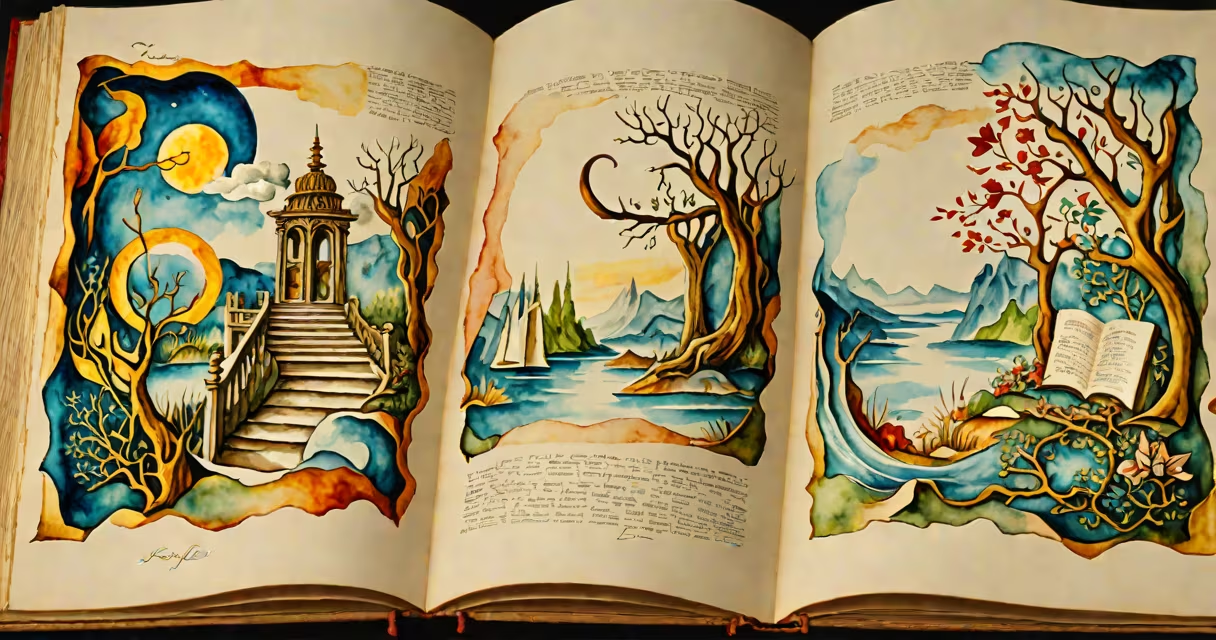
Abstract examples in literature are instances where themes, emotions, or ideas are conveyed indirectly through symbolism, metaphor, or implied meaning rather than direct statement. These elements allow writers to explore complex human experiences-such as grief, identity, or freedom-without naming them outright.
Authors use abstract examples to invite readers into interpretive engagement. Instead of saying "she was devastated," a writer might describe a cracked mirror reflecting fragmented light, implying emotional fracture. This technique deepens narrative resonance and encourages personal reflection.
These representations rely on cultural and linguistic associations. A dove may symbolize peace across many traditions, while a locked door can suggest isolation or unattainable desire. The power lies not in the object itself, but in the shared understanding between author and reader.
Abstract examples function by substituting concrete images for intangible concepts. They operate on the principle that emotional truths are often more effectively communicated through suggestion than declaration.
For instance, in Toni Morrison's *Beloved*, the ghost of Sethe's dead child is not just a supernatural presence-it embodies the unresolved trauma of slavery. The physical manifestation of the spirit serves as an abstract example of inherited pain, making historical suffering visceral and immediate.
Another example appears in William Golding's *Lord of the Flies*. The conch shell represents order and democracy. As it shatters, so too does the boys' fragile social structure. The loss of the shell is not merely a plot event-it is an abstract example of civilization's collapse under primal impulses.
Writers deploy several techniques to embed abstraction in narrative. The most frequent include metaphor, symbol, allegory, and irony.
| Type | Description | Example from Literature |
|---|---|---|
| Metaphor | A direct comparison equating one thing with another to suggest deeper meaning. | In *The Great Gatsby*, Gatsby's green light symbolizes hope and the American Dream-its distance underscores unattainability. |
| Symbol | An object, person, or event representing a larger idea. | Madame Bovary's obsession with luxury goods reflects her internal emptiness and societal critique. |
| Allegory | A narrative where characters and events represent moral or political concepts. | George Orwell's *Animal Farm* uses animals to depict Soviet history and totalitarianism. |
| Ironic Contrast | Actions or outcomes contradict expectations, revealing hidden truths. | In *The Lottery*, the ritual's violence contrasts with the townspeople's casual demeanor, exposing blind adherence to tradition. |
Each form distills abstract themes into sensory or narrative experiences. Readers don't need to be told "this is about oppression"-they feel it through the weight of silence in a courtroom scene or the flicker of a dying candle during a confession.
They are central to literary fiction, poetry, and drama because they allow authors to explore psychological depth, philosophical questions, and social critique beyond surface-level realism.
Consider Virginia Woolf's *Mrs Dalloway*. The novel unfolds in a single day, yet spans decades of memory and emotion. The recurring sound of Big Ben marks time not as a clock, but as a symbol of societal pressure and inner fragmentation. This is an abstract example of mental strain under public expectation.
Abstract devices also serve structural purposes. In James Joyce's *Ulysses*, the stream-of-consciousness technique mimics the chaotic flow of thought. The absence of clear narrative progression forces readers to engage with the interiority of characters-making the abstract experience of consciousness a core element of the story.
Many assume abstract examples are vague or intentionally confusing. That's incorrect. Effective abstraction is precise in its implication, even if it avoids stating facts directly.
For example, a common error is equating symbolism with literal interpretation. When a character wears black throughout a novel, it doesn't automatically mean "grief." Context matters. If the character is a funeral director who chooses black for comfort, the color becomes a sign of control, not sorrow. Misreading abstraction leads to oversimplification.
A lesser-known but critical distinction: not all abstraction is symbolic. Some abstract examples arise from tone, syntax, or pacing. In Samuel Beckett's *Waiting for Godot*, the repetitive dialogue and lack of resolution aren't symbols-they're structural abstractions of existential futility. The form itself communicates meaning.
One non-obvious insight: abstraction often increases reader investment. When a text demands interpretation, readers remember it longer. A 2018 study published in *Psychology of Aesthetics, Creativity, and the Arts* found that participants recalled stories using symbolic language 37% better than those relying on explicit exposition.
Charlotte Perkins Gilman's short story is a masterclass in abstract representation. The narrator, confined to a room with barred windows and peeling yellow wallpaper, begins to see a woman trapped behind the pattern.
The wallpaper is not just a visual detail-it's an abstract example of patriarchal confinement. The narrator's descent into madness mirrors the suppression of women's voices in late 19th-century society. The creeping figure in the paper is not a ghost; it's the protagonist's own suppressed self.
When she finally declares, "I've got to get out," she tears down the wallpaper. The act is both liberation and breakdown. The story ends with her crawling around the room, still trapped-but now in motion. The ambiguity is intentional. The reader must decide whether this is progress or surrender.
This story demonstrates how abstract examples can carry multiple interpretations while remaining grounded in narrative details. The wallpaper's pattern, the room's layout, the husband's dismissive tone-all contribute to a layered meaning that resists easy summary.
Paradoxes also function abstractly. In *The Catcher in the Rye*, Holden Caulfield says he hates phonies but keeps pretending to be one. This contradiction reveals his internal conflict-not a flaw in logic, but a deliberate abstract example of alienation.
When analyzing texts, ask: What emotion or idea is being represented without being named? What image, action, or contrast suggests it? The answer reveals the abstract layer beneath the surface.
Abstract examples in literature are not decorative. They are essential tools for conveying the ineffable-the thoughts we cannot speak, the feelings we cannot define. They turn stories into experiences.