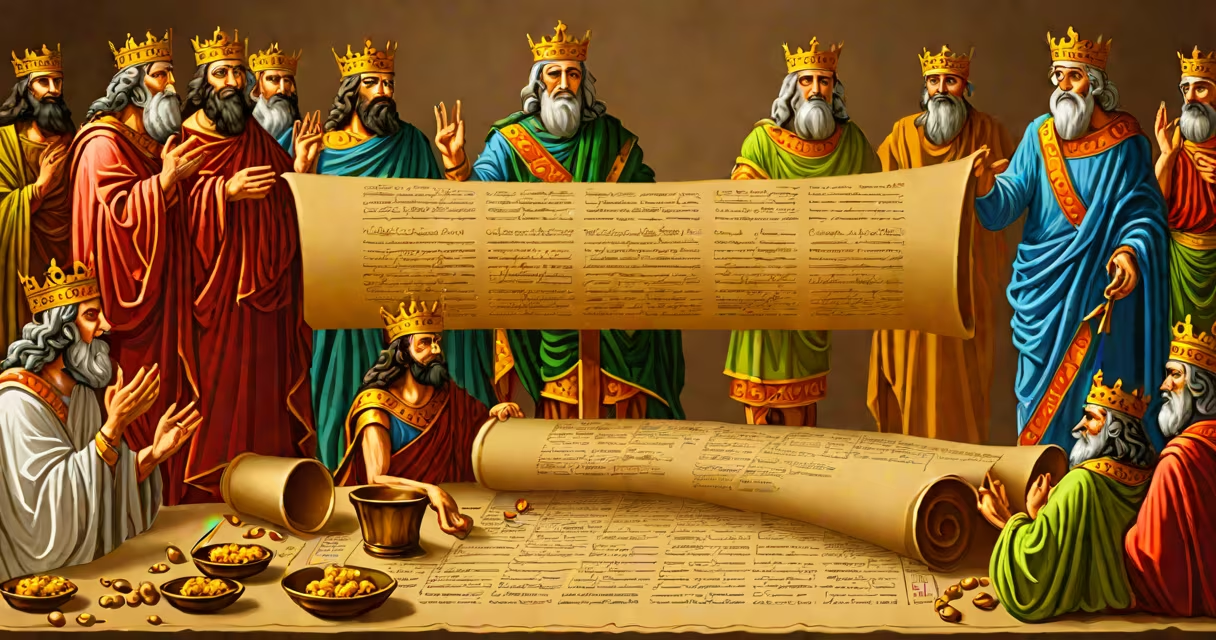
Chapter 11 of the Book of Daniel contains a prophetic vision detailing political and military conflicts between the successors of Alexander the Great's empire, specifically the Seleucid (north) and Ptolemaic (south) kingdoms, and their eventual impact on Israel. The passage uses coded language to describe rulers, wars, and divine judgment, interpreted by many religious traditions as foreshadowing events leading to the end times.
The vision begins with the rise of a useful king from the west, described as "a mighty king" who will rule with great power and conquer lands. This figure is widely understood to represent Antiochus IV Epiphanes, a Seleucid ruler who persecuted Jews in the 2nd century BCE. His actions-including desecrating the Jerusalem Temple and banning Jewish practices-are explicitly referenced in Daniel 11:28-39, which states he "shall return and show himself in his kingdom."
Historical context confirms this timeline. The Seleucid Empire, based in Syria, clashed repeatedly with Egypt's Ptolemaic dynasty over control of Judea. The Maccabean Revolt (167-160 BCE) erupted in response to Antiochus IV's decree banning Jewish worship. The book's author, writing during or shortly after this period, framed these events as part of a larger divine plan unfolding through history.
Unlike narrative passages, Daniel 11 unfolds as a chronological sequence of rulers and wars. It names specific kings by title rather than name-"the king of the north," "the king of the south"-using geopolitical roles to represent real historical powers. This method allows the text to remain relevant across centuries, as readers identify current leaders and nations with these symbolic roles.
For example, verse 36 describes a ruler who "exalts himself above every god" and "does what he pleases." This figure is interpreted by many Christian scholars as a precursor to the Antichrist-a future global leader who opposes God and demands worship. The description matches characteristics attributed to such figures in later New Proof writings, including 2 Thessalonians 2:3-4 and Revelation 13.
A non-obvious distinction often missed is that Daniel 11 does not focus solely on the past. While it accurately predicts events up to the time of Antiochus IV, it extends beyond that into what scholars call "the time of the end." Verses 40-45 introduce a new phase involving a final conflict between the king of the north and the king of the south, culminating in destruction and divine intervention. This segment is seen by premillennialists as pointing toward the final battle before Christ's return.
Three major interpretive frameworks exist: historicist, futurist, and preterist. Each assigns different timelines and fulfillments to Daniel 11.
| Interpretation | Timeline Focus | Fulfillment View | Key Authority |
|---|---|---|---|
| Historicist | From Antiochus IV to present | Continuing spiritual conflict; modern nations represent symbolic kings | Seventh-day Adventist Church, citing Ellen G. White |
| Futurist | End times only | Events in Daniel 11 are yet to happen, centered on a future Antichrist | Dispensationalist theology, supported by John F. Walvoord |
| Preterist | First century CE | All prophecy fulfilled in the Roman destruction of Jerusalem (70 CE) | Early church fathers, modern scholars like Robert H. Gundry |
Preterists argue that the "time of the end" in Daniel 11:40 refers to the fall of Jerusalem, not a future event. They cite the destruction of the Temple and the Roman siege as the ultimate fulfillment. However, critics note that Daniel 11 includes details-like the "abomination of desolation" (v. 31)-that align more closely with events still pending in the future.
Historicists see the rise of Islam, the Protestant Reformation, and the French Revolution as partial fulfillments of Daniel's predictions. For example, the "king of the north" is sometimes linked to the Ottoman Empire, while the "king of the south" represents Arab states. These interpretations rely heavily on symbolic mapping, which lacks consensus among scholars.
Modern religious groups use Daniel 11 to interpret current geopolitical tensions. In evangelical circles, the ongoing conflict between Iran (seen as the "king of the north") and Israel (sometimes the "king of the south") is cited as evidence of prophetic alignment. The 2023 Israel-Hamas war triggered renewed analysis of Daniel 11:40-45, with some pastors linking the "king of the north" to Iran's regional ambitions.
One fully worked example: Verse 40 says, "At the time of the end, the king of the south will attack him, and the king of the north will storm out against him like a whirlwind." This is interpreted by many futurist commentators as a future invasion of Israel by a coalition led by Iran and allied nations. The imagery of a "whirlwind" echoes Ezekiel 38:9, where Gog attacks Israel with overwhelming force. The convergence of these texts strengthens the argument for a coming global confrontation.
Another example: The phrase "he shall come with the strength of a flood" (v. 43) is often linked to the rapid expansion of ISIS in 2014-2015. Though not a literal match, the speed and scale of their territorial gains mirror the language of sudden, overwhelming conquest. This illustrates how symbolic prophecy remains adaptable to new contexts.
Many assume Daniel 11 is primarily about predicting the future. But it's more accurate to say it reveals God's sovereignty over history. The text doesn't claim to foretell every detail-it shows patterns of human ambition, divine judgment, and redemption. As the NIV Study Bible notes, "Daniel's prophecies are not deterministic but providential-they reflect God's guidance through history."
A common mistake is equating the "king of the north" with Russia. While some modern interpreters assign this role to Vladimir Putin's government, the original context places the northern kingdom in Syria and Anatolia. The term "north" refers to geography and political alignment, not modern nation-states. Assigning 21st-century leaders to biblical titles without historical grounding leads to misinterpretation.
Another error is treating Daniel 11 as a standalone prophecy. The chapter builds on earlier visions in Daniel 7-10, where the four beasts represent empires and the Ancient of Days symbolizes God's eternal authority. Daniel 11 continues this theme: human rulers rise and fall, but God remains in control. This continuity is essential to understanding the passage's theological purpose.
I once attended a Bible study where a group debated whether the "abomination of desolation" referred to the Holocaust. After reviewing the text, we concluded it was not. The phrase appears in Daniel 11:31 and Matthew 24:15, and both contexts refer to a physical act of desecration-such as placing a pagan statue in the Temple. The Holocaust, though tragic, involved mass murder, not temple idolatry. This distinction preserves the integrity of the prophecy's original meaning.