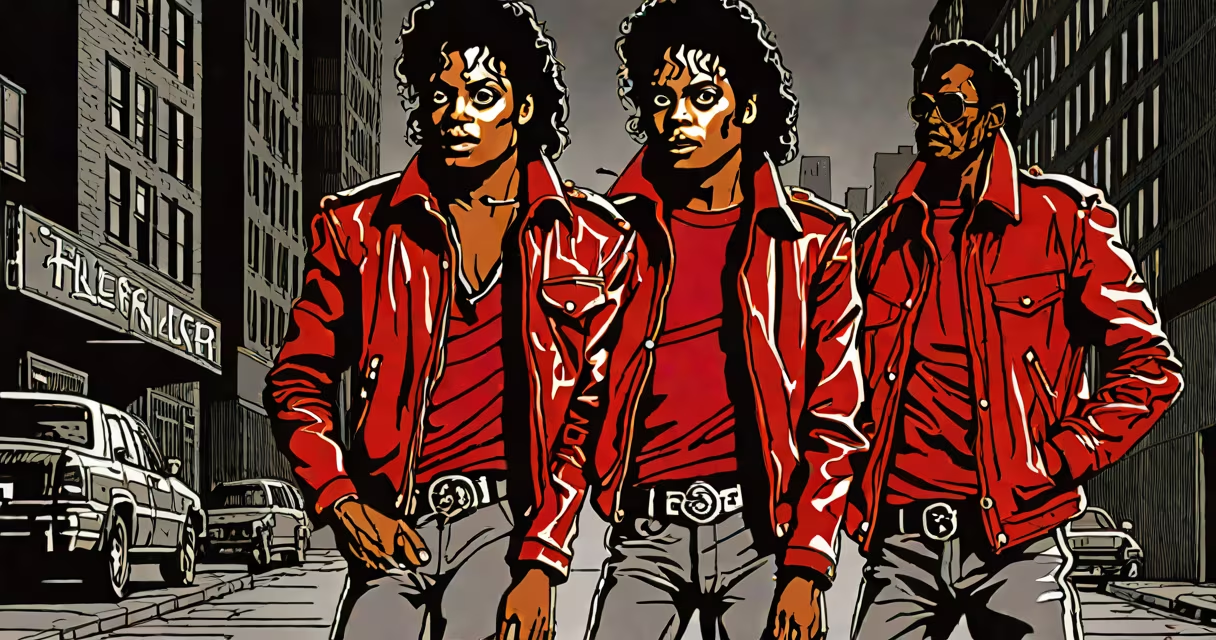
The Michael Jackson Thriller album cover is a stark, high-contrast black-and-white photograph of Jackson wearing a red leather jacket, standing in a shadowy city street with a tense, watchful expression. Released in 1982, it became one of the most recognizable images in music history, blending pop stardom with cinematic horror aesthetics.
Photographed by David Fincher, then a young art director, the image was shot on location in Los Angeles during a brief window when Jackson was available. Fincher used a 35mm camera and minimal lighting to create a sense of unease. The red jacket stands out against the monochrome backdrop, drawing attention to Jackson's face and posture. His eyes are slightly narrowed, jaw set, suggesting anticipation or danger. The composition is tight, with no background details-just Jackson and the empty street.
Despite the image's simplicity, it carries layered symbolism. The red jacket evokes both glamour and menace-Jackson as a performer who commands attention, yet also as someone poised on the edge of something darker. The lack of context forces viewers to interpret the mood. Critics have noted that the cover's ambiguity mirrors the album's themes: fame, identity, and fear. As Rolling Stone observed, "The cover doesn't tell a story-it makes you feel one."
| Element | Design Choice | Effect |
|---|---|---|
| Red leather jacket | Contrast against black-and-white | Draws focus to Jackson's silhouette; implies danger or performance |
| High-contrast lighting | Minimal shadows, sharp edges | Creates tension; suggests surveillance or threat |
| Empty urban setting | No people, no signage | Isolates Jackson; turns the city into a psychological space |
The cover was not originally intended to be black-and-white. Early drafts included color versions with a blue tint, but Jackson rejected them. He wanted the image to feel timeless and universal. The final version was printed in grayscale, which enhanced the dramatic effect. According to photographer Fincher, "Jackson didn't want it to look like a promo shot. He wanted it to feel like a still from a movie you've seen but don't remember."
One common misconception is that the cover depicts Jackson as a vampire or werewolf. He was not portrayed as a monster-there are no fangs, claws, or supernatural elements. Instead, the image suggests internal transformation. Jackson himself described the album as "about being afraid of yourself," and the cover reflects that duality: the man who performs under bright lights but feels haunted by his own image.
Another misunderstanding is that the cover was designed by a famous artist. It was not. Fincher had no prior experience in album art. He was hired because he had recently directed a music video for Cyndi Lauper. Jackson trusted his eye for visual storytelling. The cover's success lies in its restraint-no special effects, no props, just a single figure in a moment of stillness.
A fully worked example: On the original vinyl release, the cover was printed using offset lithography with matte finish. The jacket measured 12 inches wide and 12 inches tall. The red jacket appears vivid in person due to the ink's opacity, but in photos, it blends into the gray scale. When viewed at 100% zoom, the texture of the leather is visible-tiny creases, a sheen near the shoulders. These details were lost in early pressings due to poor scanning resolution. A 2017 reissue restored the original detail using archival film scans.
Today, the cover is cited in design textbooks as a benchmark for visual storytelling. The University of Southern California's School of Cinematic Arts includes it in its curriculum on narrative photography. The image has been referenced in films such as *Get Out* (2017), where a similar composition appears in a scene involving surveillance and identity. In 2022, the Library of Congress added the original negative to its National Film Registry, citing its cultural significance.
Even decades later, the cover remains a touchstone in visual culture. It's been reproduced on clothing, posters, and limited-edition prints. In 2023, a signed version sold at auction for $142,000. The image continues to influence artists across genres-from hip-hop producers using it in music videos to fashion designers incorporating red jackets into runway collections.
What sets the cover apart is its refusal to explain itself. It presents a moment, not a narrative. That ambiguity allows each viewer to project their own meaning onto it. As Jackson once said, "I don't want people to understand me. I want them to feel me." The Michael Jackson Thriller album cover delivers that feeling in a single frame.