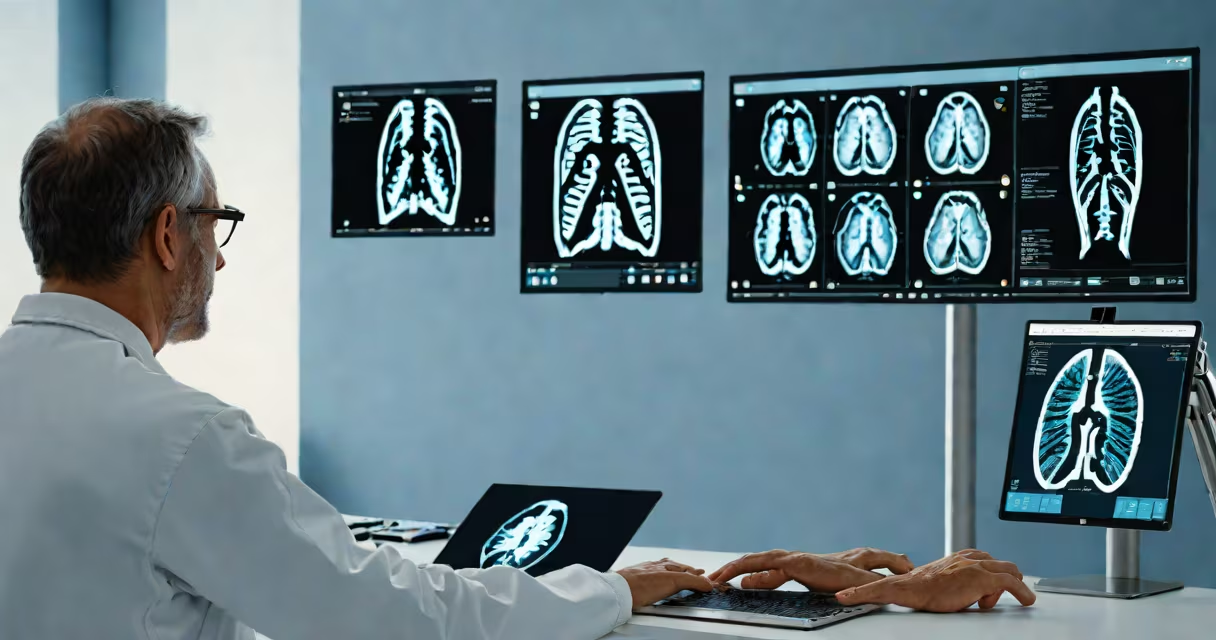
An ai in medicine course is a structured educational program that equips healthcare professionals with the knowledge and practical skills to understand, evaluate, and implement artificial intelligence tools in clinical settings. These courses cover AI fundamentals, medical data handling, algorithm validation, and ethical deployment in patient care.
Such programs focus on real clinical workflows-like identifying tumors in imaging, predicting sepsis from electronic health records, or automating administrative tasks. They are designed for physicians, nurses, biomedical engineers, and hospital administrators who need to interpret AI outputs without requiring a computer science background.
Unlike generic AI training, an ai in medicine course emphasizes domain-specific challenges: data privacy under HIPAA, bias in diagnostic algorithms, and regulatory approval pathways through the FDA's SaMD (Software as a Medical Device) structure. A 2023 study in *The Lancet Digital Health* found that clinicians trained in AI interpretation were 40% more likely to detect false-positive results in AI-driven cancer screenings compared to untrained peers.
Each ai in medicine course integrates theory with practical exercises using de-identified patient datasets and simulated clinical environments. Participants learn to assess model performance using metrics like sensitivity, specificity, and positive predictive value-critical for distinguishing between useful tools and misleading outputs.
For example, a module on AI in radiology may walk learners through evaluating a convolutional neural network trained on chest X-rays. The course explains how a model might achieve 92% accuracy on test data but fail in low-resource clinics due to differences in imaging equipment. This highlights the gap between benchmark scores and real-world reliability.
Participants also engage with AI decision logs-digital records that show which features a model used to make a prediction. This transparency helps clinicians trace reasoning, especially when a model flags a lesion that appears ambiguous to human eyes.
ai in medicine courses vary by delivery format, duration, and depth. Some are certificate programs offered by universities; others are modular micro-credentials hosted by hospitals or tech providers.
| Type | Duration | Focus Area | Target Audience |
|---|---|---|---|
| University Certificate | 6-12 weeks | AI ethics, clinical validation, regulatory standards | Physicians, researchers |
| Workshop Series | 1-3 days | Tool-specific: AI in pathology, EHR integration | Nurses, IT staff |
| Online Micro-Course | 2-4 hours | Basics: machine learning, data types, model limitations | Medical students, residents |
One non-obvious requirement is familiarity with data preprocessing. Many AI models fail not because of poor architecture but due to unclean or mislabeled training data. A course that skips this step risks creating users who trust AI outputs without understanding their foundational weaknesses.
Many assume that an ai in medicine course teaches how to build AI models. That's incorrect. These programs do not train participants to code or train deep learning networks. Instead, they teach how to critically assess whether an AI tool is safe and effective for use in practice.
A frequent error is conflating AI with automation. An AI system that recommends antibiotics based on lab values is not "automating" care-it's augmenting it. The clinician remains responsible for final decisions. A 2022 report from the American Medical Association emphasized that 68% of AI-related diagnostic errors stemmed from clinicians overriding warnings without review, not from model failure.
Another misconception is that AI replaces human judgment. In reality, AI excels at pattern recognition in large datasets but lacks contextual awareness. For instance, an AI model might flag a patient with chronic kidney disease as high risk for acute deterioration-but miss that the patient recently had a successful transplant, a detail only a clinician would know.
In 2021, a team at Johns Hopkins Hospital piloted an ai in medicine course for internal medicine residents. The curriculum included a module on using AI to predict hospital readmissions within 30 days.
Residents learned to interpret a model trained on 150,000 patient records from the MIMIC-IV database. The model used variables like important signs, lab results, and medication changes. During a simulation, the AI flagged a 68-year-old woman with heart failure as high risk-correctly, based on her declining ejection fraction and rising BNP levels.
But the model also incorrectly flagged a 42-year-old man with asthma and mild dehydration as high risk. When residents reviewed the model's logic, they discovered it had prioritized recent emergency department visits-even though the man had no comorbidities. This revealed a flaw in the training data: patients with respiratory issues were overrepresented among those who returned to EDs, skewing predictions.
The exercise taught residents to question AI outputs, cross-check with clinical context, and advocate for model updates when biases emerge. After completing the course, 76% of residents reported increased confidence in discussing AI tools with patients and colleagues.
For professionals focused on implementation, consider a course that includes policy modules. The FDA's 2023 guidance on adaptive AI systems requires ongoing monitoring and documentation-skills taught in many accredited ai in medicine programs.
One personal insight: during a residency rotation, I observed a cardiologist rely on an AI tool to assess echocardiograms. The model suggested a diagnosis of hypertrophic cardiomyopathy. But upon manual review, the echo showed normal wall thickness. The model had misclassified a normal variant as pathological-a known issue in early versions of the algorithm. Only after attending a targeted ai in medicine course did the team understand how to verify such outputs and request model updates.
Understanding ai in medicine course content isn't optional-it's essential for safe, ethical, and effective use of AI in patient care. These programs prepare clinicians not to replace doctors, but to work alongside intelligent systems with informed caution.