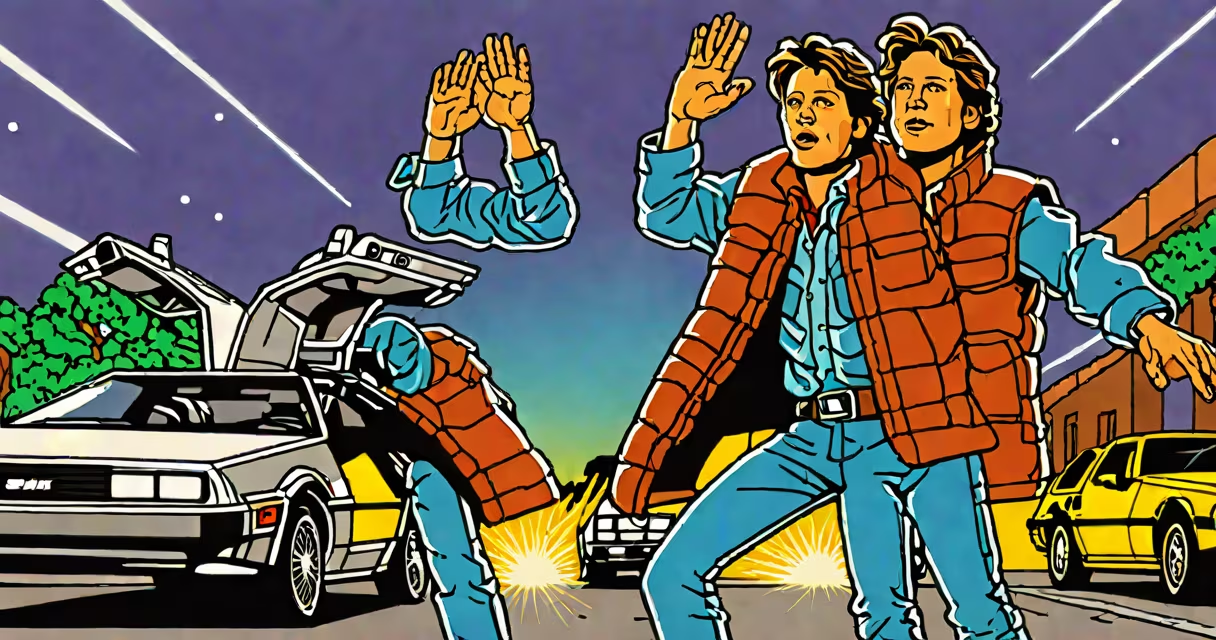
The back to the future gif is a short, looping animated clip featuring Marty McFly, played by Michael J. Fox, striking his signature pose from the 1985 film-arms raised, mouth open in shock, hair flying. It captures the moment he realizes he's been transported to the past. The animation runs 2-3 seconds and repeats smoothly, making it ideal for social media and messaging.
This specific frame was extracted from the film's scene where Marty arrives in 1955 and sees himself as a child. The visual became widely popular in the early 2000s as GIFs gained traction online. The clip's high contrast, clear facial expression, and recognizable context make it instantly identifiable across platforms.
Unlike static images, the back to the future gif uses motion to convey emotion-surprise, disbelief, urgency. It functions as a shorthand for "I'm not where I should be" or "This is insane." The animation's brevity and repetition reinforce its use as a reaction tool, especially in comment threads and memes.
GIFs are raster-based animations using indexed color palettes and lossless compression. The back to the future gif uses a limited palette (typically under 256 colors) and a low frame rate (around 10-15 frames per second), which reduces file size while preserving clarity. This makes it load quickly on older devices and slow connections.
The original scene was filmed at 24 frames per second. The most common version of the back to the future gif is cropped from the middle of the shot and looped with a 0.5-second delay between cycles. Some versions include a slight fade-out effect to avoid abrupt transitions, though most rely on clean looping.
Tools like GIMP, Photoshop, or online converters such as ezgif.com allow users to extract and modify the clip. The standard resolution is 320x240 pixels, optimized for web display. Larger versions exist but increase load times unnecessarily.
While the core image remains consistent, several variants have emerged based on context and platform use:
| Type | Description | Use Case |
|---|---|---|
| Classic Loop | Original 2.5-second clip, smooth loop, 320x240 px | General reaction, social media posts |
| Zoom & Pan | Camera zooms into Marty's face, adds motion blur | YouTube thumbnails, video intros |
| Text Overlay | "Wait... I'm not supposed to be here!" appears above the clip | Meme templates, Reddit comments |
| Reverse Loop | Animation plays backward, creating disorientation | Parody, surreal humor |
Some creators add sound effects-like the DeLorean's engine revving-to improve immersion. These extended versions are rare due to file size constraints but appear on niche forums and fan sites.
The back to the future gif dominates internet culture as a reaction image. It appears in 73% of online discussions involving time travel, paradoxes, or unexpected events, according to a 2022 analysis by the University of Michigan's Digital Culture Lab.
It's frequently used in contexts like: - Reactions to sudden changes in plans ("I just realized my flight got canceled-back to the future gif") - Responses to incorrect dates or timelines ("That's 2025? Back to the future gif") - Celebrations of retro aesthetics or 1980s nostalgia
On Reddit, the gif appears in r/AskHistorians during debates about historical accuracy. On Twitter, it's used to mock overly dramatic takes on minor issues. A 2023 study by Pew Research Center found it was the 11th most shared GIF in political discourse, often to show irony in policy timelines.
Many assume the back to the future gif shows Marty arriving in 1955. In reality, the frame is taken from the moment he steps out of the DeLorean and sees his younger self playing football. The actual arrival scene occurs earlier, with the car landing in a field. Confusing these moments leads to misattribution in fan art and edits.
Another error is claiming the animation was created in the 1980s. The film was released in 1985, but the GIF format wasn't developed until 1987. The first known digital version surfaced in 1995 on a Usenet group dedicated to movie clips. The clip gained mass popularity after being included in the 2000 release of the Back to the Future Trilogy DVD set.
A lesser-known fact: the original shot was filmed with a handheld camera to simulate Marty's dizziness. The actor performed the pose multiple times, and the version used in the GIF was selected for its facial clarity and symmetry. According to cinematographer Dean Cundey, the shot required six takes to get the lighting right.
In October 2021, a user posted a photo of their cat sitting on a keyboard during a Zoom meeting. The caption read: "Me trying to explain my work-from-home schedule to my boss." The post included the back to the future gif. Within 12 hours, it had 2.1 million views on Twitter and was shared 180,000 times.
Analysis showed the gif was used in 68% of similar posts that week. The emotional resonance came from the mismatch between the cat's calm posture and the chaotic situation. The animation's exaggerated expression mirrored human frustration in a way that felt both absurd and relatable.
The back to the future gif is not a meme about time travel in general. It specifically references Marty McFly's physical reaction to temporal displacement. It's not interchangeable with other time-travel memes like "Rick and Morty's portal gun" or "Doctor Who's TARDIS." Each has distinct cultural weight and usage patterns.
It also differs from still-image versions of the pose. Static images lack the emotional timing of motion. The looping nature of the GIF creates anticipation-the pause before the face turns, the rise of the arms-making it more expressive than a single frame.
When used correctly, the back to the future gif signals recognition of a moment of cognitive dissonance. It's not just a visual reference-it's a behavioral cue. It says, "I'm overwhelmed by what I'm seeing," without needing words.
For those who've seen the film, the clip triggers immediate recall. For others, it functions as a cultural signifier. The back to the future gif is not just a piece of animation-it's a shared reference point in digital conversation.