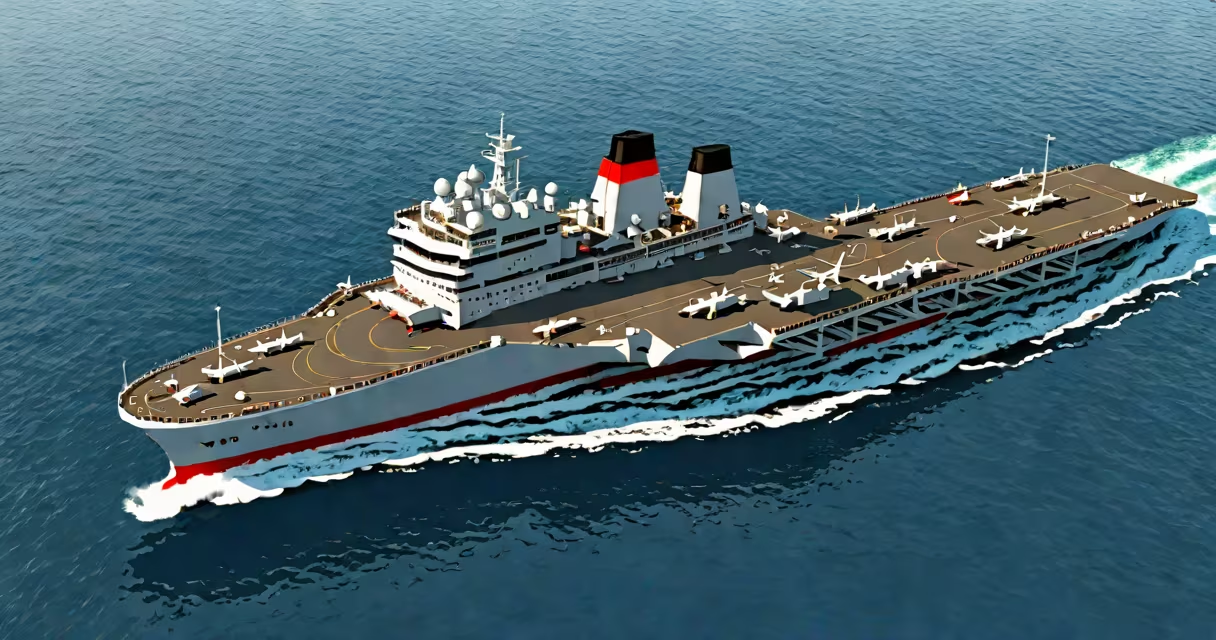
HMS Queen Elizabeth II is the lead ship of the Queen Elizabeth-class aircraft carriers, the largest warships ever built for the Royal Navy. Commissioned in 2017, it serves as the centerpiece of the UK's maritime strike capability, capable of deploying F-35B fighter jets and supporting amphibious operations.
The ship measures 280 meters (919 feet) in length and displaces 65,000 tonnes when fully loaded. Its flight deck spans 170 meters (558 feet), allowing for simultaneous takeoffs and landings. The vessel operates with a crew of approximately 1,600 personnel, including air wing staff and support teams. It is powered by a combined diesel-electric and gas propulsion system, enabling sustained high-speed operations and efficient fuel use.
Designed for global deployment, HMS Queen Elizabeth II supports extended missions without frequent refueling. It features advanced radar systems, electronic warfare suites, and integrated command centers. The ship's design prioritizes survivability, with redundant systems and blast-resistant compartments. It can operate independently or as part of a carrier strike group, integrating with allied forces during multinational exercises.
Unlike traditional aircraft carriers that rely solely on steam catapults, HMS Queen Elizabeth II uses a ski-jump ramp at the bow to launch F-35B Lightning II fighters. This enables short takeoff and vertical landing (STOVL) operations, reducing the need for complex electromagnetic launch systems. The F-35B can carry up to 7,500 kg of weapons and perform air-to-air combat, precision strikes, and reconnaissance.
Onboard, the ship houses a hangar deck below the flight deck, capable of housing up to 40 aircraft. Maintenance facilities, fuel storage, and munitions handling areas are located within the hull. The ship's command center coordinates air operations, surveillance, and communications with ground and sea units. Data from satellites, drones, and radar feeds are processed in real time to support mission planning and threat response.
During operations, the carrier's air wing typically includes 12-16 F-35Bs, along with helicopters such as the Merlin and Wildcat for anti-submarine warfare and logistics. The ship also hosts a detachment of Royal Marines for rapid deployment scenarios. All systems are monitored through a centralized digital interface, allowing for coordinated responses across multiple domains.
The Royal Navy operates two ships in the Queen Elizabeth-class:
| Ship Name | Commissioned | Length | Displacement | Primary Role |
|---|---|---|---|---|
| HMS Queen Elizabeth II | 2017 | 280 m | 65,000 tonnes | Strike and power projection |
| HMS Prince of Wales | 2019 | 280 m | 65,000 tonnes | Strike and fleet support |
Both vessels share the same core design, propulsion, and armament. Differences include minor upgrades in sensor packages and internal layout based on lessons learned during HMS Queen Elizabeth II's initial deployments. Neither ship is equipped with nuclear reactors; they run on conventional fuel, which limits endurance compared to nuclear-powered carriers like those operated by the U.S. Navy.
HMS Queen Elizabeth II has participated in operations across the Mediterranean, the South China Sea, and the North Atlantic. In 2021, it deployed to the Indo-Pacific region as part of a strategic reassurance mission, demonstrating the UK's ability to project military influence beyond Europe. The ship supported joint exercises with Japan, Australia, and the United States, reinforcing regional alliances.
It played a central role in Operation Shader, the UK's contribution to the campaign against ISIS in Iraq and Syria. During these missions, F-35Bs launched sorties from the carrier's deck to conduct airstrikes on enemy positions. The ship's presence enabled rapid response times and reduced reliance on forward bases in unstable regions.
Domestically, the ship supports national security objectives by maintaining a visible naval presence. It serves as a platform for scientific research, hosting meteorological and oceanographic instruments. The Royal Navy also uses it for training exercises involving cadets and reserve personnel.
Many confuse HMS Queen Elizabeth II with the former HMS Queen Elizabeth, a battleship commissioned in 1915. That ship was a dreadnought-class vessel, armed with 15-inch guns and designed for surface combat. It sank in 1916 after striking a mine during World War I. The current ship bears the same name but represents a completely different class of naval technology.
Another common error is assuming the ship operates exclusively in wartime. In reality, it spends most of its service life in peacetime roles: humanitarian aid, disaster relief, and diplomatic engagement. In 2020, it hosted a virtual summit between UK ministers and representatives from Commonwealth nations, highlighting its utility beyond combat.
A lesser-known fact is that the ship's construction involved over 100 subcontractors across the UK. The final assembly took place at Rosyth Dockyard in Scotland, where over 10 million man-hours were logged. The project faced delays due to technical issues with the electrical distribution system, which required redesigns and additional testing before commissioning.
In 2022, HMS Queen Elizabeth II deployed to the Baltic Sea amid rising tensions in Eastern Europe. The ship arrived near the coast of Latvia, conducting joint drills with NATO allies. Over five days, it launched 32 F-35B sorties, simulated air defense scenarios, and practiced coordination with Polish and Estonian air forces. The operation demonstrated the ship's ability to integrate into existing alliance structures without prior joint infrastructure.
During the deployment, the ship's onboard medical team treated 14 local civilians during a regional health crisis, providing emergency care and supplies. This dual-purpose capability-military readiness paired with humanitarian support-was noted in a report by the UK Ministry of Defence. The event underscored the ship's role as both a deterrent and a stabilizing force.
While the term "queen elizabeth ii ship" often appears in media reports, it is technically accurate only when referring to HMS Queen Elizabeth II. The Royal Navy uses formal naming conventions: all capital letters, no abbreviations. The ship is never referred to as "Queen Elizabeth II" in official documentation, though public usage often drops the "HMS" prefix.