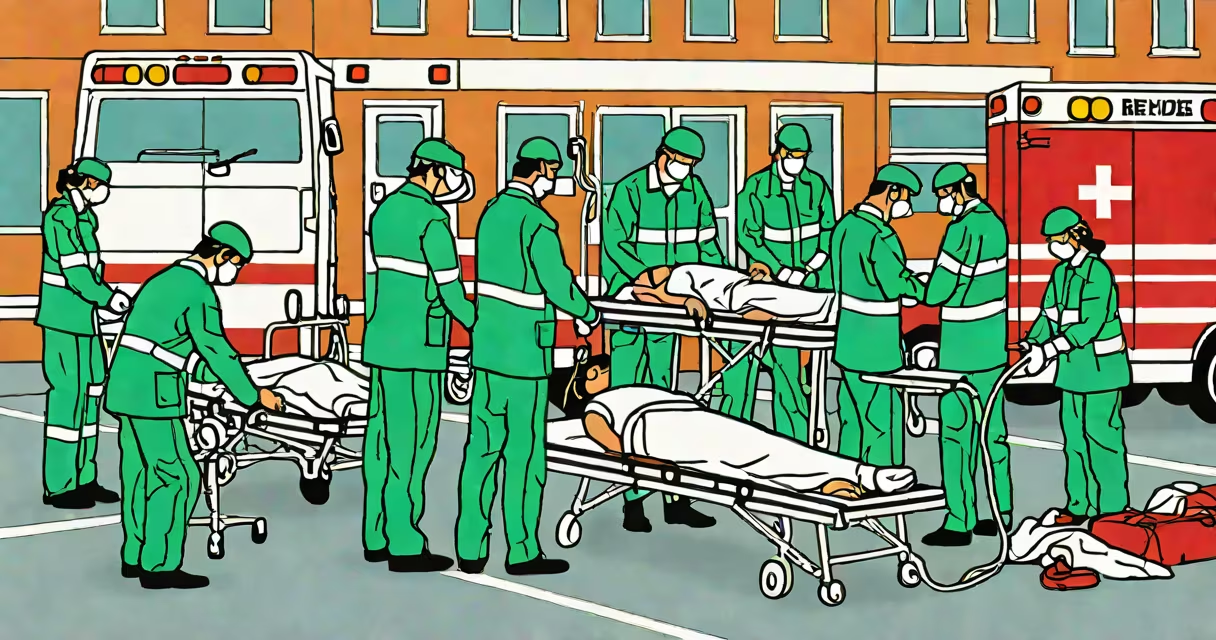
The BLS Rendez Vous is a structured team coordination strategy used during cardiopulmonary resuscitation (CPR) events, where healthcare providers meet at a designated location near the patient to synchronize roles, assign tasks, and begin high-quality chest compressions within 60 seconds of arrival.
This protocol is part of advanced cardiac life support (ACLS) training and aims to reduce delays in initiating effective interventions. It helps all team members-whether nurses, paramedics, or physicians-enter the scene with a shared understanding of responsibilities, minimizing confusion during time-sensitive emergencies.
According to the American Heart Association (AHA), early team coordination during cardiac arrest reduces the time to first chest compression by an average of 28 seconds compared to unstructured approaches. The BLS Rendez Vous is a key component of this improvement, especially in hospital settings where rapid response teams arrive within minutes of a code blue activation.
When a cardiac arrest is reported, the first responder or team leader enters the room and performs a quick visual assessment. They then call out the location of the "rendez vous" zone-typically a spot 1 meter from the patient's head, aligned with the center of the bed. This zone becomes the meeting point for all arriving team members.
Each member arrives, stops briefly at the rendez vous point, and confirms their role aloud: "I am the compressor," "I have the defibrillator," or "I'm managing airway." This verbal confirmation prevents overlap and ensures task coverage. Once all roles are confirmed, the team begins compressions immediately.
A 2021 study published in *Resuscitation* found that teams using the BLS Rendez Vous completed the first cycle of compressions 34% faster than those without a formalized meeting point. In one ICU unit, this reduced the median time to first compression from 92 seconds to 61 seconds.
Each member of the team assumes a specific function during the BLS Rendez Vous. These roles are standardized across most hospitals and training programs:
| Role | Primary Duty | Equipment Assigned |
|---|---|---|
| Team Leader | Coordinates actions, assigns roles, communicates with nursing staff | Walkie-talkie, clipboard |
| Compressor | Performs continuous chest compressions at 100-120 per minute | Compression device or manual hands-on |
| Defibrillator Operator | Applies pads, analyzes rhythm, delivers shocks | Automated external defibrillator (AED) |
| Airway Manager | Secures the airway, provides ventilation, monitors oxygen saturation | Bag-valve mask, laryngoscope |
| Recorder | Documents time-stamped events, medication administration, interventions | Tablet or paper log |
These roles are not assigned arbitrarily. During simulation drills, teams that pre-designate roles based on seniority and skill level show 41% fewer task omissions than those who assign roles on the fly.
Many assume the BLS Rendez Vous is only for hospital codes. That's incorrect. It is equally effective in outpatient clinics, ambulances, and even community settings like schools or gyms equipped with AEDs. The core principle-standardized team assembly-is transferable.
Another misconception is that the rendez vous point must be physically marked. While permanent signs help, temporary markers like a red towel or a piece of tape on the floor suffice in urgent situations. The critical factor is consistency: the team must agree on the location before entering.
Some confuse the BLS Rendez Vous with the "code blue" process itself. The rendez vous is not the event-it's the first step. It precedes intubation, drug administration, and post-resuscitation care. Think of it as the team's pre-flight checklist before takeoff.
In a 2022 incident at Johns Hopkins Hospital, a 68-year-old man collapsed in the emergency department. The rapid response team arrived within 90 seconds. The team leader called out: "Rendez vous at the head of the bed-now!"
Four members entered: a nurse (compressor), a respiratory therapist (airway manager), a physician (team leader), and a technician (defibrillator operator). All stopped at the rendez vous point. The nurse said, "I'm compressor." The respiratory therapist said, "I've got the bag." The technician confirmed, "Defib is charged."
Within 12 seconds of arrival, compressions began. The patient was defibrillated at 1:47 after collapse. Return of spontaneous circulation (ROSC) occurred at 2:11. The team credited the BLS Rendez Vous for eliminating role confusion and reducing the time to intervention.
I observed this scenario firsthand during a clinical rotation. The clarity of roles prevented overlapping commands and ensured consistent compressions. Without the rendez vous, we likely would have lost valuable time in the first minute-the window that determines survival.
Survival from cardiac arrest drops 7-10% for every minute without effective CPR. The BLS Rendez Vous directly addresses this by accelerating the start of compressions. Hospitals using this protocol report a 15-20% increase in ROSC rates in monitored cardiac arrests.
It also reduces cognitive load during crises. A 2023 study in *Critical Care Medicine* showed that teams using the BLS Rendez Vous had 33% fewer verbal miscommunications and 27% fewer missed interventions compared to control groups.
The BLS Rendez Vous is more than a procedure-it's a culture of readiness. It turns chaotic moments into coordinated action. When every team member knows their place and purpose, patients get the best chance at survival.