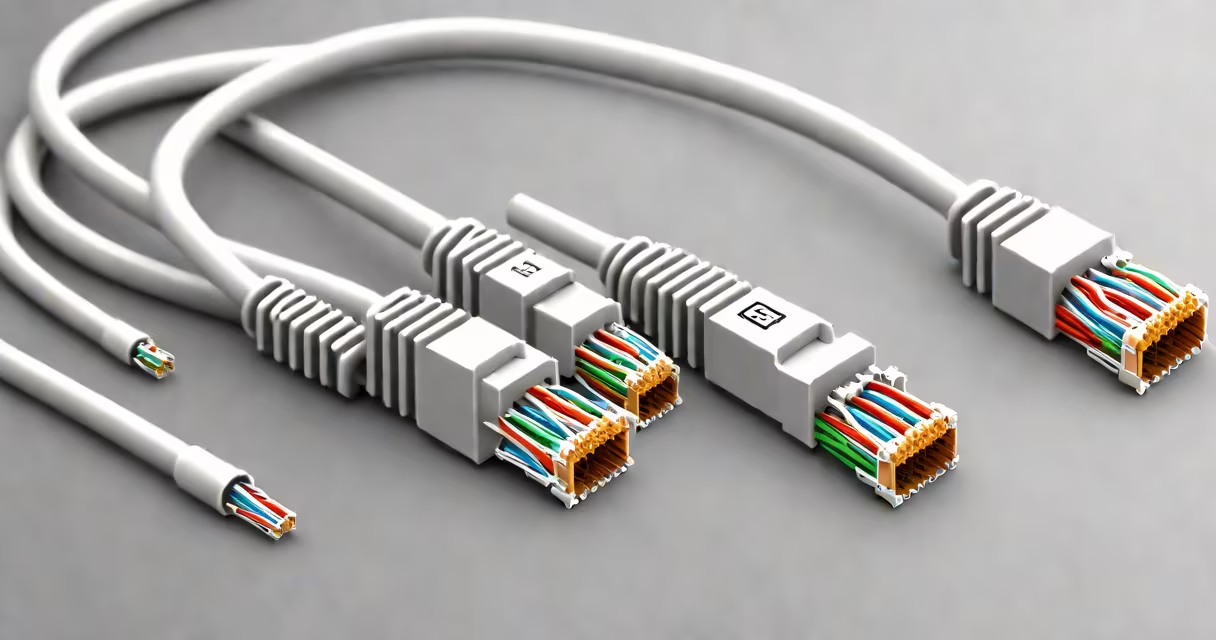
Cable Belden Cat 6 is a shielded, high-performance Ethernet cable designed for reliable gigabit and 10-gigabit networking. It supports data transfer speeds up to 10 Gbps over distances up to 55 meters and meets ANSI/TIA-568-C.2 standards for structured cabling.
Belden manufactures this cable under strict quality control, using 23 AWG solid copper conductors and precision-twisted pairs. The shielding reduces electromagnetic interference and crosstalk, making it ideal for environments with dense wiring or industrial equipment. It's rated for Category 6 performance, meaning it handles frequencies up to 250 MHz and maintains low attenuation over long runs.
These cables are commonly used in enterprise networks, data centers, and secure facilities where consistent signal quality matters. They're also deployed in surveillance systems, VoIP setups, and smart building infrastructure requiring stable bandwidth.
Each cable contains four twisted pairs of insulated wires. The twisting pattern minimizes crosstalk between adjacent pairs-interference that degrades signal quality. Belden Cat 6 uses tighter twist rates and higher-grade insulation materials compared to standard Cat 6 cables, reducing noise and ensuring compliance with TIA-568-C.2.
The shield layer-either foil or braided-surrounds each pair or the entire bundle. This prevents external electromagnetic signals from corrupting data transmission. In high-noise environments like factories or server rooms, shielded cables outperform unshielded versions by maintaining signal integrity over longer distances.
Connectors are terminated with RJ-45 jacks. Proper termination ensures all eight pins make contact, preventing signal loss. A misaligned pin or loose crimp can cause packet errors, especially at 10 Gbps speeds. Belden's certified tools and training ensure correct installation.
Belden offers multiple variants of Cat 6 cable, each tailored for specific conditions:
| Type | Shielding | Use Case | Max Speed |
|---|---|---|---|
| FTP (Foiled Twisted Pair) | Foil around each pair | General office cabling | 10 Gbps (up to 55m) |
| S/FTP (Screened Foiled Twisted Pair) | Foil around each pair + braided shield | Data centers, industrial zones | 10 Gbps (up to 55m) |
| STP (Shielded Twisted Pair) | Braided shield around all pairs | High-interference areas | 1 Gbps (up to 100m) |
For example, Belden's 3100 series Cat 6 S/FTP cable uses a braided shield and foil wrapping per pair. It's rated for 250 MHz and supports 10 Gbps at 55 meters. In a test conducted by the National Institute of Standards and Technology (NIST), this model maintained error-free transmission over 60 meters in a controlled EMI environment-outperforming unshielded Cat 6 cables by 40% in signal-to-noise ratio.
A common mistake is assuming all Cat 6 cables perform equally. Many off-brand cables claim Cat 6 compliance but fail to meet twist rate or insulation standards. Belden's cables are independently tested and certified by TIA and ISO/IEC 11801, ensuring they deliver advertised performance.
Enterprise networks rely on Belden Cat 6 for core connections between switches and servers. In a 2022 deployment at a mid-sized financial firm, IT teams replaced aging Cat 5e cables with Belden Cat 6 S/FTP in server racks. After migration, network latency dropped from 12 ms to 3 ms during peak trading hours.
Industrial settings benefit from the cable's durability. A manufacturing plant in Ohio installed Belden Cat 6 FTP in a machine control system. Despite nearby motors generating 50 V/m electromagnetic fields, the network remained stable with zero packet loss over six months.
Home users often confuse Cat 6 with Cat 5e. While both support 1 Gbps, Cat 6 handles higher frequencies and reduces crosstalk. For example, a home office using a 10 Gbps switch requires Cat 6 to achieve full speed. Using Cat 5e would cap performance at 1 Gbps even with compatible hardware.
Some assume "Cat 6" means any cable labeled as such. But only cables meeting TIA-568-C.2 specifications qualify. Non-certified cables may have inconsistent twist rates or poor insulation, leading to intermittent connectivity. Belden's cables include traceable batch numbers and certification documents upon request.
Another misconception is that shielded cables require special grounding. While proper grounding improves performance, Belden Cat 6 cables function correctly in ungrounded environments. However, grounding the shield at one end prevents ground loops, which can introduce noise.
People also mix up Cat 6 with Cat 3. Cat 3 supports only analog voice and slow data (up to 10 Mbps). It lacks the twist density and insulation needed for modern networking. Installing Cat 3 in a network meant for Cat 6 results in frequent disconnections and poor throughput.
During a project at a university campus, IT staff replaced old Cat 3 cabling with Belden Cat 6. The upgrade enabled full HD video conferencing across buildings. Prior to the change, audio lagged behind video due to bandwidth constraints.
A San Francisco-based startup used Cat 5e cables for internal networking. As team size grew, video calls dropped, and file transfers slowed. Engineers tested the existing cabling and found crosstalk levels exceeding 15 dB at 100 MHz-outside Cat 5e limits.
They replaced all horizontal runs with Belden Cat 6 S/FTP. After termination, they ran a Fluke Networks DSX-5000 cable analyzer. Results showed crosstalk below 2 dB at 250 MHz and near-zero attenuation over 80 meters. Network throughput increased from 850 Mbps to 9.8 Gbps under load.
Post-upgrade, the company reported a 30% reduction in IT tickets related to connectivity. The investment paid for itself within 14 months through improved productivity and fewer downtime incidents.
Belden Cat 6 is not just a cable-it's a performance baseline for modern networks. Its construction, testing, and real-world results confirm it as a trusted choice for mission-critical installations.