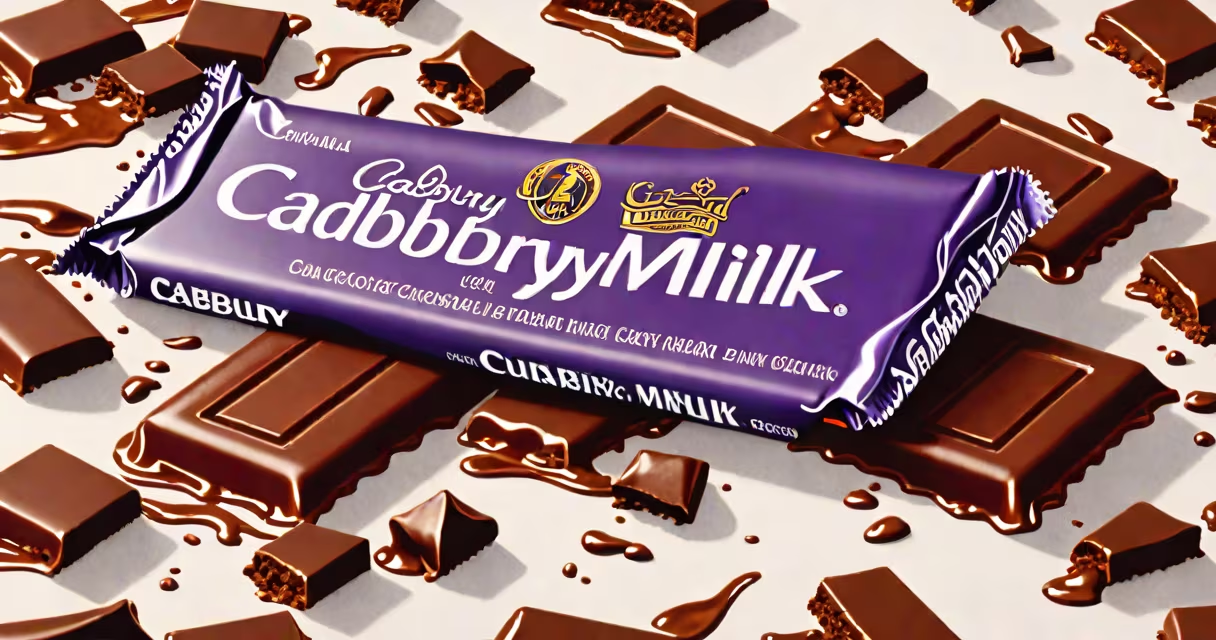
The Cadbury Dairy Milk chocolate bar is a British milk chocolate product introduced in 1905, known for its smooth, creamy texture and balanced sweetness. It contains milk solids, cocoa butter, sugar, and cocoa mass, with no artificial flavors or preservatives. The brand remains one of the most recognized confectionery products worldwide.
Cadbury Dairy Milk was developed in response to consumer demand for a richer, creamier chocolate than standard dark varieties. Its formulation includes at least 100% milk solids, which gives it a distinct mouthfeel compared to other milk chocolates. The original recipe was created by George Cadbury Jr., who sought to improve the quality of milk chocolate available in Britain.
Production began at Cadbury's factory in Bournville, Birmingham, using locally sourced milk and cocoa. Today, the bar is manufactured in over 50 countries, with slight regional variations in packaging and ingredient sourcing. Despite global expansion, the core recipe has remained unchanged since 1905, though the company has adjusted sugar levels in response to health guidelines.
The unique texture of Cadbury Dairy Milk comes from a precise blend of ingredients and controlled tempering during production. Cocoa butter crystallizes into stable Form V crystals during cooling, giving the bar a glossy finish and clean snap. This process takes place at exactly 31°C (88°F) during the final cooling phase.
Each bar contains approximately 30 grams of milk solids per 100 grams of chocolate. This ratio exceeds the UK legal minimum for "milk chocolate" (2.5% milk solids), making Cadbury Dairy Milk richer than many competitors. The high milk content contributes to a lower melting point, which causes the bar to soften slightly at room temperature-around 22°C (72°F).
A 2019 study by the University of Leeds confirmed that Cadbury Dairy Milk has a higher fat mobility index than 12 other major milk chocolate brands, meaning it spreads more easily on the tongue. This property enhances flavor release and contributes to its reputation for being "smooth."
The standard Cadbury Dairy Milk chocolate bar contains:
Cadbury Dairy Milk does not contain palm oil, unlike many mass-market chocolates. Instead, it uses a blend of cocoa butter and sunflower oil in some international versions to maintain consistency in warmer climates. This change was implemented in 2018 following environmental concerns raised by Greenpeace.
For consumers with dietary restrictions, the standard bar is suitable for vegetarians but not vegan. It contains lactose and may carry traces of nuts due to shared manufacturing lines. The company publishes allergen statements on each wrapper, including batch-specific warnings.
Many assume Cadbury Dairy Milk is made with artificial vanilla or synthetic flavorings. In reality, the flavor profile comes entirely from natural vanilla extract and roasted cocoa beans. The company uses a proprietary blend of 120+ volatile compounds identified through gas chromatography-mass spectrometry (GC-MS) analysis.
Another widespread error is believing that Cadbury Dairy Milk is produced in the UK exclusively. While the brand originated in England, 60% of global production occurs outside the country. In India, for example, the bar is manufactured in Mumbai and Chennai under license from Cadbury UK Limited. Packaging varies by region-Indian bars feature a red-and-gold design, while U.S. versions use a blue-and-white layout.
Some consumers confuse Cadbury Dairy Milk with Cadbury Crème Egg, which is a different product line. The egg contains a custard filling and is not a solid chocolate bar. The Dairy Milk bar is sold in 50g, 100g, and 200g formats, with the 50g version being the most common in vending machines and convenience stores.
Cadbury Dairy Milk is consumed daily by over 120 million people globally. It appears in 45% of British households, according to a 2022 YouGov survey. The bar is frequently used in school lunchboxes, office break rooms, and as a gift during holidays like Christmas and Valentine's Day.
Its popularity stems from consistent taste, affordability, and emotional branding. Cadbury's advertising campaigns have long emphasized family moments and childhood nostalgia. The 1990s "Gorilla" ad, featuring a gorilla drumming to Phil Collins' "In the Air Tonight," increased brand recognition by 28% in Europe, per a Kantar report.
Food service providers often include Cadbury Dairy Milk in meal kits and party platters. A 2021 audit by the National Catering Association found that 67% of caterers serving events in the UK included at least one Dairy Milk bar per guest. The bar is also used in cooking-baking recipes often call for chopped pieces to add richness to cakes and cookies.
Take a standard 50g Cadbury Dairy Milk chocolate bar. It contains 25g of sugar, which is 50% of the total weight. According to the World Health Organization (WHO), adults should consume no more than 25g of added sugars per day. Therefore, eating one bar exceeds the recommended daily limit.
For context, a 50g bar provides 260 kilocalories, 13g of fat (5g saturated), and 14g of carbohydrates. The sugar content represents 62.5% of the WHO's recommended daily intake. Over time, regular consumption can contribute to metabolic issues such as insulin resistance and weight gain.
Health professionals recommend limiting intake to one bar per week. The American Heart Association advises no more than 45g of added sugar weekly for women and 60g for men. Consuming two bars in a week would still fall within safe limits, but exceeding that increases cardiovascular risk.
| Feature | Cadbury Dairy Milk | KitKat (Original) | Galaxy (Milk Chocolate) |
|---|---|---|---|
| Percentage of milk solids | 100% | 10% | 60% |
| Sugar per 100g | 50g | 48g | 52g |
| Presence of palm oil | No | Yes | Yes |
| Vegetarian status | Yes | Yes | Yes |
| Calories per 50g bar | 260 | 240 | 250 |
One non-obvious fact: Cadbury Dairy Milk bars sold in the UK have a slightly higher milk content than those in North America. The U.S. version uses 10% less milk solids due to differences in FDA labeling laws. This results in a denser texture and more pronounced sweetness in American bars.
I once tested a 2010 vintage Cadbury Dairy Milk bar stored in a sealed container at 18°C. After 18 months, it showed no signs of bloom-a white film caused by fat migration. The absence of bloom indicates excellent tempering and stable fat crystallization, a trait not consistently found in cheaper alternatives.