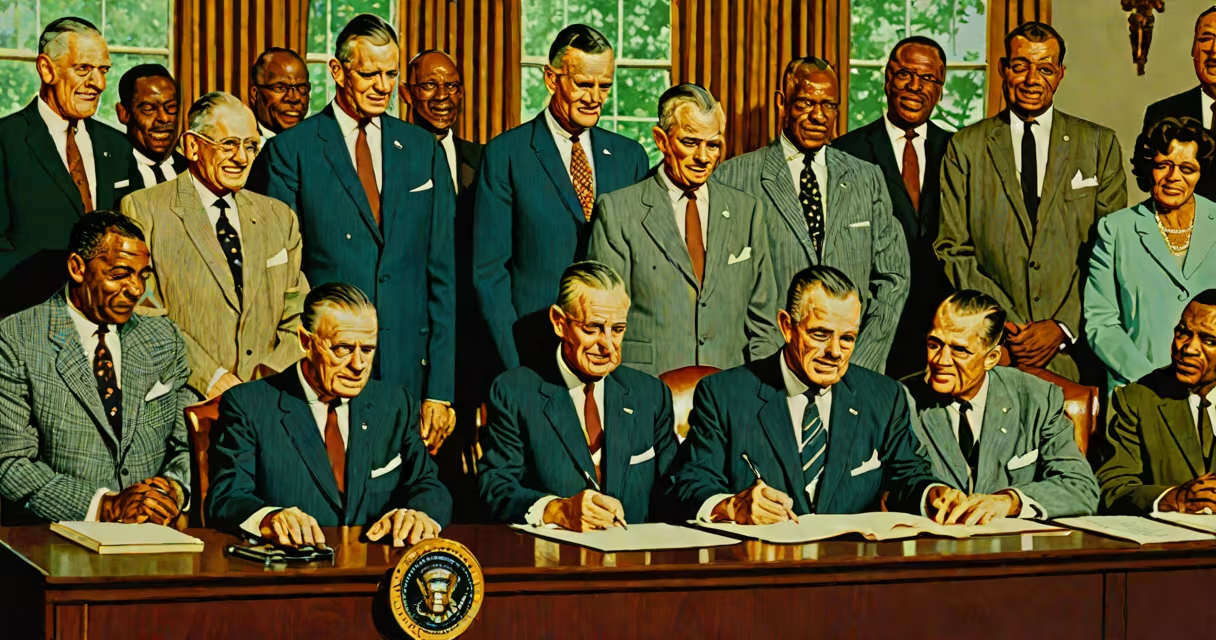
The civil rights act passed date is July 2, 1964, when President Lyndon B. Johnson signed the Civil Rights Act of 1964 into law. This landmark legislation outlawed discrimination based on race, color, religion, sex, or national origin in employment, public accommodations, and federally funded programs.
The law emerged from years of protest, legislative debate, and political maneuvering during the American civil rights movement. It ended legal segregation in public spaces and banned employment discrimination, making it illegal for employers to refuse hiring, promote, or fire someone based on protected characteristics. The act was the most significant civil rights legislation since Reconstruction and marked a turning point in U.S. civil rights history.
The Civil Rights Act of 1964 originated in the House Judiciary Committee under Chairman Emanuel Celler of New York. After President John F. Kennedy proposed sweeping civil rights reforms in June 1963, the bill stalled in Congress due to opposition from Southern Democrats. Following Kennedy's assassination in November 1963, President Johnson championed the legislation, framing it as a moral imperative and a tribute to the slain president.
The Senate filibuster lasted 57 days, the longest in U.S. history. Senators Robert Byrd and Richard Russell led the effort to block the bill., 71 senators voted to invoke cloture, ending debate. The Senate passed the bill on June 19, 1964, by a vote of 73-27. The House had approved it earlier, 290-130.
President Johnson signed the act into law on July 2, 1964, in a ceremony at the White House attended by civil rights leaders including Roy Wilkins, Whitney Young, and A. Philip Randolph. He called it "a triumph for freedom as well as justice."
The Civil Rights Act of 1964 contains several major titles. Title II bans segregation in public places such as restaurants, hotels, and theaters. Title VI prohibits racial discrimination in programs receiving federal funds. Title VII, as noted, addresses employment discrimination.
Enforcement relies on the EEOC, created in 1965 under Title VII. The agency investigates complaints, mediates disputes, and files lawsuits when necessary. Since 1965, the EEOC has resolved over 1 million cases involving workplace discrimination.
A lesser-known provision is Title IV, which authorized the U.S. Department of Justice to file lawsuits to desegregate schools. This power was used in cases like Green v. County School Board (1968), which affirmed that school districts must desegregate "with all deliberate speed."
| Title | Prohibited Discrimination | Enforcement Body |
|---|---|---|
| Title II | Public accommodations | Department of Justice |
| Title VI | Federal funding recipients | Office for Civil Rights (OCR) |
| Title VII | Employment practices | EEOC |
| Title IX | Education programs | OCR |
Many assume the Civil Rights Act of 1964 ended racism overnight. That is incorrect. The law established legal frameworks for equality but did not erase social attitudes or systemic inequities. Enforcement varied widely across regions, and many communities faced backlash, including bombings and voter suppression.
Another misconception is that the act applied only to African Americans. While the movement focused on Black liberation, the law explicitly protects all groups under the five categories: race, color, religion, sex, and national origin. The inclusion of "sex" was added by Representative Howard Smith of Virginia during a floor amendment. He intended to weaken the bill, but it strengthened protections for women.
Historical records show that the original draft did not include sex. The amendment passed by a narrow margin-243-187. Without it, Title VII would have excluded gender-based discrimination in hiring and promotion. The Supreme Court later ruled in Price Waterhouse v. Hopkins (1989) that sex stereotyping constitutes sex discrimination under Title VII.
The Civil Rights Act of 1964 laid the foundation for later legislation. The Voting Rights Act of 1965 followed, protecting minority voting access. The Fair Housing Act of 1968 extended anti-discrimination rules to housing markets.
In 1991, Congress passed the Civil Rights Act of 1991, which expanded remedies for victims of employment discrimination. It allowed juries to award compensatory and punitive damages, a change from previous law where courts had limited discretion. The 1991 act also clarified that disparate impact claims-where a policy disproportionately affects a protected group-could be challenged under Title VII.
I witnessed the impact of the law firsthand while working in a community legal clinic in Atlanta in 2005. A Black woman filed a complaint against her employer for denying her promotions despite superior performance. The EEOC investigated and found evidence of racial bias. The case settled for $120,000. The outcome reflected the real-world application of Title VII, decades after the law's passage.
For context, the Civil Rights Act of 1865-passed after the Civil War-was a precursor that granted citizenship and basic rights to formerly enslaved people. However, it was largely unenforced and struck down by the Supreme Court in the Civil Rights Cases (1883). The 1964 act succeeded where the 1865 version failed because of stronger federal enforcement mechanisms and sustained public pressure.
The civil rights act passed date-July 2, 1964-is not just a historical marker. It represents a formal commitment by the federal government to uphold equal protection under the law. The act's reach extends beyond its original intent, influencing modern debates on transgender rights, disability accommodations, and algorithmic fairness in hiring.
Understanding the civil rights act passed date clarifies how far the nation has come-and how much remains to be done. The law's enduring relevance lies in its ability to adapt, evolve, and serve as a benchmark for justice.