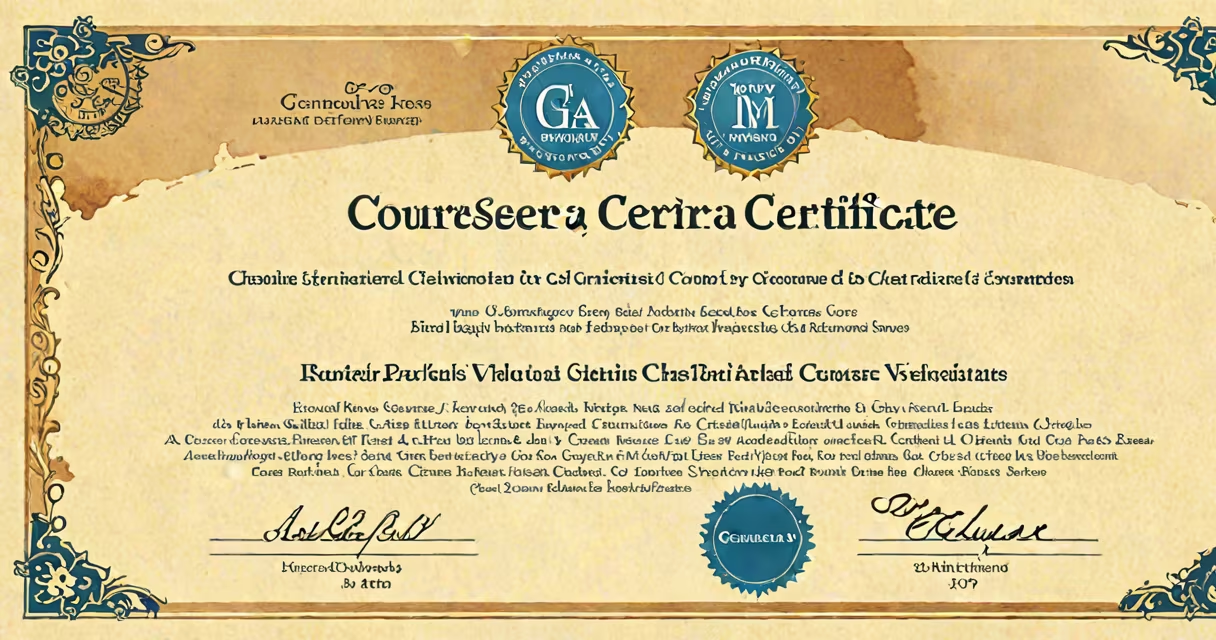
A course certificate from Coursera is a digital credential awarded upon successful completion of a verified learning track. It confirms you've finished all required coursework, passed assessments, and met the passing threshold set by the instructor. The certificate includes your name, course title, date of completion, and a unique verification code for authenticity.
Coursera partners with universities, companies, and professional organizations to deliver courses across fields like computer science, business, data analytics, and cybersecurity. Upon finishing a course, learners receive a shareable digital certificate. This credential is not a degree, but it holds value in job applications, promotions, and continuing education.
For example, completing the "Python for Everybody" course on Coursera earns a certificate issued by the University of Michigan. The document shows the learner's name, the course title, and a QR code to verify authenticity. Employers can scan this code to confirm the credential hasn't been forged.
Coursera uses a tiered system for course delivery. Free access lets users watch lectures and complete practice quizzes. To earn a certificate, learners must pay a fee or qualify for financial aid. Once enrolled in the paid track, they gain access to graded assignments, peer-reviewed projects, and proctored exams.
To pass, learners must achieve a minimum score-typically 70% or higher-on all assessments. After meeting this threshold, Coursera generates a certificate automatically. The process takes 24 to 72 hours. The certificate appears in the learner's profile under "My Learning" and can be downloaded or shared via email, LinkedIn, or social media.
For instance, the "Google IT Support Professional Certificate" requires learners to complete eight courses over six months. Each course ends with a quiz and a final project. Only those who score above 80% on each project receive the final certificate. The entire program aims to prepare learners for entry-level IT roles.
Coursera offers several types of credentials, each with different recognition levels:
| Type | Recognition Level | Duration | Example |
|---|---|---|---|
| Individual Course Certificate | Entry-level career support | 1-6 weeks | "Introduction to Data Science in Python" |
| Specialization Certificate | Mid-level skill validation | 3-6 months | "Business Analytics Specialization" by University of Pennsylvania |
| Professional Certificate | Industry-recognized training | 4-8 months | "Google Project Management: Professional Certificate" |
| MasterTrack Certificate | Graduate-level credit potential | 6-12 months | "Data Science MasterTrack" by University of California San Diego |
Employers often treat Specialization and Professional Certificates as equivalent to short-term certifications from industry bodies. A 2023 survey by LinkedIn found that 68% of hiring managers consider Coursera Professional Certificates relevant for technical roles, especially in IT and data fields.
One non-obvious distinction: Coursera certificates do not expire. Unlike some certifications from CompTIA or AWS, which require renewal every two years, Coursera credentials remain valid indefinitely. However, their relevance depends on how current the skills are. A certificate earned in 2018 may not carry weight for a 2024 cloud engineering role unless paired with recent experience.
Many assume a course certificate from Coursera is equivalent to a college degree. It is not. The credential does not grant academic credit or qualify for graduate school admission. It also does not replace formal qualifications like a bachelor's in computer science or a master's in business administration.
Another common error is confusing a certificate with a diploma. A diploma from a university is a formal qualification awarded after completing a full degree program. A Coursera certificate is a micro-credential focused on specific skills. For example, earning a certificate in "SQL for Data Analysis" doesn't mean you're qualified to manage enterprise databases-it means you can write queries and interpret results.
I once reviewed a job application where a candidate listed "Coursera Certificate in Machine Learning" as if it were a formal degree. The hiring manager rejected the application. The candidate had completed the course but hadn't applied the skills in a real-world setting. The certificate was accurate, but the context was missing.
To earn a course certificate, follow these steps:
Once earned, the certificate can be added to resumes, LinkedIn profiles, and portfolios. Many learners use it to apply for internships or switch careers. For example, someone transitioning from retail to tech might list a "Python for Everybody" certificate to demonstrate foundational coding ability.
When sharing your certificate, include the verification code. This allows employers to validate it directly on Coursera's public registry. You can also export it as a PDF or PNG file for inclusion in job applications.
Course certificate Coursera is not a substitute for experience-but it is a proven way to build skills, prove competence, and advance professionally in a competitive job market.