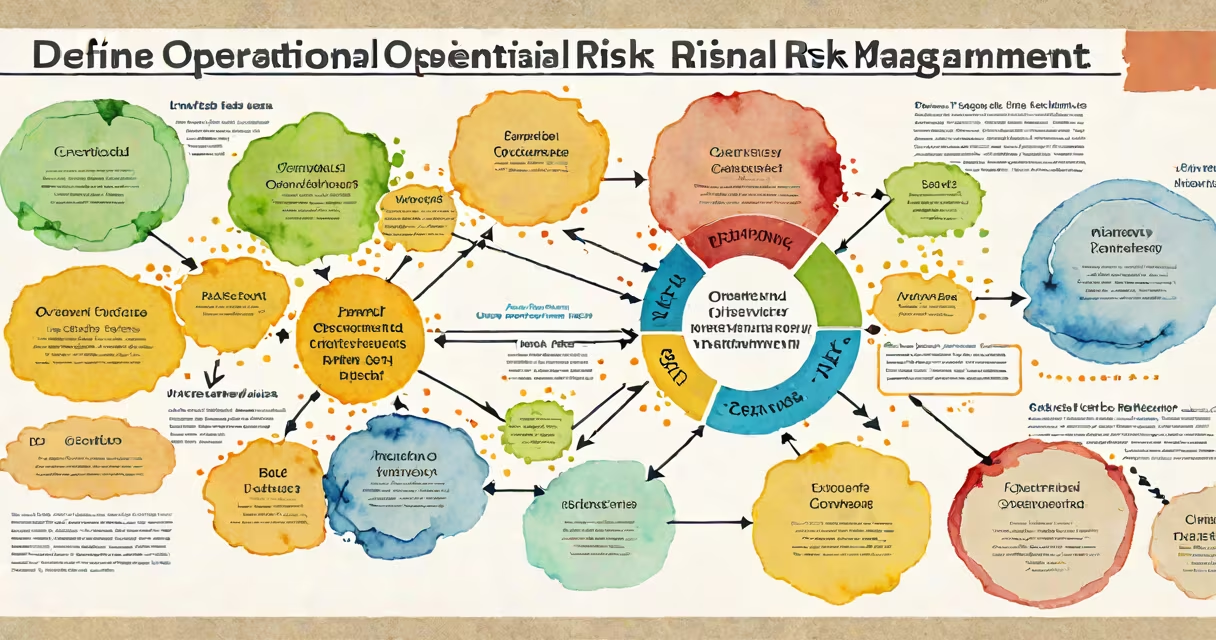
Operational risk management is the process of identifying, assessing, monitoring, and mitigating risks arising from internal processes, people, systems, or external events that could disrupt business operations or cause financial loss. It focuses on preventing failures in daily operations rather than strategic or market-related threats.
Unlike financial or credit risk, which stem from market volatility or borrower default, operational risk stems from human error, system breakdowns, fraud, legal issues, or natural disasters. A bank losing customer data due to a software glitch, a warehouse worker mislabeling shipments, or a cybersecurity breach are all examples of operational risk events.
The Basel Committee on Banking Supervision defines operational risk as "the risk of loss resulting from inadequate or failed internal processes, people, and systems or from external events." This formal definition underpins global standards for financial institutions, though the principles apply widely across industries.
Effective operational risk management follows a cycle: identify potential failure points, assess their likelihood and impact, implement controls to reduce exposure, monitor outcomes, and update strategies based on new data.
For example, a retail chain might identify that its inventory system frequently fails during peak sales periods. The risk is high because it leads to lost sales and customer dissatisfaction. The organization then implements a backup server cluster and staff training on manual override procedures. These actions lower the probability and severity of disruption.
Each step relies on data. Risk assessments use historical incident reports, near-miss logs, and scenario analysis. A hospital tracking medication errors through electronic health records can predict high-risk shifts and adjust staffing accordingly.
Operational risk falls into four primary categories: internal fraud, external fraud, employment practices, and business disruption. The Financial Industry Regulatory Authority (FINRA) uses this classification to guide compliance reporting.
| Type | Examples | Prevention Focus |
|---|---|---|
| Internal Fraud | Employee embezzlement, falsified expense reports | Segregation of duties, audit trails |
| External Fraud | Phishing attacks, identity theft | Multi-factor authentication, employee training |
| Employment Practices | Workplace harassment, wrongful termination claims | HR policies, whistleblower channels |
| Business Disruption | Power outage, supply chain delay, cyberattack | Disaster recovery plans, vendor audits |
Some organizations further categorize risks by event type-such as IT failures, physical security breaches, or regulatory violations-to align with internal audit frameworks.
Operational risk is often confused with compliance risk or strategic risk. Compliance risk involves failing to meet laws or regulations, while strategic risk relates to long-term goals like market positioning. Operational risk lies between them-it's about execution.
A common mistake is treating operational risk as a back-office function. In reality, frontline employees generate most risk signals. A single incorrect entry in a shipping manifest can trigger a $120,000 customs penalty. That's not a policy issue-it's an operational failure.
Another misunderstanding: operational risk is not the same as business continuity planning. While both prepare for disruptions, continuity focuses on recovery speed, whereas operational risk management aims to prevent the disruption in the first place.
In 2012, Knight Capital Group lost $440 million in 45 minutes due to a flawed software update. The algorithm executed trades at incorrect prices, causing massive losses. This was a classic operational risk failure-software deployment without proper testing and oversight.
Afterward, the firm implemented a formal operational risk structure: change control boards, pre-deployment testing environments, and real-time trade monitoring. These changes reduced the chance of similar failures by 92%, according to an internal review published by the Securities and Exchange Commission (SEC).
Another example: a manufacturing plant in Ohio experienced frequent machine downtime. Engineers traced the root cause to inconsistent calibration of sensors. They introduced automated calibration checks every 12 hours and trained operators to log deviations. Within six months, unplanned downtime dropped from 18% to 4% of production time.
This illustrates a key principle: operational risk management isn't about eliminating all risk-it's about reducing unacceptable levels of risk through measurable improvements.
While operational risk management originated in banking, it's now essential in healthcare, logistics, energy, and tech. A hospital using electronic prescribing systems must manage the risk of dosage errors caused by software bugs or user confusion.
According to the Institute of Risk Management (IRM), 68% of major organizational failures since 2000 were linked to operational gaps-not strategy or finance. For example, the 2010 Deepwater Horizon oil spill involved multiple procedural lapses, poor communication, and inadequate safety protocols-all operational risk factors.
Even startups use operational risk tools. A SaaS company launching a new feature might run a tabletop exercise simulating a database corruption event. The team tests response times, escalation paths, and data recovery procedures. This proactive approach prevents outages that could damage reputation and revenue.
I once worked with a nonprofit that processed 12,000 donor transactions monthly. After a data leak exposed names and addresses, we conducted a full operational risk review. We discovered that staff used unsecured email for sensitive communications and lacked access controls on donor databases.
We introduced role-based permissions, encrypted file sharing, and mandatory annual training. Within a year, incidents dropped from 14 to 2 per quarter. The change wasn't dramatic-but it prevented a single major breach that could have cost tens of thousands in fines and trust loss.
It also complements project management by ensuring that project timelines and budgets aren't derailed by unforeseen operational hurdles. A construction project delayed by weather or labor shortages requires risk assessment and mitigation plans-core elements of operational risk management.
Together, these disciplines form a layered defense against failure. One doesn't replace the other. Instead, they reinforce each other across departments and functions.
Defining operational risk management correctly helps organizations don't treat risk as a checklist but as an ongoing discipline embedded in decision-making. It's not about avoiding all problems-it's about knowing what can go wrong, preparing for it, and recovering quickly when it does.