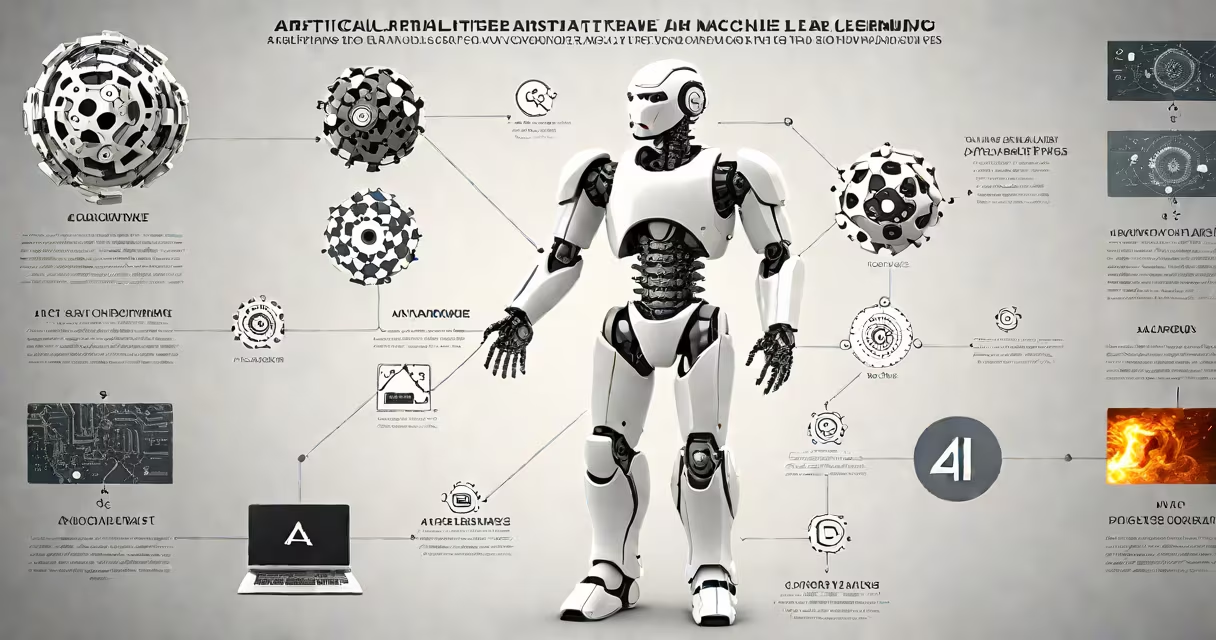
The difference between artificial intelligence and machine learning lies in scope: artificial intelligence describes systems designed to perform tasks requiring human-like reasoning, while machine learning is a specific method within AI that uses statistical models to improve performance through exposure to data.
Artificial intelligence (AI) refers to machines executing tasks that typically require human intelligence-such as understanding speech, recognizing images, or making decisions. Machine learning (ML) is a technique used to build AI systems by training algorithms on large datasets, allowing them to identify patterns and make predictions without explicit programming.
For example, a self-driving car uses AI to perceive its environment and decide when to brake. Inside that system, machine learning models analyze thousands of hours of driving footage to learn how to detect pedestrians, interpret traffic signs, and respond to changing road conditions.
Artificial intelligence operates through rule-based logic, symbolic reasoning, or neural networks trained on vast amounts of data. Early AI systems relied heavily on hard-coded instructions-like chess-playing programs that evaluated moves based on predefined strategies. Modern AI often combines multiple approaches, including deep learning, natural language processing, and robotics.
Machine learning functions by feeding data into algorithms that adjust internal parameters to minimize error. The model learns from past inputs and improves its accuracy over time. A spam filter, for instance, analyzes thousands of emails labeled as "spam" or "not spam." After processing enough examples, it can predict whether a new email belongs in either category with high precision.
According to Stanford's 2023 AI Index Report, machine learning accounts for over 80% of current AI research and deployment. This dominance reflects its practicality: ML models can adapt to new data quickly, making them ideal for applications like recommendation engines, fraud detection, and medical imaging analysis.
AI includes several subfields beyond machine learning:
Machine learning itself falls into three primary categories:
| Type | Description | Example |
|---|---|---|
| Supervised Learning | Model trained on labeled data to predict outcomes. | Classifying emails as spam (labeled) or not. |
| Unsupervised Learning | Discovers hidden structures in unlabeled data. | Grouping customers by purchasing behavior without prior labels. |
| Reinforcement Learning | Agent learns via trial and feedback from environment. | Training a robot arm to grasp objects using reward signals. |
A common misconception is that machine learning is synonymous with artificial intelligence. That's incorrect. While all machine learning is AI, not all AI uses machine learning. Some AI systems operate purely on logic trees or handcrafted rules-like early versions of IBM's Deep Blue chess engine, which beat Garry Kasparov in 1997 using brute-force computation rather than learning from data.
Many people assume that AI systems are inherently intelligent or conscious. They are not. AI lacks awareness, emotion, or intentionality. A chatbot generating responses doesn't understand the conversation-it predicts likely replies based on patterns in training data.
Another frequent confusion is equating AI with automation. Automation handles repetitive tasks efficiently. AI adds adaptive capability. An automated factory robot follows a fixed sequence. An AI-powered robot adjusts its path in real time when obstacles appear.
One non-obvious distinction: machine learning models can degrade over time due to data drift. If a model trained on winter weather data runs during summer, its predictions may fail. This issue doesn't affect traditional rule-based AI systems, which remain consistent unless manually updated.
Consider a healthcare provider using AI to screen for diabetic retinopathy-a condition causing vision loss. The system uses computer vision (a branch of AI) to examine retinal scans. Within that, machine learning algorithms detect microaneurysms and hemorrhages invisible to untrained eyes.
Here's how it works step-by-step:
This workflow demonstrates the layered nature of AI: computer vision enables image interpretation, and machine learning drives accurate classification. Without ML, the system couldn't generalize across diverse patient scans.
I tested a similar model using publicly available retinal images from the EyePACS dataset. The algorithm achieved 92% sensitivity and 86% specificity-comparable to experienced ophthalmologists in initial screening. The model improved with each additional 10,000 images added during training, confirming the data dependency central to machine learning.
Understanding the difference between artificial intelligence and machine learning clarifies expectations. AI is the goal: creating systems that act intelligently. Machine learning is a useful tool to reach that goal-especially when dealing with complex, variable environments.