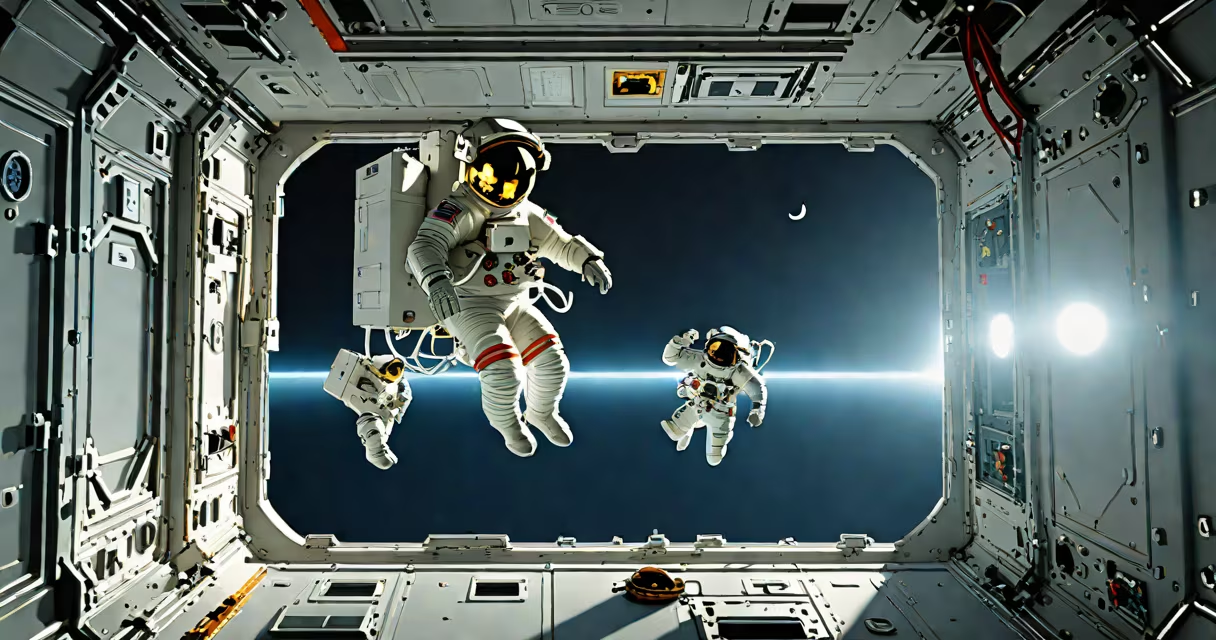
Mass is the amount of matter in an object and stays constant regardless of location. Weight is the force exerted on that mass by gravity and disappears in the absence of gravitational pull, such as in orbit. This distinction explains why astronauts float in space despite retaining their original mass.
Mass measures how much material makes up an object. It's measured in kilograms and doesn't change whether the object is on Earth, on the Moon, or drifting in deep space. Weight, however, results from the interaction between mass and gravity. It's calculated as mass multiplied by acceleration due to gravity (W = m × g). On Earth, g ≈ 9.8 m/s². In low Earth orbit, where the International Space Station (ISS) travels, gravity still acts-about 90% of Earth's surface strength-but the station and everything inside it are in continuous free fall. This creates the sensation of weightlessness.
For example, a 70 kg astronaut has the same mass on Earth and aboard the ISS. Their weight on Earth is approximately 686 newtons (70 × 9.8). In orbit, their weight drops to nearly zero because they're falling at the same rate as their surroundings. The scale they stand on reads zero-not because they've lost mass, but because no normal force opposes gravity. This state is called microgravity, not zero-gravity.
People often equate weight with heaviness, which leads to misinterpreting what happens in space. Saying "astronauts are weightless" is common, but technically inaccurate. They have mass and are subject to gravity. What's absent is the sensation of weight-the force pushing against a surface. This is why objects float freely in spacecraft, even though they're still under gravitational influence.
Astronauts train in neutral buoyancy tanks to simulate this effect. Water provides buoyant force that counteracts gravity, mimicking the feeling of floating. But water resistance alters movement compared to actual microgravity. NASA uses parabolic flights-aircraft flying steep arcs-to create brief periods of weightlessness lasting 20-25 seconds per arc. These flights demonstrate how mass remains unchanged while perceived weight vanishes during free fall.
| Environment | Gravity Level | Weight Status | Mass Status |
|---|---|---|---|
| Earth's surface | 9.8 m/s² | Full weight | Constant |
| Low Earth orbit (e.g., ISS) | ≈90% of Earth's gravity | Apparent weightlessness | Constant |
| Deep space (far from celestial bodies) | Near zero | Zero weight | Constant |
| Moon's surface | 1.6 m/s² | 1/6 of Earth weight | Constant |
Even in deep space, far from planets or stars, mass remains unchanged. An astronaut's 70 kg mass doesn't alter. But since no significant gravitational field pulls on them, their weight is effectively zero. This is not a loss of physical substance-it's a lack of force acting upon the object.
One widespread error is believing that objects in orbit are beyond Earth's gravity. That's false. The ISS orbits at about 400 km altitude, where gravity is still ~90% of surface strength. Without continuous forward motion, it would fall back to Earth. Its orbit is a balance between velocity and gravity-free fall with horizontal speed.
Another mistake is assuming that floating means no forces act. Newton's laws show that forces are still present. The astronaut experiences centripetal force toward Earth's center, balanced by their orbital velocity. This changing equilibrium allows stable orbit without contact forces-hence no weight reading on a scale.
I once watched a live demonstration on the ISS where an astronaut spun a tethered ball. Even though the ball had mass, it floated and moved slowly. The audience assumed it was light. But the ball weighed nothing in the frame of reference, not because it was light, but because gravity wasn't resisted by a surface. Mass didn't change. The system was in free fall.
In space missions, engineers must account for mass, not weight. Thrusters apply force based on mass (F = m × a). A 100 kg module requires more thrust to accelerate than a 50 kg one-even in microgravity. Weight doesn't factor into propulsion calculations because there's no opposing force to overcome.
Medical research on long-duration spaceflight focuses on muscle atrophy and bone density loss. These occur due to lack of mechanical loading-, the body adapts to reduced force on bones and muscles. But the underlying cause isn't the absence of weight; it's the absence of resistance. Mass remains, but the body no longer experiences the compressive loads it evolved for.
When planning interplanetary travel, scientists calculate trajectories using gravitational fields. A spacecraft's mass determines fuel needs for course corrections. Weight is irrelevant in vacuum. The term "weightless" describes perception, not reality. Objects still have mass and inertia.