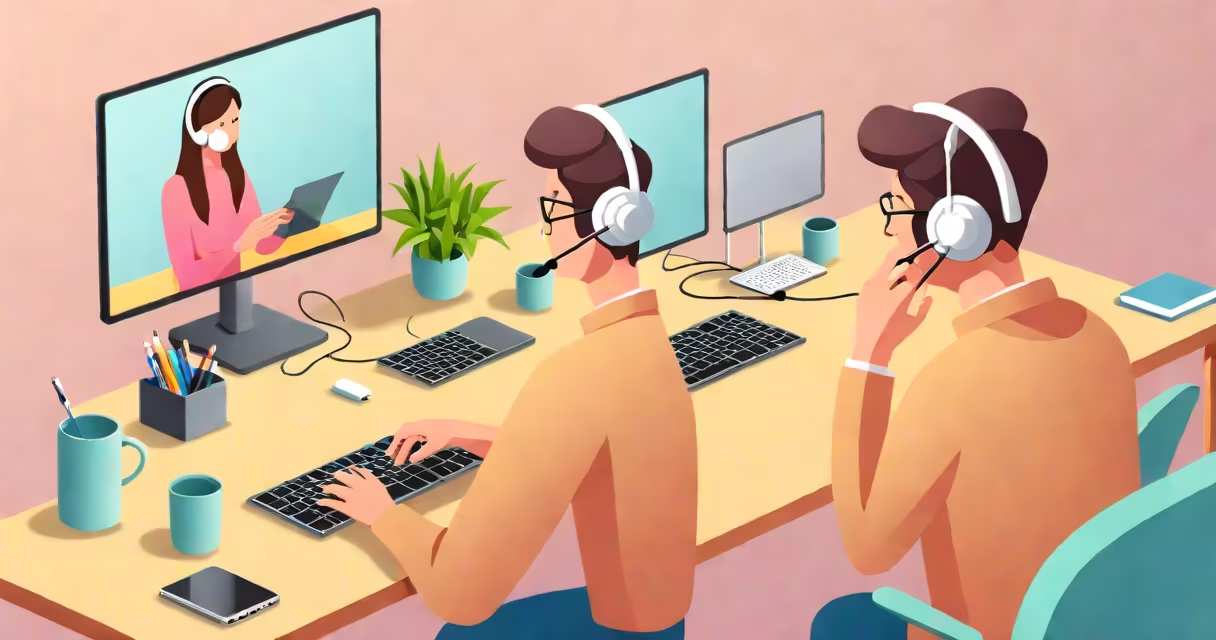
English speaking practice online involves real-time conversations with native or fluent speakers via video chat, voice calls, or live chat platforms to improve pronunciation, fluency, and confidence in everyday communication.
These sessions simulate authentic interactions, allowing users to rehearse topics like job interviews, travel planning, or casual small talk. Platforms range from AI-powered chatbots to human-led tutoring services and peer exchange networks. Most require only a device with a microphone and internet connection.
According to the British Council, consistent speaking practice is critical for language acquisition-learners who engage in regular spoken interaction show 40% greater progress in conversational skills compared to those relying solely on reading and listening. Online tools make this accessible anytime, anywhere.
Users join scheduled or spontaneous sessions through apps or websites. They may be matched with a tutor, partner, or AI agent based on their proficiency level, goals, and time zone. Sessions typically last 20 to 60 minutes and include guided prompts, role-play scenarios, or free-flowing dialogue.
For example, a beginner in Tokyo might connect via Zoom with a teacher in Manchester for a 30-minute lesson focused on ordering food. The instructor corrects pronunciation in real time, uses visual aids, and gives immediate feedback. Afterward, the learner receives a summary of errors and suggested improvements.
Some platforms integrate speech recognition software to analyze intonation, stress patterns, and word accuracy. Duolingo's Speaking feature, for instance, evaluates responses against a native speaker's model and assigns scores based on clarity and grammar. This automated feedback loop supports independent practice between live sessions.
Not all online speaking practice is the same. The format depends on peers-and what your goal is.
| Type | Best For | Example Platforms | Cost |
|---|---|---|---|
| Tutor-led lessons | Structured learning, personalized feedback | Preply, iTalki, Verbling | $10-$30/hour |
| Peer exchange | Low-cost practice, cultural exchange | ConversationExchange, Tandem | Free to $5/month |
| AI simulation | On-demand practice, instant feedback | Duolingo, ELSA Speak, Speechling | Free tier; premium from $10/month |
| Group classes | Speaking under pressure, group dynamics | Outschool, Live Lingua | $15-$25/session |
Many users combine formats. A student might attend weekly iTalki sessions with a certified teacher and supplement with daily practice on Tandem, where they swap languages with a Spanish speaker. This hybrid model builds both accuracy and spontaneity.
A common mistake is assuming that all online speaking practice delivers equal results. Research from the University of Michigan shows that learners using structured, feedback-rich sessions improve faster than those in unguided peer exchanges. The difference lies in accountability and targeted correction-not just talking.
Some assume that simply watching YouTube videos or mimicking dialogues counts as speaking practice. That's passive consumption. True speaking practice requires producing original utterances, receiving feedback, and adjusting in real time.
Another myth is that you need perfect grammar to start. The reality, confirmed by Cambridge English Language Assessment, is that fluency develops through repeated attempts-even with errors. Native speakers often adjust their speech to accommodate non-native speakers, creating a supportive environment for growth.
I once joined a free Tandem session with a woman in Buenos Aires. We spoke for 25 minutes about our favorite books. My grammar was shaky, and I stumbled over verb tenses. But she didn't correct me mid-sentence-she waited until I paused, then gently repeated my sentence with the correct form. That moment taught me more than any textbook ever did.
Set a consistent routine. Even 15 minutes a day is effective. A study published in the Journal of Second Language Acquisition found that learners who practiced speaking daily for 30 days improved their self-rated fluency by 58%, compared to 22% for those who practiced twice a week.
Track your progress. Record a 1-minute monologue on a topic like "My weekend plans" once a week. Listen back after four weeks. You'll notice smoother pacing, fewer pauses, and clearer articulation.
When choosing a service, look for verified teachers, clear cancellation policies, and options to reschedule. Avoid platforms that charge high fees for low-quality matches. Always test the audio and video quality beforehand.
Remember: speaking is not about perfection. It's about connection. Every mispronounced word is a step toward becoming understood. With consistent effort, online practice turns hesitation into habit.
English speaking practice online isn't just a tool-it's a direct path to fluency. just want to talk freely, the right platform makes real conversation possible.