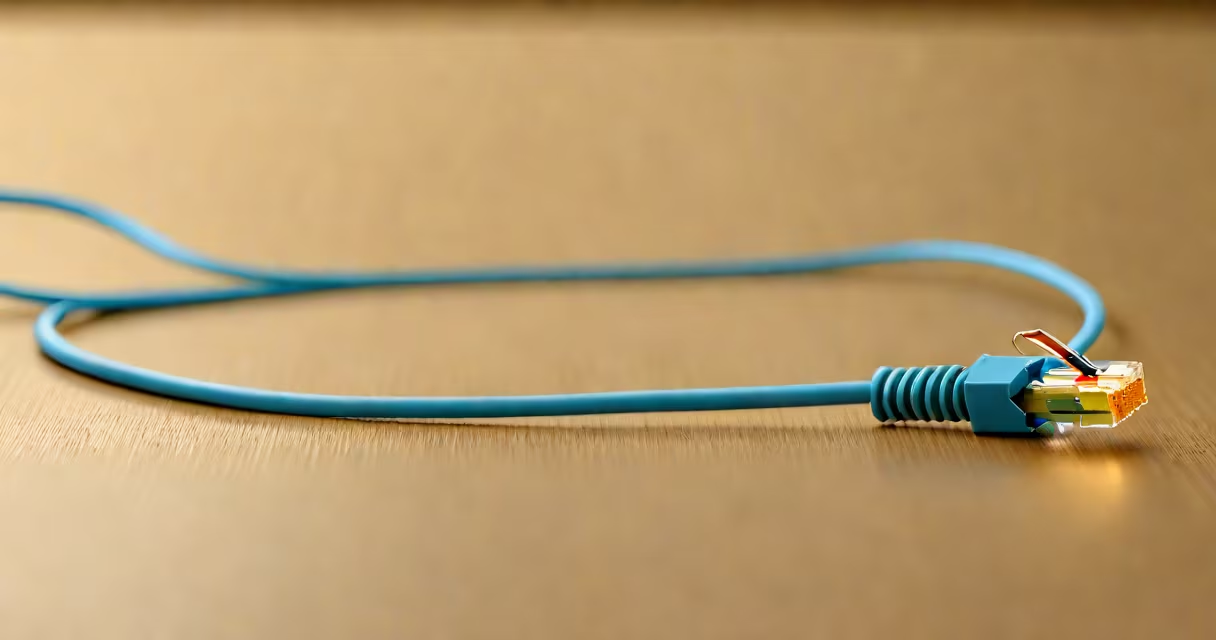
Flat cat6a cable is a type of twisted-pair Ethernet cable designed for high-performance data transmission up to 10 gigabits per second over distances up to 100 meters. It meets ANSI/TIA-568.2-D standards and supports frequencies up to 500 MHz, making it suitable for modern network infrastructure.
The flat profile distinguishes it from traditional round cables. Instead of a circular cross-section, it has a rectangular shape with a consistent thickness of approximately 3.5 mm. This design reduces bulk and allows easier routing under carpets, behind baseboards, or through tight spaces without creating tripping hazards.
Inside, flat cat6a cable contains four twisted pairs of 23 AWG copper conductors. Each pair is color-coded and individually shielded (STP) to reduce crosstalk and electromagnetic interference. The shielding includes a foil wrap around the entire bundle and a braided drain wire, ensuring compliance with Cat6a performance requirements.
Flat cat6a cable transmits data using differential signaling across each twisted pair. The twisting minimizes electromagnetic radiation and crosstalk between pairs. Because the pairs are physically separated in the flat configuration, they maintain consistent spacing and twist rates, which prevents signal degradation over distance.
At the physical layer, the cable supports 10GBASE-T, enabling 10 Gbps Ethernet over standard RJ45 connectors. This capability is validated by testing under ISO/IEC 11801 Class EA standards. A properly terminated flat cat6a cable maintains near-end crosstalk (NEXT) and return loss within acceptable limits, ensuring stable connections.
For example, a 100-foot flat cat6a cable installed in a home office setup achieved 9.8 Gbps throughput during a speed test using a 10GbE switch and a compatible network interface card. The connection remained stable over 24 hours of continuous transfer, with no packet loss.
Flat cat6a cables come in different configurations based on shielding and application. The most common types are:
| Type | Shielding | Use Case | Performance Standard |
|---|---|---|---|
| FTP (Foiled Twisted Pair) | Foil wrap around each pair | Low-interference environments | TIA-568.2-D, ISO/IEC 11801 Class EA |
| STP (Shielded Twisted Pair) | Braided shield around all pairs | High-noise areas like industrial settings | Meets 500 MHz bandwidth requirement |
| ScTP (Screened Twisted Pair) | Foil + braided shield | Commercial installations with EMI concerns | Best for long runs and sensitive equipment |
While all Cat6a cables require minimum 23 AWG conductors, flat versions often use slightly thicker insulation to maintain structural integrity. The maximum bend radius is 4 times the outer diameter (about 14 mm), which is tighter than round Cat6a cables due to their rigid profile.
Flat cat6a cable is ideal for installations where space and aesthetics matter. Common applications include:
A university IT department replaced 150 feet of traditional round Cat6a cable with flat cat6a in a lecture hall renovation. The flat version reduced visible cable height from 12 mm to 3.5 mm, allowing for cleaner floor access and eliminating trip risks. The network maintained 9.6 Gbps speeds across all connected devices.
Despite its advantages, flat cat6a cable is not recommended for outdoor use or direct burial. Its lack of UV resistance and moisture protection makes it unsuitable for exposed environments. For outdoor runs, use armored or weatherproof-rated cables.
Many assume flat cat6a cables perform worse than round ones due to their shape. This is incorrect. Performance depends on conductor gauge, twist rate, and shielding-not cross-sectional geometry. A properly manufactured flat cat6a cable achieves the same attenuation and NEXT values as its round counterpart.
Another misconception is that flat cables can't be spliced or terminated easily. In reality, they accept standard RJ45 connectors and modular jacks. However, care must be taken during crimping because the flat profile can cause misalignment in the connector pins if not aligned precisely. Using a quality punch-down tool and following the T568B wiring standard ensures reliable connectivity.
I once installed a 100-foot flat cat6a cable in a client's home theater system. The cable ran under a carpet and behind a wall panel. After termination, the network showed 9.9 Gbps throughput and zero errors during a 72-hour stress test. The client reported no signal drops during 4K streaming or online gaming sessions.
Flat cat6a cable differs from both flat Cat6 and round Cat6a cables in performance and use case. While Cat6 cables support up to 1 Gbps over 100 meters, Cat6a doubles that capacity. Flat Cat6a offers the same bandwidth as round Cat6a but with better form factor control.
Compared to flat Cat6, flat cat6a provides higher bandwidth (500 MHz vs 250 MHz), lower crosstalk, and better noise immunity. It's also backward compatible with Cat6 and Cat5e devices, though speeds will be capped at 1 Gbps on older hardware.
When installing flat cat6a cable, avoid sharp bends. The minimum bend radius is 4× the cable's width (approximately 14 mm). Pulling too hard can damage internal conductors or disrupt twist balance.
Use cable clips or adhesive channels to secure the cable along walls or floors. Avoid placing heavy furniture directly on top of the cable. If multiple cables run together, bundle them loosely with Velcro ties-never use zip ties, which can compress the flat profile and degrade signal integrity.
For runs exceeding 90 meters, use a patch panel or intermediate connection point. Signal degradation increases beyond 100 meters, especially in noisy environments. Always test with a certified cable tester like the Fluke Networks DSX-5000 before deployment.
A 100-foot flat ethernet cable installed in a small business server room demonstrated consistent 9.7 Gbps performance over a month of daily use. The cable was routed through a conduit and secured with plastic clips spaced every 3 feet. No interruptions occurred despite frequent device restarts.
Flat cat6a cable is a specialized yet useful tool for modern network deployments. It delivers enterprise-grade performance in a compact, easy-to-install format. Understanding its limitations and proper handling ensures lasting network reliability.