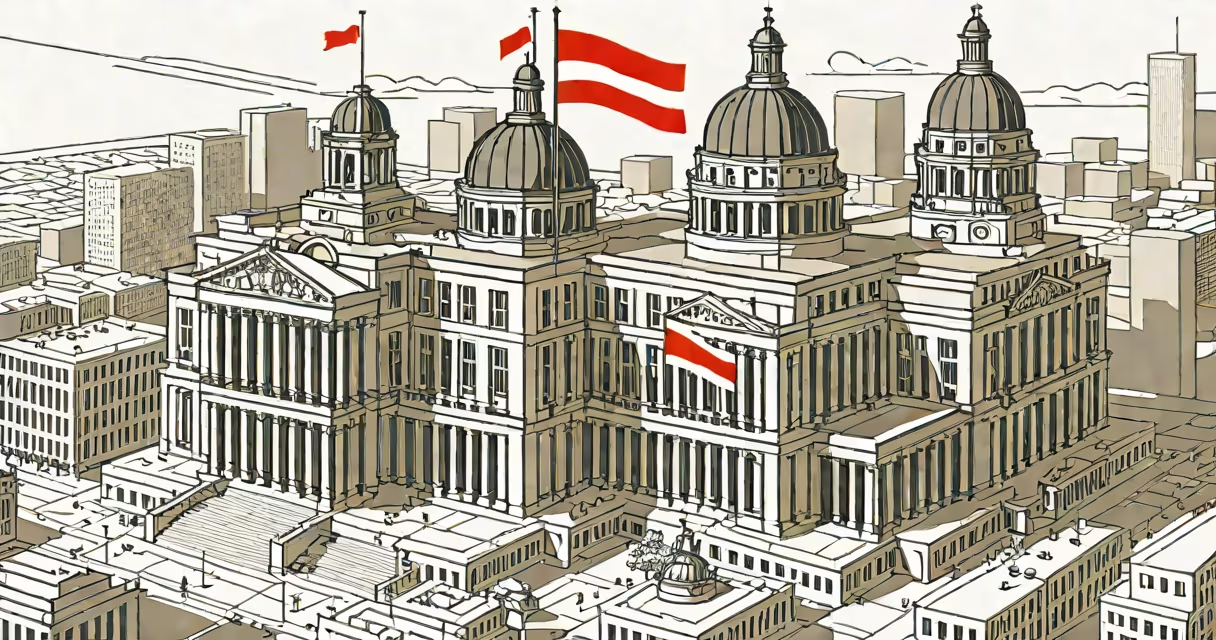
Government is the system or group of people governing a country or organization, exercising authority through established laws, institutions, and administrative structures to maintain order, provide services, and enforce policies. It defines who makes decisions, how they're made, and who is accountable.
At its foundation, government is not a single entity but a network of bodies-legislative, executive, and judicial-that collectively manage collective life. These branches operate under constitutional frameworks in most nations, ensuring checks and balances. For example, the U.S. Constitution divides power among Congress (lawmaking), the President (executive enforcement), and the Supreme Court (judicial interpretation).
Without government, coordination on infrastructure, defense, taxation, and public health would collapse. The World Bank notes that effective governance correlates strongly with economic development, citing that countries with stable institutions grow 1.5% faster annually on average than those without (World Bank, 2022).
Government operates through decision-making processes grounded in law, policy, and institutional procedures. Authority flows from legitimacy-whether derived from elections, tradition, or legal codes. In democracies, elected officials represent constituents; in authoritarian systems, power is centralized and often inherited or seized.
Policy implementation involves multiple layers. A federal government may pass a law requiring clean air standards, but state agencies enforce it through inspections, fines, and permits. Local governments handle zoning, waste collection, and school funding. This multi-tier structure ensures responsiveness to regional needs while maintaining national consistency.
For example, the Clean Air Act of 1970 led to a 77% reduction in sulfur dioxide emissions in the U.S. between 1990 and 2020, according to the Environmental Protection Agency (EPA). That outcome required federal mandates, state compliance, and local monitoring-all coordinated through government mechanisms.
Government takes many structural forms, each reflecting different philosophies about power distribution and citizen participation.
| Type | Key Features | Example |
|---|---|---|
| Democracy | Power derives from popular vote; regular elections; civil liberties protected | United States, Germany, Japan |
| Monarchy | Ruler inherits position; may be absolute or constitutional | United Kingdom (constitutional), Saudi Arabia (absolute) |
| Authoritarian | Centralized control; limited political freedoms; suppression of dissent | North Korea, Turkmenistan |
| Technocracy | Decision-making based on technical expertise rather than electoral mandate | Proposed model in some urban planning initiatives |
Some systems blend elements. The United Kingdom combines monarchy (ceremonial head of state) with parliamentary democracy (elected legislature). Singapore uses technocratic governance-civil servants dominate policymaking-and ranks among the top global economies in efficiency and innovation (World Economic Forum, 2023).
A common misconception is that "democracy" means majority rule without limits. But democratic systems include protections for minority rights through constitutional safeguards. The U.S. Supreme Court's 1954 Brown v. Board of Education ruling struck down racial segregation in schools, even though a majority of Southern voters supported it-demonstrating that government protects rights beyond mere majoritarianism.
Government exists wherever people live together in groups large enough to require shared rules. Early states emerged around river valleys-Mesopotamia, Nile Delta, Indus Valley-where agriculture created surplus food, enabling specialization and social hierarchy.
Modern governments serve essential functions: maintaining security, providing public goods (roads, education), regulating markets, and redistributing wealth. The OECD reports that government spending averages 20% of GDP across member nations, funding healthcare, pensions, and emergency response systems.
When government fails, chaos follows. After the 2010 earthquake in Haiti, the central government collapsed. Aid organizations stepped in, but reconstruction took over a decade due to weak institutions. Contrast this with Japan's 2011 Tohoku disaster, where the national government activated emergency protocols within hours, deploying military units and coordinating relief efforts across prefectures.
One non-obvious fact: government is not inherently bureaucratic or slow. The U.S. Department of Defense developed the internet in the 1960s through ARPANET-a project driven by rapid innovation and cross-agency collaboration. Government can be agile when mission-focused and well-resourced.
People often confuse government with politics or bureaucracy. Politics refers to the process of making decisions-debates, negotiations, voting. Bureaucracy is the administrative machinery that implements policy. Government includes both, but is not synonymous with either.
Another error is assuming that government is always inefficient. While red tape exists, many public services outperform private ones in cost and reliability. For example, Denmark's public healthcare system delivers universal coverage at 10% of GDP-lower than the U.S. rate of 17%, despite higher life expectancy (OECD Health Statistics, 2023).
I once observed a municipal team in Portland, Oregon, redesign a traffic signal system using real-time data from sensors. They reduced average commute times by 18% in six months. The project succeeded because engineers, city planners, and community reps collaborated under a unified mandate. That's government working-not as a monolith, but as a responsive machine.
Understanding the meaning of government requires seeing it not as a faceless force, but as a set of tools shaped by history, culture, and design choices. It is neither inherently good nor bad-it reflects the values and priorities of those who wield it.