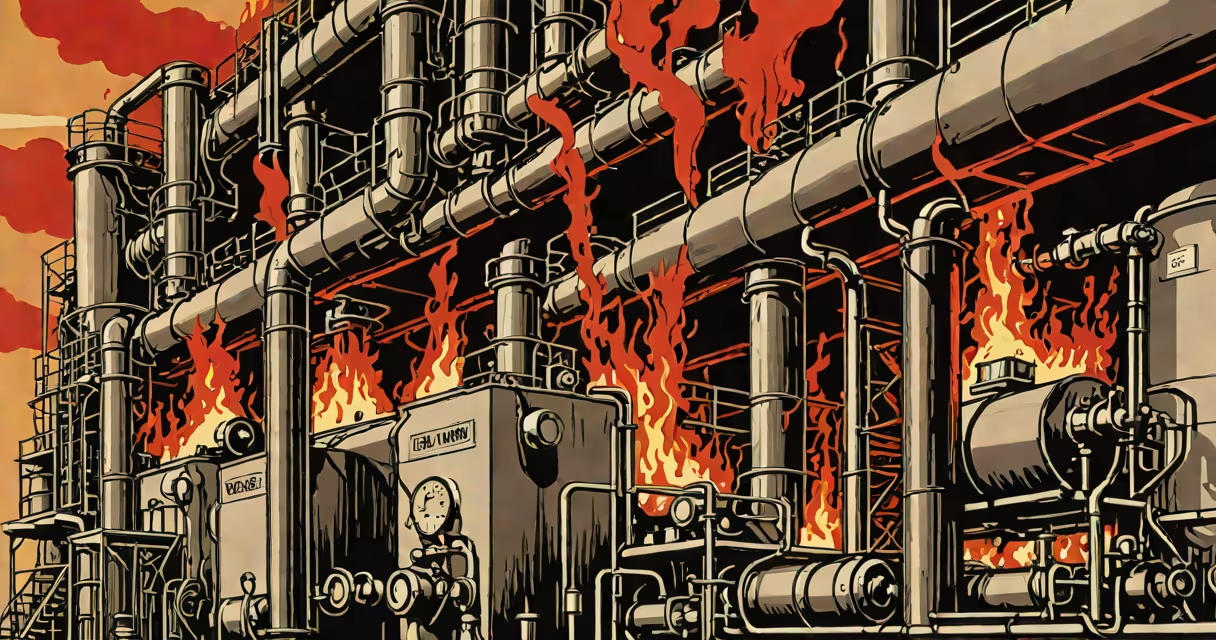
Fossil fuels produce energy through controlled combustion of carbon-rich organic material-coal, oil, or natural gas-releasing heat that generates steam to turn turbines and create electricity. This process powers roughly 60% of global electricity generation, according to the International Energy Agency (IEA).
The core mechanism is chemical energy conversion: the hydrocarbons in fossil fuels react with oxygen during combustion, forming carbon dioxide and water vapor while releasing thermal energy. That heat boils water into high-pressure steam, which spins a turbine connected to a generator. The spinning magnets within the generator induce an electric current via electromagnetic induction.
Coal-fired plants typically operate at 33-40% efficiency, meaning less than half the energy in the fuel becomes usable electricity. Modern natural gas combined-cycle plants reach 50-60% efficiency, making them more effective than older coal units. The U.S. Energy Information Administration (EIA) reports that in 2023, fossil fuels supplied 61% of U.S. electricity, with natural gas leading at 40%.
Combustion begins when fossil fuel is fed into a furnace or combustion chamber. In coal plants, pulverized coal is blown into a burner at high temperatures. Oil and gas are injected as liquids or gases and ignited with air. The resulting flame reaches 1,200-1,600°C, depending on the fuel type.
Heat from the flame transfers to water circulating through metal tubes in a boiler. The water absorbs thermal energy and turns into steam at pressures between 150 and 250 bar. This high-pressure steam flows into a turbine, where it expands rapidly across blades attached to a central shaft. As the steam pushes the blades, the shaft rotates at speeds up to 3,600 RPM.
The rotating shaft connects to a generator rotor inside a stator. Magnetic fields generated by electromagnets on the rotor cut through copper windings in the stator, inducing alternating current. A transformer steps up the voltage for long-distance transmission. After exiting the turbine, steam is cooled and condensed back into water, then recycled to the boiler-a closed-loop system.
Each fossil fuel has distinct energy density and combustion characteristics. Natural gas yields about 50 megajoules per kilogram (MJ/kg), oil around 42 MJ/kg, and coal approximately 24 MJ/kg. These values reflect the amount of energy released per unit mass during complete combustion.
| Fuel Type | Energy Density (MJ/kg) | CO₂ Emissions (g CO₂/MJ) | Common Use |
|---|---|---|---|
| Natural Gas | 50 | 56 | Power plants, heating, industrial processes |
| Crude Oil | 42 | 73 | Transportation, petrochemicals, power generation |
| Bituminous Coal | 24 | 94 | Electricity generation, steel production |
These figures come from the U.S. Department of Energy's National Renewable Energy Laboratory (NREL), which tracks emissions and energy content across fuel types. Natural gas emits less CO₂ per unit of energy than coal or oil due to its higher hydrogen-to-carbon ratio.
Many assume that burning fossil fuels directly produces electricity. In reality, electricity is generated indirectly through mechanical rotation. The fuel's chemical energy becomes heat, then kinetic energy in the turbine, and finally electrical energy in the generator.
Another misconception is that all fossil fuel plants operate at peak efficiency. In practice, many older coal plants run below 35% efficiency due to outdated equipment and poor maintenance. A 2022 study by the World Resources Institute found that upgrading to modern combustion systems can improve efficiency by 8-12 percentage points.
A lesser-known fact: the cooling system in fossil fuel plants consumes significant water. A typical 500 MW coal plant uses 1.5 million gallons of water per hour for condensation. This water demand often strains local supplies, especially in arid regions.
Consider a 500 MW coal-fired power station operating at 35% efficiency. To produce 500 megawatts of electricity continuously, it must burn approximately 140 tons of coal per hour. Over a 24-hour period, that totals 3,360 tons of coal.
Each ton of bituminous coal releases about 2.4 tons of CO₂ when burned completely. So, the plant emits roughly 8,064 tons of CO₂ daily. Annually, this amounts to nearly 2.9 million tons-equivalent to the emissions of 600,000 passenger vehicles.
This level of output underscores why fossil fuel plants remain major contributors to climate change. The Intergovernmental Panel on Climate Change (IPCC) states that fossil fuel combustion accounts for 75% of global CO₂ emissions from energy use.
Fossil fuels dominate energy systems in developing nations due to low infrastructure costs and existing supply chains. Countries like India and Indonesia rely heavily on coal for base-load power because grid stability depends on consistent, dispatchable sources.
Even in advanced economies, fossil fuels persist. The U.S. still operates over 200 coal plants, though their share of electricity has declined since 2008. Natural gas remains critical for balancing variable renewable sources like solar and wind. During periods of low sunlight or calm winds, gas plants ramp up quickly to maintain grid frequency.
Despite the rise of renewables, fossil fuel infrastructure is deeply entrenched. Replacing it requires massive capital investment-estimated at $1.7 trillion annually through 2030 by the IEA-to build new transmission lines, storage, and backup capacity.
For context, a single large-scale natural gas plant can cost $2 billion to construct and take four years to complete. This scale and timeline make rapid phase-outs impractical without concurrent policy and financial support.
Fossil fuel energy production is not the same as nuclear fission or geothermal heat extraction. Nuclear plants split atoms to release energy, while geothermal taps underground heat. Fossil fuels depend on oxidation reactions, not atomic decay or subsurface temperature gradients.
Also, fossil fuel power is not synonymous with "dirty" energy in all contexts. While emissions are high, modern scrubbers reduce sulfur dioxide by 95% and particulate matter by over 99%. The Clean Air Act Amendments of 1990 led to measurable improvements in air quality near power plants.
Finally, fossil fuel plants do not run continuously at full load. They cycle based on demand. A plant may operate at 80% capacity during daytime and drop to 30% overnight. Load-following capability allows utilities to match supply with consumption patterns.
When I worked at a regional utility in Pennsylvania, I observed a coal plant shift from 100% output during winter peak hours to 40% at night. The control room logged 12 load changes per day, each adjusting fuel feed rates and steam pressure to maintain grid stability.