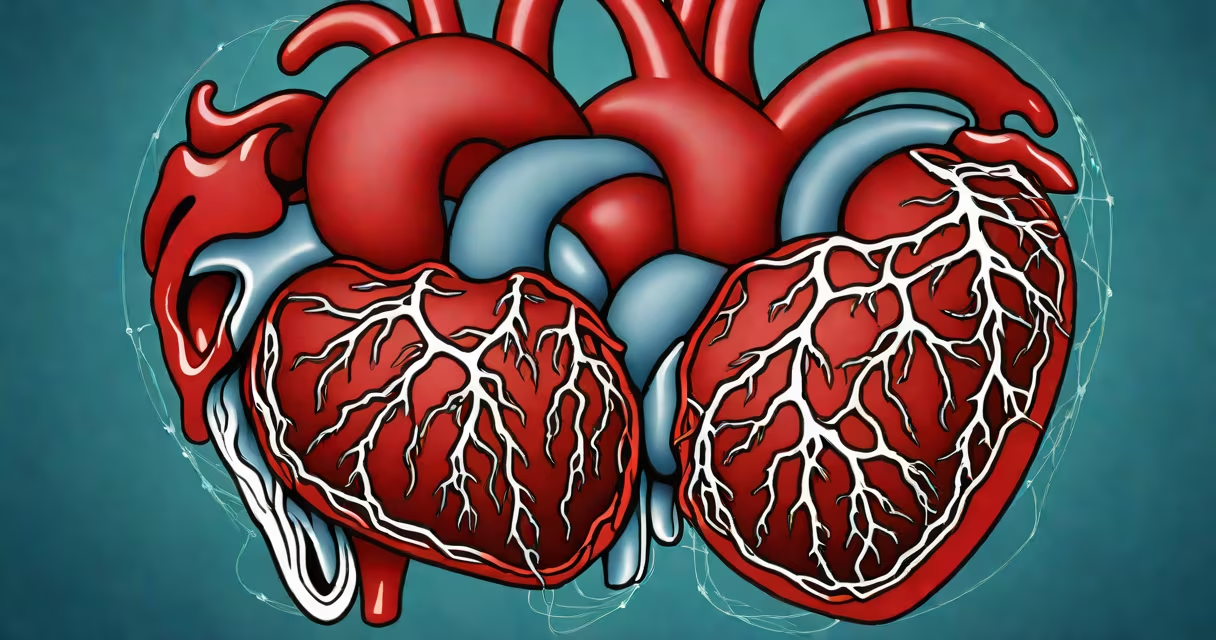
A heart murmur is an abnormal sound heard during a heartbeat, caused by turbulent blood flow through the heart's chambers or valves. Not all murmurs indicate disease-some are harmless (innocent), while others signal underlying heart conditions that require medical attention.
Heart murmurs are detected during a physical exam using a stethoscope. The sound results from blood moving too quickly or abnormally through the heart. While many murmurs are benign, certain types carry risks tied to structural abnormalities, infections, or progressive heart damage. Identifying whether a murmur is innocent or pathological is critical to determining clinical risk.
Blood normally flows smoothly through the heart's four chambers and four valves. When blood moves too fast, the valves don't close completely, or there's a hole between chambers, turbulence occurs. This turbulence creates vibrations audible as a murmur.
Murmurs are graded on a scale from I to VI based on loudness and intensity. A grade I is faint and hard to hear; a grade VI is very loud and may be felt through the chest wall. However, loudness doesn't always correlate with severity-some life-threatening conditions produce soft murmurs.
For example, a patient with aortic stenosis-a narrowing of the aortic valve-may have a grade IV murmur heard best at the right upper sternal border. This condition increases the risk of sudden cardiac death, especially in older adults with calcified valves.
Heart murmurs fall into two broad categories: innocent (functional) and pathological (organic). Innocent murmurs are common in children and young adults and typically disappear with time. Pathological murmurs stem from structural heart problems and carry measurable health risks.
| Type | Common Causes | Risk Level | Typical Findings |
|---|---|---|---|
| Innocent | Normal blood flow in healthy hearts | Low | Faint, systolic, no radiation |
| Pathological | Valve stenosis, regurgitation, septal defects | High | Loud, radiates to neck, associated with symptoms |
One often overlooked distinction is that murmurs due to anemia or hyperthyroidism are functional but still increase cardiac workload. These are not structural defects, yet they raise the risk of heart failure over time. For instance, a patient with untreated hyperthyroidism may develop a high-output murmur due to increased blood volume and cardiac output.
Not all murmurs lead to complications, but certain patterns suggest significant risk. Murmurs that worsen with exertion, cause fatigue, dizziness, or chest pain should prompt further evaluation. The American Heart Association notes that untreated severe aortic stenosis reduces life expectancy to less than five years after symptom onset.
Another red flag is a murmur accompanied by cyanosis (bluish skin), especially in infants. This may indicate a congenital defect such as tetralogy of Fallot-a combination of four heart anomalies including a ventricular septal defect. Without surgical repair, survival past infancy is rare.
During my time as a cardiology fellow, I saw a 62-year-old man with a long-standing systolic murmur who dismissed it as "just aging." He presented with syncope and was later diagnosed with severe aortic stenosis. His ejection fraction dropped to 35%, and he required valve replacement. This case underscores that murmurs aren't always silent-they can silently progress to life-threatening events.
When a murmur is detected, doctors use echocardiography to visualize heart structure and function. Transthoracic echocardiograms (TTE) are standard first-line tests. They measure valve motion, chamber size, and blood flow velocity.
If the initial echo is inconclusive, transesophageal echocardiography (TEE) provides higher-resolution images, especially useful for detecting small vegetations in infective endocarditis. The presence of a vegetation increases the risk of embolic stroke by 15% per year, according to the European Society of Cardiology guidelines.
Patients with known murmurs should undergo regular follow-up. The frequency depends on the diagnosis: those with mild mitral regurgitation may be monitored every 1-2 years, while patients with moderate-to-severe aortic stenosis require annual assessment.
Many people assume all murmurs are dangerous. That's false. Up to 50% of murmurs in children are innocent and resolve by adolescence. Similarly, some adults develop murmurs with age due to valve thickening-this is not necessarily pathology.
Another misconception is that murmurs always cause symptoms. In reality, many remain asymptomatic until significant damage occurs. A study published in *Circulation* found that nearly 40% of patients with severe aortic stenosis had no symptoms at diagnosis, highlighting the need for routine screening in at-risk populations.
It's also incorrect to equate a murmur's loudness with its danger. A grade III murmur from a small patent ductus arteriosus (PDA) can be more clinically significant than a louder innocent murmur. Always rely on imaging, not auscultation alone.
Seek immediate evaluation if a murmur is new, changes in quality, or appears with:
These signs may indicate progression toward heart failure or arrhythmia. Early intervention improves outcomes. For example, patients with symptomatic aortic stenosis who receive timely valve replacement have a 90% survival rate at five years, compared to 50% if surgery is delayed.
Understanding heart murmur risks begins with knowing that not all murmurs are equal. Some are normal variants; others are warning signs of serious disease. The key is accurate diagnosis, not alarm.