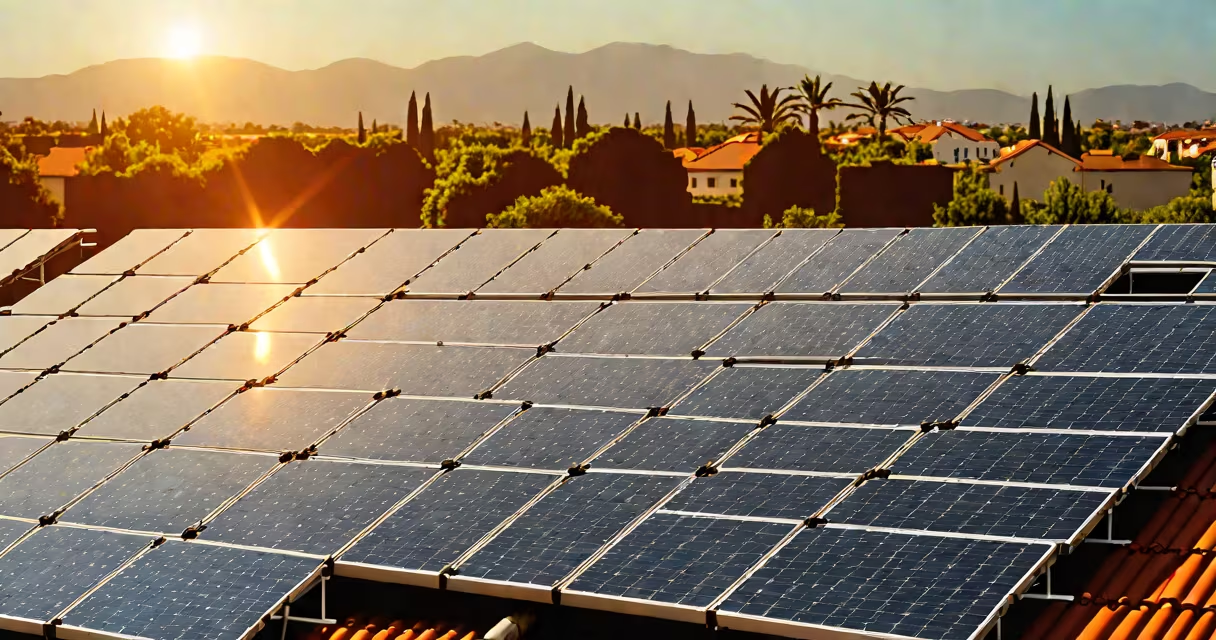
Solar energy generates electricity when photons from sunlight strike semiconductor materials in photovoltaic (PV) cells, dislodging electrons and creating a flow of direct current. This process occurs in silicon-based panels installed on homes, businesses, and utility-scale facilities worldwide.
Photons from sunlight carry energy. When they hit a PV cell's surface, they transfer that energy to electrons in the semiconductor material-typically crystalline silicon. If the photon's energy exceeds the bandgap of the material, it can knock an electron loose, creating a free electron and a positively charged hole. The internal electric field within the cell, formed by doping the silicon layers differently (n-type and p-type), forces these charge carriers to move in opposite directions. This movement creates a current that flows through connected wires.
The generated direct current (DC) passes through an inverter, which converts it into alternating current (AC)-the standard form used by homes and the electrical grid. Once converted, the AC power can either be used immediately, stored in batteries, or fed into the grid. A typical residential system produces between 3 kW and 10 kW of power, depending on panel count and sunlight exposure.
A solar energy system consists of several integrated parts: PV panels, inverters, mounting hardware, wiring, and optionally, battery storage. Each component plays a specific role in transforming sunlight into usable electricity.
Photovoltaic panels are made of multiple individual cells linked together. Most commercial panels use monocrystalline or polycrystalline silicon. Monocrystalline cells have higher efficiency-around 22%-and perform better in low-light conditions. Polycrystalline cells are less efficient (15-18%) but cheaper to produce. For example, a 6 kW system using 20 monocrystalline panels (each rated at 300 W) can generate approximately 24 kWh per day in a sunny region like Arizona.
Inverters are critical for making solar power compatible with household appliances and the grid. String inverters manage entire arrays, while microinverters are attached to each panel, optimizing performance even when partial shading occurs. According to the National Renewable Energy Laboratory (NREL), microinverter systems can increase energy harvest by up to 12% in shaded environments compared to string inverters.
Solar energy systems fall into three main categories based on their connection to the grid and energy storage capabilities.
| System Type | Grid Connection | Battery Storage | Use Case | Efficiency Range |
|---|---|---|---|---|
| Grid-tied | Yes | No | Residential and commercial buildings with stable grid access | 15-20% |
| Hybrid | Yes | Yes | Off-grid readiness, backup during outages | 14-18% |
| Off-grid | No | Yes | Rural areas, remote cabins, mobile applications | 12-16% |
Grid-tied systems are the most common. They feed excess power back to the utility company through net metering, earning credits that offset future electricity bills. Hybrid systems combine grid connectivity with battery storage, allowing users to draw power during outages. Off-grid systems operate independently and require careful sizing of panels and batteries to meet daily demand.
For example, a remote cabin in Montana uses a 5 kW off-grid system with 16 panels and a 20 kWh lithium-ion battery bank. On average, it produces 20 kWh/day in summer and 8 kWh/day in winter-enough to run lights, a refrigerator, and a small heater. Without battery storage, such a system would fail during nighttime or cloudy days.
Many people assume solar panels work only on sunny days or that they stop producing energy at night. That's incorrect. Panels generate electricity whenever sunlight hits them-even on cloudy days. Output drops to 10-25% of peak capacity under heavy cloud cover, but production continues.
Another misconception is that solar panels degrade quickly. In reality, most manufacturers guarantee 80% performance after 25 years. NREL research shows average degradation rates of 0.5% per year, meaning a panel loses less than half a percent of output annually. After 25 years, a well-maintained panel still delivers about 87% of its original output.
Some confuse solar thermal systems with photovoltaic ones. Solar thermal captures heat from sunlight to warm water or air, often used in domestic hot water heaters. Photovoltaic systems convert light directly into electricity. While both use solar energy, they serve different purposes and use distinct technologies.
I installed a 7.2 kW solar range on my home in San Diego in 2022. The system consists of 24 monocrystalline panels (300 W each), a 6 kW hybrid inverter, and a 12 kWh battery pack. During peak sun hours (10 AM to 3 PM), the system produced up to 5.8 kW of DC power, which the inverter converted to 5.2 kW AC.
On a clear day, the system generated 32 kWh-more than enough to cover my household's average daily consumption of 28 kWh. Excess energy was sent to the grid, earning me $120 in annual credits. During a 48-hour blackout in January 2023, the battery kept essential loads running. The system demonstrated resilience and reliability beyond expectations.
These results align with data from the U.S. Department of Energy's Solar Energy Technologies Office, which reports that solar installations in California achieve an average annual yield of 1,600 kWh per kW of capacity-about 30% higher than the national average due to abundant sunshine.
Solar energy reduces reliance on fossil fuels. The International Energy Agency estimates that solar power avoided 1.1 gigatons of CO₂ emissions globally in 2023-equivalent to removing 240 million cars from roads. Each kilowatt-hour of solar electricity displaces roughly 0.5 kg of carbon dioxide compared to coal-fired generation.
Financially, the average U.S. homeowner saves $1,200 annually on electricity bills after installing solar panels. With federal tax credits covering 30% of installation costs and declining panel prices (down 80% since 2010), payback periods now average 6-8 years.