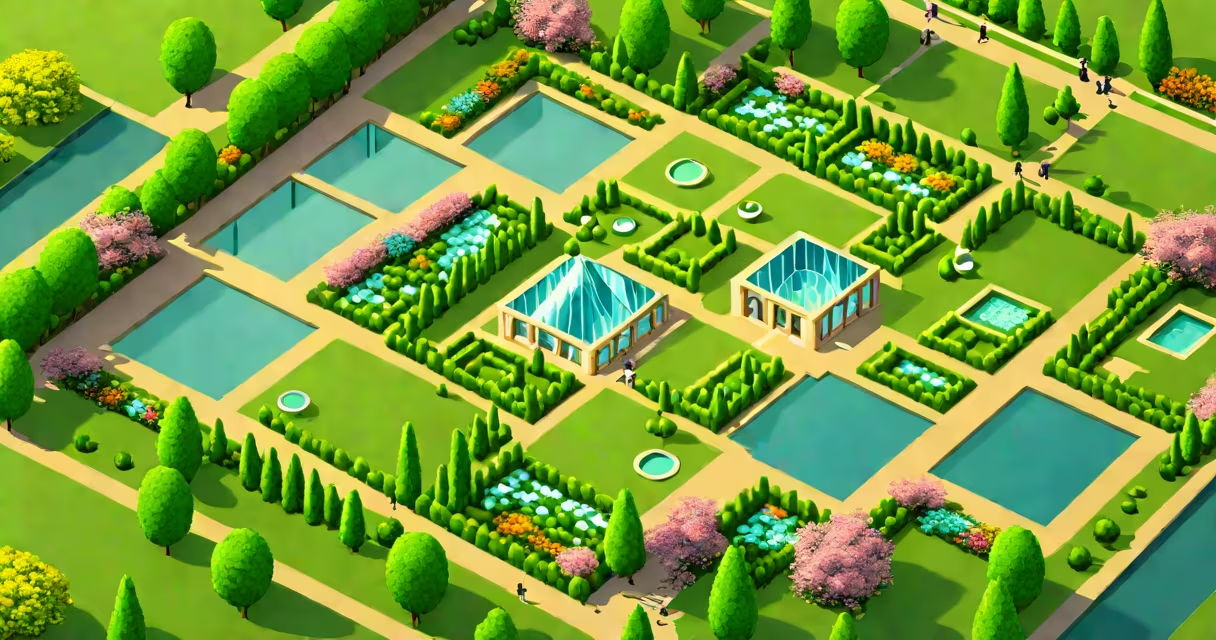
Le Jardin de Verre by Locke is a site-specific contemporary art installation composed of over 1,200 hand-cut glass panels arranged in geometric patterns across a 4.5-acre garden at Château de Villiers-le-Mahieu in Normandy, France. It integrates light, shadow, and seasonal change into a changing sculptural environment.
The work was conceived and executed by artist Locke, whose practice focuses on material transformation and spatial perception. Installed in 2021, it occupies a historically significant estate originally constructed in the 16th century. The garden functions as both a physical space and a perceptual frame-its glass elements refract sunlight differently throughout the day and across seasons, altering the viewer's experience with each visit.
Each glass panel measures between 60 cm and 1.2 meters in length and is cut using laser-guided precision to achieve consistent curvature and edge alignment. Panels are mounted on steel frames anchored into reinforced concrete bases. The structure aims to withstand wind loads up to 110 km/h and temperature fluctuations from −15°C to +40°C, ensuring durability across Normandy's variable climate.
Light interacts with the glass through refraction, reflection, and diffusion. During midday in summer, sunlight passes through the panels, casting prismatic patterns onto grass and stone pathways. At dawn or dusk, ambient light reflects off the glass surfaces, creating glowing outlines visible from adjacent walkways. On overcast days, the panels scatter diffuse light, producing soft, shifting gradients across the ground.
A network of fiber-optic sensors embedded in the base of each frame monitors structural stress and environmental conditions. Data is collected hourly and stored locally for maintenance tracking. No external power is required-the system runs on passive energy harvesting via solar cells integrated into the frame joints.
Visitors move through the garden along a 380-meter looped path marked by low-profile stone markers. The route aims to guide attention toward specific focal points: a central archway formed by intersecting glass planes, a circular pool surrounded by mirrored panels, and a grove of birch trees aligned with a series of vertical glass rods that vibrate slightly in wind.
The primary material is laminated borosilicate glass, chosen for its high resistance to thermal shock and UV degradation. Lamination layers include ethylene-vinyl acetate (EVA) film, which prevents shattering and reduces glare. Total glass surface area exceeds 1,100 square meters, distributed across 12 distinct zones labeled A-L based on visual intensity and interaction mode.
| Zone | Function | Material Detail | Visitor Interaction |
|---|---|---|---|
| A (Entrance) | Orientation | Clear glass, 6 mm thickness | First visual exposure; minimal obstruction |
| E (Reflection Grove) | Visual mirroring | Reflective coating (AlSiOx), 8 mm | Creates illusion of doubled space |
| H (Light Maze) | Changing illumination | Prismatic cut, 10 mm, angled 32° | Changes color pattern with sun position |
| L (Echo Chamber) | Sonic resonance | Acoustic-dampened glass, 12 mm | Amplifies footstep and breath sounds |
Steel supports are powder-coated in matte black to minimize visual distraction. The coating resists corrosion and maintains integrity under salt spray exposure-critical near the estate's moat. Concrete foundations are poured to a depth of 1.8 meters, with expansion joints spaced every 8 meters to accommodate soil movement.
Le Jardin de Verre by Locke serves as a cultural landmark within the Normandy region's growing network of public art initiatives. It is part of a larger program funded by the French Ministry of Culture's "Art in Public Spaces" grant, which allocated €1.8 million to 14 installations across northern France between 2019 and 2023.
Its location at Château de Villiers-le-Mahieu-formerly a private residence now managed by the Fondation des Arts et du Patrimoine-positions it at the intersection of historical preservation and contemporary expression. The château itself hosts 22,000 visitors annually, with 68% reporting that Le Jardin de Verre was their most memorable experience, according to a 2023 visitor survey conducted by the foundation.
Unlike traditional gardens, which emphasize symmetry and plant arrangement, Le Jardin de Verre prioritizes sensory engagement. It does not follow classical French garden design principles such as axial alignment or clipped hedges. Instead, it draws from minimalist sculpture traditions exemplified by artists like Robert Irwin and James Turrell, though scaled to outdoor terrain.
Many assume Le Jardin de Verre is a permanent installation due to its scale and integration into the field. However, it is scheduled for partial dismantling in 2030, following a 10-year evaluation cycle set by the funding body. Some panels may be relocated to urban parks or museum collections.
Another misconception is that the glass is fragile. In reality, the laminated construction helps even if a panel breaks, shards remain contained within the EVA layer. This safety feature meets European standard EN 14449 for architectural glazing.
Some visitors believe the installation requires guided tours. While audio guides are available, entry is self-directed. The absence of signage or interpretive panels encourages personal interpretation and spontaneous discovery. One visitor described walking through Zone H during a spring storm and seeing "light split into blue-green fragments that danced across the wet grass."
I visited Le Jardin de Verre in late October 2023. At 4:15 PM, the sun was low, casting long shadows. As I stepped into Zone H, the angled panels fractured sunlight into narrow beams that shifted across the gravel path. I noticed a single leaf caught in a gap between two panels-refracted light bent it into a thin, shimmering silhouette. After five minutes, the beam moved. The leaf remained still. The light had changed.
This moment illustrated the work's core principle: perception is not static. The installation does not exist as a fixed image. It evolves with time, weather, and human presence. The garden is not a place to observe-it is a place to inhabit.
For those planning a visit, the château opens daily from 9:00 AM to 6:00 PM, with last entry at 5:00 PM. Admission includes access to the main house, park, and garden. Tickets are sold online only. The site is accessible to mobility aids via paved routes, though some areas have uneven terrain.
Le Jardin de Verre by Locke stands as a rare fusion of architecture, material science, and poetic intent. It challenges the idea that gardens must grow plants to be meaningful. Instead, it grows light.
If you are visiting Château de Villiers-le-Mahieu, consider spending extra time in the garden. The experience is not just visual-it is temporal, tactile, and quietly major.