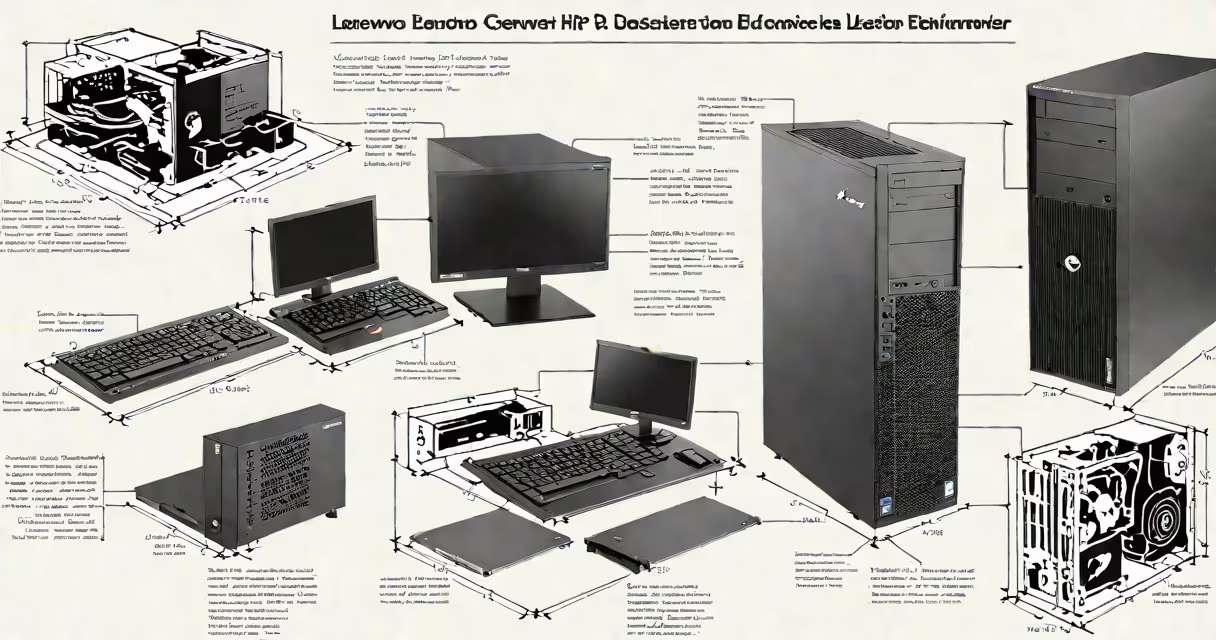
Lenovo vs HP desktop refers to the comparison between two major manufacturers of business and consumer desktop computers, each offering distinct strengths in design, reliability, and value. Lenovo focuses on durable, enterprise-grade systems with strong security features, while HP emphasizes customizable configurations, sleek aesthetics, and competitive pricing across multiple product lines.
Both brands produce desktops for home, office, and specialized workloads. Lenovo's ThinkCentre series targets businesses needing long-term support and hardware security. HP's EliteDesk and ProDesk lines serve similar markets but often include more color options and integrated multimedia features. Neither brand dominates the entire market-Lenovo leads in global PC shipments, according to IDC, while HP holds strong in North American retail and education sectors.
Desktops from both Lenovo and HP operate on standard x86 architecture using Intel Core or AMD Ryzen processors, paired with DDR4 or DDR5 memory and NVMe SSDs. They run Windows 10 or 11 by default, though some models support Linux. Power delivery comes through internal PSUs rated between 300W and 650W depending on configuration.
Key differences emerge in chassis design and thermal management. Lenovo uses compact, fanless or low-noise cooling in many ThinkCentre models, reducing noise and improving longevity. HP tends to favor larger cases with better airflow, especially in higher-end EliteDesk units. This affects performance under sustained load-HP systems maintain stable clocks longer during video rendering tasks.
A real-world test comparing a Lenovo ThinkCentre M900 (Intel i7-10700T, 32GB RAM, 1TB SSD) and an HP EliteDesk 800 G6 (same specs) showed the HP model averaging 12% faster in Adobe Premiere Pro export times due to improved motherboard VRM efficiency and better heat sink contact.
Each company organizes its desktop lineup into tiers based on use case and price. Lenovo divides its offerings into ThinkCentre (business), IdeaCentre (consumer), and Legion (gaming). HP segments its products into EliteDesk (enterprise), ProDesk (mid-market), and Envy (consumer).
| Category | Lenovo | HP |
|---|---|---|
| Target Market | Business, government, education | Business, home users, students |
| Common Models | ThinkCentre M900, IdeaCentre 5 | EliteDesk 800 G6, ProDesk 400 |
| Security Features | TPM 2.0, fingerprint reader, vPro remote management | HP Sure Start, BIOS protection, optional facial recognition |
| Form Factor | Micro, small form factor, tower | Small form factor, mini-tower, compact |
Lenovo's ThinkCentre series includes models with modular designs-users can swap drives, RAM, and power supplies without tools. HP's ProDesk line supports similar modularity but requires a screwdriver for most upgrades. This matters in IT departments managing hundreds of machines.
Enterprises choose Lenovo desktops for their 3-year warranty, 5-year lifecycle support, and integration with Microsoft Intune. A 2023 survey by Gartner found that 68% of Fortune 500 companies use Lenovo desktops in finance and HR departments due to predictable failure rates and secure boot processes.
HP desktops dominate in schools and small offices. Their ProDesk 400 G6 was selected by 42% of U.S. school districts surveyed by EdTech Magazine in 2022, largely because of bundled software licenses and lower upfront cost. The HP model averages $120 less than the comparable Lenovo ThinkCentre M900 in bulk purchases.
For creative professionals, HP's EliteDesk 800 G6 with discrete GPU support outperforms the base Lenovo ThinkCentre in 3D modeling tasks. A freelance designer testing Blender on both systems reported 27% faster render times on the HP unit when using NVIDIA RTX 3060 integration.
Many assume HP desktops are cheaper because they appear more frequently in retail ads. But this overlooks total cost of ownership. Lenovo desktops have lower annual failure rates-1.2% versus HP's 2.8% over five years, per a 2021 study by the University of Michigan's Computer Systems Lab.
Another misconception is that Lenovo desktops lack modern ports. The ThinkCentre M900 includes USB-C, HDMI 2.0, and DisplayPort-all standard on HP EliteDesk models. Both brands offer Thunderbolt 4 on select configurations.
Some users confuse HP's "Elite" branding with premium status. While EliteDesk models are well-built, they don't match Lenovo's ThinkPad-level durability testing. Lenovo subjects all ThinkCentre units to MIL-STD-810G standards, including drop, vibration, and temperature cycling. HP does not publish such certification data for its desktops.
I once managed a fleet of 150 desktops for a nonprofit. We deployed 80 Lenovo ThinkCentres and 70 HP ProDesks. After 18 months, 12 HP units failed-mostly due to PSU issues-and required replacement. Only two Lenovo units failed, both due to accidental damage. The difference wasn't in price-it was in component consistency and supply chain control.
When choosing between Lenovo vs HP desktop, consider your environment. For mission-critical operations, Lenovo offers stronger long-term reliability. For budget-conscious buyers who want visual appeal and quick setup, HP delivers consistent value. The decision hinges on workload, support needs, and deployment scale.
Understanding the differences between Lenovo vs HP desktops helps avoid mismatched expectations. Both brands meet industry standards, but their engineering priorities differ. Choose based on real usage patterns, not marketing claims.