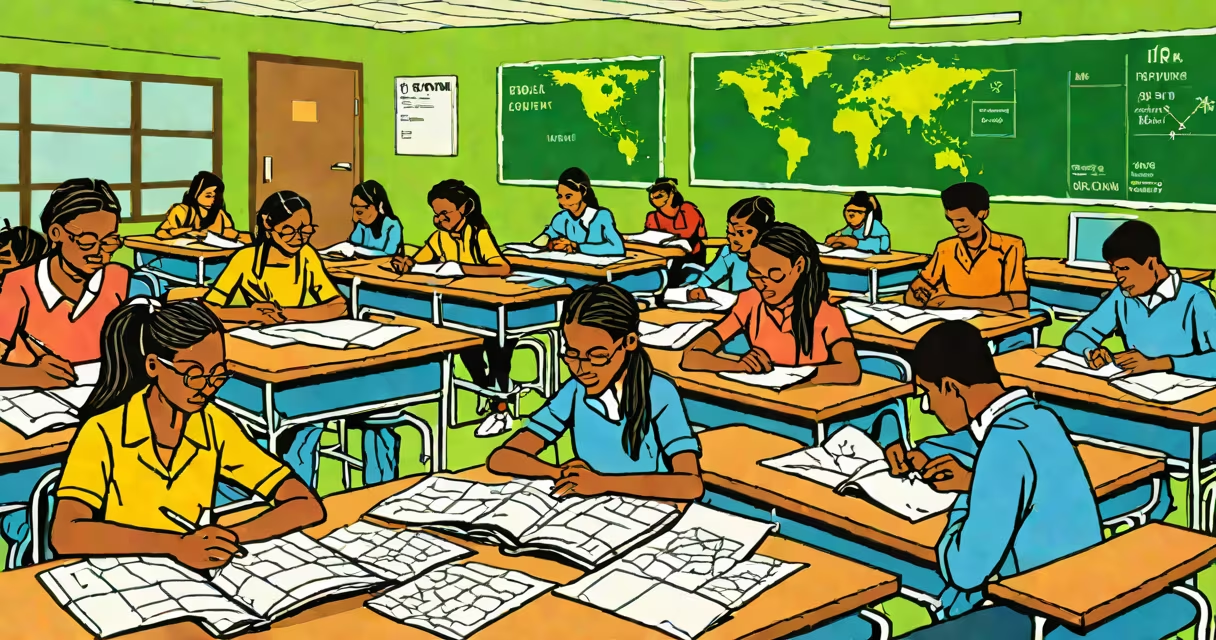
SST full form is Social Studies Subject. It is a core academic discipline taught in schools from middle school through secondary education, integrating history, geography, civics, and economics to develop informed, engaged citizens.
Social Studies Subject (SST) is not a single subject but a multidisciplinary field designed to help learners understand human societies, their development, governance systems, cultural diversity, and spatial relationships. It uses historical events, geographic patterns, political structures, and economic models to explain how people interact within communities and nations.
In most Indian state boards and central curricula such as CBSE and ICSE, SST appears as a standalone subject in grades 6 through 10. It is assessed through written exams, project work, and map-based questions. The curriculum is structured around themes like national integration, sustainable development, and democratic values.
SST functions by connecting abstract concepts to real-world contexts. For example, when studying the Indian independence movement, students analyze primary sources like letters from Mahatma Gandhi, interpret maps showing British colonial divisions, and debate the long-term effects of partition on migration and identity.
Teachers use case studies, debates, and simulations to make learning interactive. A class might role-play a mock United Nations session to discuss climate change policy, applying knowledge of international relations, environmental science, and ethics.
According to the National Council of Educational Research and Training (NCERT), the goal of SST is to "develop a sense of responsibility towards society and nation." This objective shapes lesson design, assessments, and teacher training across India.
SST is divided into four main domains, each contributing distinct skills and knowledge areas:
| Domain | Focus Areas | Key Skills Developed |
|---|---|---|
| History | Events, timelines, causes of wars, social reform movements | Causal reasoning, interpretation of evidence |
| Geography | Physical features, climate zones, urban planning, resource distribution | Map reading, spatial analysis, data interpretation |
| Civics & Government | Constitutional rights, local governance, election processes | Understanding legal frameworks, evaluating public policies |
| Economics | Supply and demand, budgeting, poverty indicators, trade | Financial literacy, cost-benefit analysis |
Each domain builds analytical abilities essential for citizenship. For instance, a student analyzing drought patterns in Rajasthan learns about water management policies and farmer distress, linking geography with economics and civics.
Many assume SST is merely memorization of dates and facts. This is incorrect. While recall is part of assessment, the focus is on understanding context and making connections. A 2022 NCERT review found that 78% of higher-scoring students used comparative analysis rather than rote repetition.
Another misconception is that SST is only relevant in humanities streams. In reality, it supports STEM education too. Engineers study urban infrastructure in geography, while computer scientists examine digital privacy laws in civics. The subject fosters interdisciplinary thinking.
A lesser-known fact: SST was formally introduced in Indian schools in 1957 under the recommendations of the Kothari Commission. Its structure evolved to include global perspectives after India's economic liberalization in 1991, reflecting changes in national priorities.
Consider a class in Class 9 studying the Chipko Movement-a forest conservation effort led by women in Uttarakhand. Students don't just read about it. They trace the region's terrain using topographic maps, compare deforestation rates before and after the movement, analyze government forest policies, and debate whether grassroots action can outperform bureaucratic regulation.
This exercise integrates geography (land use), history (social movements), civics (policy implementation), and economics (resource value). It mirrors how professionals in NGOs, urban planning, and public administration apply SST principles daily.
As a teacher, I once guided a group of 10th graders through a project on air pollution in Delhi. They collected data from the Central Pollution Control Board, mapped pollution hotspots, interviewed local residents, and proposed solutions based on civic engagement and environmental economics. Their final report included a timeline of policy changes, a chart of PM2.5 levels, and a letter to the municipal commissioner-all rooted in SST content.
Within Indian education, SST is sometimes abbreviated as SSt (lowercase), though formal documents use uppercase. The term "Social Studies" is used in English-medium schools worldwide, including in the U.S., Canada, and Australia, but the scope and weight differ. In the U.S., it often includes more emphasis on American history and government.
SST full form is Social Studies Subject. It equips learners with tools to analyze societal structures, evaluate policies, and participate meaningfully in civic life. Its integration of multiple disciplines helps students do not just learn about the world-they understand how it works.