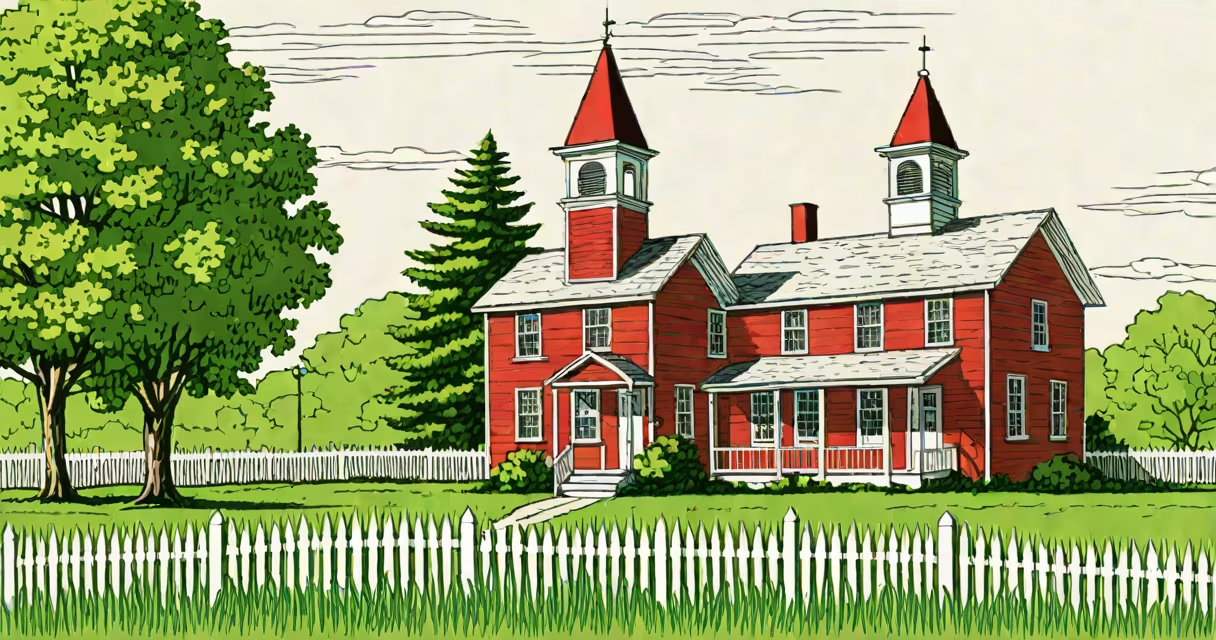
The little red school house is a symbolic representation of early American rural education, typically depicted as a small, single-room wooden building painted red, often with a central bell tower. It emerged in the 19th century as a practical solution for remote communities needing access to basic literacy and arithmetic instruction. This image persists in literature, art, and national memory, though few such buildings survive in their original form.
These structures were usually constructed from local timber, with minimal insulation and no indoor plumbing. Classes were taught by a single teacher who managed students of all ages, often using a slate board and textbooks passed between desks. Attendance varied with seasonal work demands-children might attend only during spring and fall, missing winter months due to snow and cold.
Despite its widespread cultural presence, the "little red school house" was rarely red in reality. Most were unpainted wood or gray-stained. The red color became iconic through later illustrations and songs, especially the 1916 song "The Little Red School House," which romanticized rural learning. The visual trope gained traction in the 20th century through children's books and educational films.
One-room schoolhouses operated on a decentralized model. A single teacher instructed students from grades one through eight in a single classroom. Lessons were delivered in shifts based on grade level, with older students helping younger ones. Reading, writing, and arithmetic were core subjects, supplemented by geography, history, and moral instruction drawn from religious texts.
Attendance records from 1880 show that average daily attendance in rural districts ranged from 40% to 60%. Many children walked miles each way to school, often carrying their own lunch and books in cloth bags. Winter sessions were shorter due to fuel shortages and poor heating systems. Some schools closed entirely during harsh weather, relying on community volunteers to deliver lessons via mail or home visits.
A 1904 report from the U.S. Bureau of Education noted that 75% of American schoolchildren attended one-room schools before 1920. By 1950, that number dropped to less than 5%, as consolidation and urbanization led to larger, centralized schools. Still, remnants remain: over 1,200 one-room schoolhouses are listed on the National Register of Historic Places.
While the image of a red building with a bell tower dominates popular imagination, actual schoolhouses varied widely by region and available materials.
| Region | Common Materials | Distinct Features |
|---|---|---|
| Midwest (e.g., Iowa, Illinois) | Wood frame, clapboard siding | Large windows for daylight, stoves for heat |
| Appalachia (e.g., West Virginia) | Log construction, stone foundation | Often built into hillsides for insulation |
| Prairie states (e.g., Kansas) | Brick, sometimes tile roofs | Used locally fired bricks; fewer windows |
| New England (e.g., Vermont) | Hand-hewn timber, shingle roof | High-pitched roofs to shed snow; small classrooms |
Some schools used repurposed barns or cabins. In Texas, schoolhouses were sometimes built from adobe or corrugated metal due to limited timber. The size of classrooms averaged 12 feet by 16 feet-small enough to fit 20 students and a teacher's desk, but large enough to allow movement during lessons.
The term "little red school house" is frequently conflated with the "Little Red Hen" story-a fable about cooperation and effort. While both share the word "red" and appear in children's literature, they are unrelated. The "Little Red Hen Story" dates to the 18th century and centers on a bird who bakes bread only after others refuse to help. It is not tied to any specific school or educational institution.
The idea that these schools were uniformly underfunded is inaccurate. Some were well-supported by local churches and farmer cooperatives. In Wisconsin, a 1890 survey showed that 30% of one-room schools received funding from private donations and land trusts. The state legislature also allocated $1.2 million annually for rural education by 1900-equivalent to nearly $40 million today.
Located in rural Minnesota, the Oak Hill Schoolhouse was built in 1889 using logs from nearby forests. It measured 18 feet by 24 feet and seated 24 students. The teacher, Mary Thompson, taught from 1890 to 1905. Her daily routine included:
Students brought their own slates and chalk. The school lacked electricity until 1925. Despite this, test scores from 1895 show that 87% of students passed the state reading exam. The school closed in 1942 due to declining enrollment and was restored in 1998 as a museum.
The little red school house remains a useful cultural symbol. It appears in 37 U.S. state flags or emblems, including Pennsylvania and Indiana. The image is used in civic events, school district logos, and public art. In 2021, the National Trust for Historic Preservation launched a campaign to preserve 50 remaining one-room schoolhouses, citing their role in shaping American democratic values.
Modern educators reference the concept when discussing equity in education. A 2022 study by the Center for American Progress found that 42% of rural school districts still operate with fewer than 10 teachers per 1,000 students-echoing the one-teacher model of the past. The term is also used metaphorically to describe under-resourced institutions, particularly in debates about school funding and student outcomes.