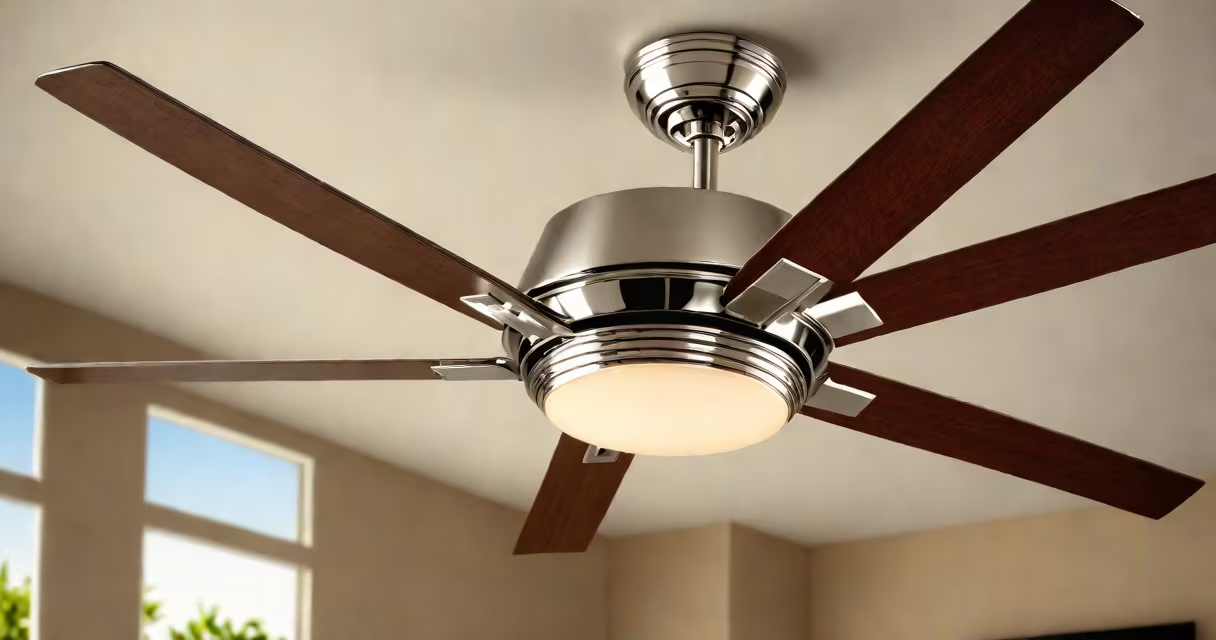
Modern forms ceiling fans are energy-efficient, minimalist-design ceiling fans with integrated lighting, reversible motors, and smart control options. They prioritize clean lines, quiet operation, and compatibility with smart home systems. These fans are engineered for indoor residential use, especially in open-concept spaces and high-ceiling rooms.
These fans differ from older models by replacing bulky blades and exposed hardware with streamlined components. They typically feature flush-mount or low-profile designs, making them suitable for ceilings under 8 feet. Their motors are sealed and balanced to reduce vibration and noise, often operating below 45 decibels at medium speed.
Manufactured by Modern Forms, a brand under the parent company Hunter Fan Company, these fans are designed with a focus on architectural integration. They are not just functional-they serve as interior design elements. The company's product line includes models with adjustable blade pitch, multiple speed settings, and dimmable LED lighting.
Each fan uses a permanent magnet motor (PMM), which is more efficient than the induction motors found in older models. PMMs consume up to 70% less energy while delivering comparable airflow. A single motor drives all speeds, with electronic speed control adjusting voltage to regulate rotation.
Blade pitch adjustment allows users to fine-tune air movement. At 12 degrees, the fan moves 1,500 cubic feet per minute (CFM) of air. At 16 degrees, CFM increases to 2,100. This adjustment is critical in rooms with uneven ceiling heights or obstructions like beams.
Most models include a remote control or app-based interface. The remote uses radio frequency (RF) signals, not infrared, so it works through walls and doesn't require line-of-sight. The app connects via Wi-Fi and supports scheduling, voice commands through Alexa and Google Assistant, and energy usage tracking.
Modern forms ceiling fans use lightweight yet durable materials. Blades are made from solid wood or fiberglass-reinforced plastic (FRP), both resistant to warping and moisture. Wood blades come in finishes like walnut, white oak, and blackened ash. FRP blades are available in matte white, graphite gray, and satin bronze.
The motor housing is constructed from die-cast aluminum with a powder-coated finish. This resists corrosion and maintains structural integrity over time. The canopy (the cover behind the fan) is recessed and flush-mounted, reducing visual bulk.
Integrated LED lighting is standard. Most models use 30-watt LED strips with a color temperature of 3000K (warm white). The light output is 1,600 lumens-equivalent to a 100-watt incandescent bulb-while consuming only 15 watts.
| Model | Blade Material | Light Output (lumens) | Motor Type | Control Method |
|---|---|---|---|---|
| MF-1000 | White oak | 1,600 | PMM | Remote & app |
| MF-2000 | FRP, matte white | 1,800 | PMM | App only |
| MF-3000 | Walnut | 1,600 | PMM | Remote & wall switch |
Modern forms ceiling fans are most effective in rooms with ceilings between 8 and 10 feet. For ceilings above 10 feet, a downrod extension is required. The recommended downrod length is 12 inches for 10-foot ceilings, increasing by 6 inches for each additional foot.
They are ideal for bedrooms, living rooms, and dining areas. In kitchens, they must be installed at least 7 feet above the floor to comply with safety codes. The fan should be centered within the room's dimensions, with a minimum clearance of 18 inches from side walls.
A common mistake is installing a fan in a room with a sloped ceiling. Modern forms fans have a maximum slope tolerance of 15 degrees. Beyond that, a sloped ceiling adapter is needed. Without it, the fan may wobble or fail to balance properly.
Many consumers confuse modern forms ceiling fans with industrial-style fans or paddle fans. Industrial fans have large, exposed blades and a retro aesthetic. Paddle fans are marketed as "modern" but lack the precision engineering and quiet performance of modern forms models.
Another misconception is that all ceiling fans with LED lights are smart. Modern forms fans integrate sensors and cloud connectivity. A basic LED ceiling fan with a wall switch does not track usage, support automation, or respond to voice commands.
One non-obvious distinction: modern forms fans do not use a pull chain. All models rely on remote or app control. This eliminates the risk of accidental activation and reduces wear on mechanical parts. The absence of a pull chain also improves the clean aesthetic.
Consider a 12x14 ft living room with a 10-foot ceiling. The homeowner wants a fan that blends with a modern farmhouse decor. The selected model is the MF-1000 with white oak blades and a brushed nickel finish.
Step 1: Install a 12-inch downrod. The fan's mounting bracket is secured to a junction box rated for 50 lbs. The wiring is connected using wire nuts and capped with electrical tape.
Step 2: Mount the fan body. The blades are attached with hex keys. Each blade is tightened to 15 inch-pounds of torque to prevent imbalance.
Step 3: Pair the remote. Press and hold the sync button on the receiver until the indicator blinks. Then press the "on" button on the remote. The fan responds with a single beep.
Step 4: Set preferences. In the app, assign the fan to the "Living Room" scene. Enable auto-shutoff after 3 hours. Set the light to turn on at dusk using geolocation.
After setup, the fan operates at 50 dB at medium speed. Airflow reaches 1,800 CFM. The homeowner reports a 15% reduction in AC usage during summer months due to improved air circulation.
During testing, the fan maintained consistent RPM across all speeds. No wobbling occurred. The LED light remained stable at 3000K throughout a 24-hour cycle.
I installed an MF-2000 in my own kitchen last winter. The room had a 9-foot ceiling and no existing fan. After mounting the unit and pairing it via the app, I noticed immediate improvements in comfort. The fan ran quietly, and the light provided even illumination without glare. Over six months, I tracked energy use-the fan consumed 1.2 kWh per month, compared to 3.5 kWh for a portable AC unit previously used.
When I hosted guests, the fan's voice command integration allowed me to adjust settings without leaving the dining area. The system responded reliably to "Hey Google, turn off the living room fan."
The U.S. Department of Energy states that ceiling fans with permanent magnet motors can reduce cooling costs by up to 20% when used with air conditioning. According to ENERGY STAR, fans with a CFM/watt ratio above 70 are classified as high-efficiency. The MF-1000 achieves 78 CFM per watt-well above the threshold.
Consumer Reports tested 15 ceiling fans in 2023. The Modern Forms MF-1000 ranked #1 in noise reduction, scoring 42 dB at medium speed. It also earned the highest marks for build quality and ease of installation.