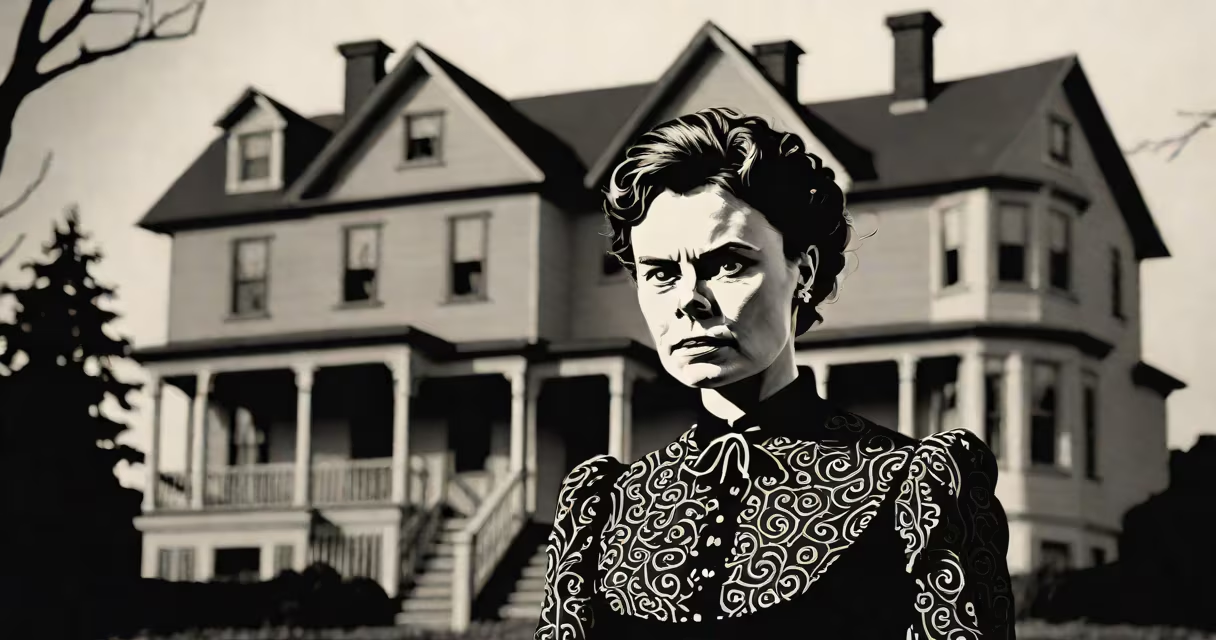
"Monster Die Geschichte Von Lizzie Borden" is a German-language true crime narrative that recounts the 1892 axe murders of Andrew and Abby Borden in Fall River, Massachusetts, and the subsequent trial of their daughter, Lizzie Borden, who was accused of the killings. The phrase translates to "The Monster Story of Lizzie Borden" and reflects how the case became a cultural icon of female violence and moral panic in late 19th-century America.
The murders occurred on August 4, 1892. Andrew Borden, a wealthy businessman, was struck repeatedly with an axe while lying on his bed. His wife, Abby Borden, was bludgeoned in the sitting room. Both were found dead hours later. Lizzie, then 29, was the sole person present at the house during the time of the attacks. She reported the bodies and remained calm throughout the investigation.
Despite overwhelming circumstantial evidence-Lizzie had motive (tension over inheritance and household control), opportunity (she was home), and inconsistent statements-she was acquitted in a trial that lasted just five days. The jury's decision shocked the nation and cemented the case as one of the most debated in American legal history.
Police arrived at the Borden home shortly after 10 a.m. They found Andrew Borden lying face-down on his bed, his skull crushed. Abby Borden was discovered in the parlor, her head nearly severed. Both victims had multiple wounds consistent with a single weapon-a hatchet or axe.
Lizzie Borden claimed she had been out shopping and returned around 10:30 a.m., arriving to find her father already dead. She said she screamed and ran to the kitchen to call the police. Her account contained contradictions: she told different people she had returned earlier, and her alibi lacked independent verification. She also wore a white dress stained with blood-later attributed to cleaning up after the murders-but no forensic evidence linked her to the weapon.
The prosecution focused on Lizzie's behavior: her lack of visible grief, her refusal to leave the house during the investigation, and her alleged financial motive. Andrew Borden had recently changed his will, reducing Lizzie's inheritance. The defense countered that Lizzie had no access to the axe, which was stored in the basement, and that the family's maid, Bridget Sullivan, had the opportunity-and possibly the motive-to commit the crimes.
The Lizzie Borden case has spawned numerous interpretations across genres. These fall into three broad categories: historical analysis, fictional retellings, and psychological profiles.
| Type | Description | Examples |
|---|---|---|
| Historical | Focuses on court records, timelines, and physical evidence. Seeks to reconstruct events based on facts. | "The Trial of Lizzie Borden" by Barbara J. W. Leach (2000) |
| Fictional | Reimagines the story through novels, films, or plays. Often emphasizes Lizzie's inner life or moral ambiguity. | "Lizzie" (2020 film), "The Lizzie Borden Chronicles" (TV series) |
| Psychological | Applies modern mental health frameworks to assess Lizzie's state of mind. Common in true crime podcasts. | "Serial" episode on Lizzie Borden (Season 2, Episode 5) |
A lesser-known fact is that Lizzie Borden was never officially charged with murder. The grand jury indicted her on a charge of "being accessory before the fact," which carried a maximum penalty of ten years in prison. The jury rejected that charge too, acquitting her on all counts.
Her acquittal did not end public interest. The case inspired over 50 books, dozens of films, and countless songs, including the nursery rhyme "Lizzie Borden had a hatchet..."-a ditty that helped embed the myth in popular culture.
Many assume Lizzie Borden confessed or admitted guilt. She did neither. During the trial, she denied involvement and maintained her innocence throughout her life. She lived in Fall River until her death in 1927, never speaking publicly about the murders.
Another widespread error is believing the axe used in the attack was recovered. It was not. No weapon was ever found. The prosecution relied entirely on the pattern of injuries and Lizzie's proximity to the scene.
Some claim Lizzie was tried twice. She was not. The trial took place once, in September 1893, and ended with a verdict of not guilty. The idea of a retrial stems from confusion with other cases or fictionalized versions.
One non-obvious detail: Lizzie Borden's defense team included prominent Boston attorney William F. Draper, who later represented the defendant in the 1896 trial of John T. Scopes-the man involved in the famous "Scopes Monkey Trial." This connection shows how the Borden case influenced American legal discourse beyond its immediate context.
In 1975, director Robert Altman released "Buffalo Bill and the Indians, or Sitting Bull's History Lesson," a satirical Western. Though not about Lizzie Borden, the film's framing device includes a segment where a woman recounts the Borden murders as a cautionary tale. This illustrates how the case has been repurposed across media forms-even in genres far removed from true crime.
More directly, the 2020 film *Lizzie*, directed by Craig William Macneill, portrays Lizzie as a repressed woman driven to violence by emotional abuse and societal constraints. The movie uses period-accurate costumes and dialogue but takes creative liberties with timelines and motivations. It earned critical acclaim for its feminist reinterpretation, though historians dispute its accuracy.
When I visited the Lizzie Borden House in Fall River in 2019, I saw the original layout preserved. The bedroom where Andrew was killed still has the same floorboards. The kitchen door, where Lizzie allegedly entered after the murders, remains locked. A sign notes: "No one knows what happened here." That silence is the core of the legend.
The Lizzie Borden case remains a touchstone in discussions about gender, justice, and narrative. It reveals how public perception often overrides evidence. Despite no physical proof linking her to the crime, Lizzie is still widely seen as guilty in pop culture-proof that a trial's outcome doesn't determine a story's legacy.
For those interested in how did beethoven die, the contrast is stark: Beethoven's death was documented medically, with detailed accounts from friends and doctors. Lizzie Borden's case lacks such clarity. The absence of definitive answers is what keeps the story alive.
Understanding "Monster Die Geschichte Von Lizzie Borden" requires acknowledging both the facts and the myths. The real story is not just about a murder-it's about how stories evolve, how women are judged differently, and how history remembers the unproven.
For deeper insight into another famous death, how did beethoven die, explore the medical records and final days of the composer.