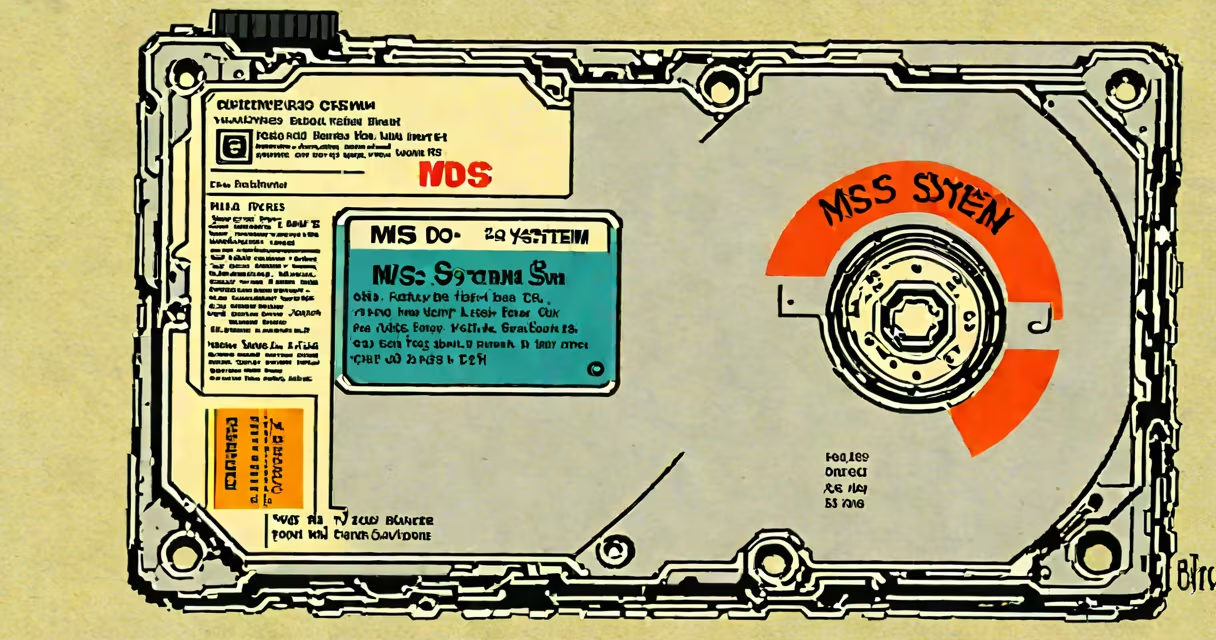
The ms dos floppy disk is a 3.5-inch magnetic storage medium used to boot MS-DOS operating systems, store programs, and transfer data between computers in the 1980s and early 1990s. It held up to 720 KB or 1.44 MB of data depending on formatting and was essential for system installation and software distribution.
These disks were physically rigid, encased in a hard plastic shell with a sliding metal shield. Inside, a flexible magnetic disk spun at 300 RPM while a read/write head accessed data through a small window. A single-sided version stored 360 KB; double-sided models reached 720 KB. High-density versions, introduced in 1986, supported 1.44 MB-the standard for most MS-DOS systems.
When inserted into a drive, the computer's BIOS detected the disk and loaded the Master Boot Record (MBR) from the first sector. If the disk contained a valid boot sector, the system executed the bootstrap loader, which then loaded the core DOS kernel from the disk's root directory. This process enabled standalone execution of the operating system without needing a hard drive.
Each ms dos floppy disk uses a single-sided or double-sided format with 80 tracks and 9 sectors per track. Data is written in concentric circles called tracks, subdivided into sectors. The file allocation table (FAT) resides in the first few sectors and maps clusters-groups of sectors-to files.
For example, a 1.44 MB disk has 80 tracks × 2 sides × 9 sectors × 512 bytes = 737,280 bytes available. After accounting for FAT, directory entries, and system overhead, usable space drops to around 1.2 MB. Files larger than a cluster are split across multiple clusters, linked via the FAT.
Bootability depends on correct structure. A bootable disk must have a valid boot sector at LBA 0 (logical block address 0), containing executable code and a jump instruction to the kernel loader. Without this, the system cannot start from the disk-even if it contains a working copy of COMMAND.COM.
Three primary formats existed:
| Format | Capacity | Use Case | Drive Requirement |
|---|---|---|---|
| Single-sided, 360 KB | 360 KB | Early IBM PC/XT systems | 5.25-inch drive |
| Double-sided, 720 KB | 720 KB | IBM PC/AT, early compatibles | 3.5-inch drive |
| High-density, 1.44 MB | 1.44 MB | Standard for MS-DOS 5.0+, Windows 3.1 | 3.5-inch high-density drive |
Some systems used dual-density drives capable of reading both 720 KB and 1.44 MB disks. However, formatting a disk to 1.44 MB required specific commands like FORMAT A: /S in DOS, which wrote the FAT and boot record.
A common mistake is assuming all 3.5-inch disks are compatible. Early 3.5-inch drives used 720 KB disks; later ones required high-density formatting. Inserting a 720 KB disk into a high-density drive results in readable data-but attempting to write 1.44 MB data fails due to mismatched sector density.
Many assume ms dos floppy disks were interchangeable across all machines. In reality, compatibility varied by controller chip. The NEC μPD765 was widely used in IBM PC compatibles, but some clones used different timing or signal levels, leading to read errors.
Another misconception: that floppy disks could store complex applications. A typical MS-DOS game like *Doom* (1993) required 440 MB-over 300 floppy disks. Distribution used multiple disks, with users switching them during installation. The *Doom* installer included a disk-swapping prompt: "Insert Disk 2 and press Enter."
I once spent 45 minutes installing MS-DOS 6.22 on a 1991 Compaq Presario using five disks. The setup program required switching disks after each phase. The process failed twice due to misaligned disk heads-corrected only after cleaning the drive with a lint-free cloth and alcohol. The lesson: physical wear matters. Floppy drives degrade faster than the media itself.
According to the Computer History Museum, over 100 million 3.5-inch floppy disks were produced annually in the late 1990s. By 2005, production had declined to under 10 million. The last major manufacturer, Sony, discontinued production in 2011.
Today, some industrial systems still rely on floppy-based boot mechanisms. In 2020, a German railway control system used 3.5-inch floppies for firmware updates. When a critical bug emerged, engineers patched it by creating a custom boot disk with updated drivers-a solution viable only because the system still accepted the old format.
Understanding the ms dos floppy disk clarifies how early computing relied on physical media. Its design shaped software distribution, system boot processes, and user interaction patterns. Even now, the concept lives on in modern tools like dd for Linux, which can write raw disk images to USB drives using the same sector-by-sector logic.