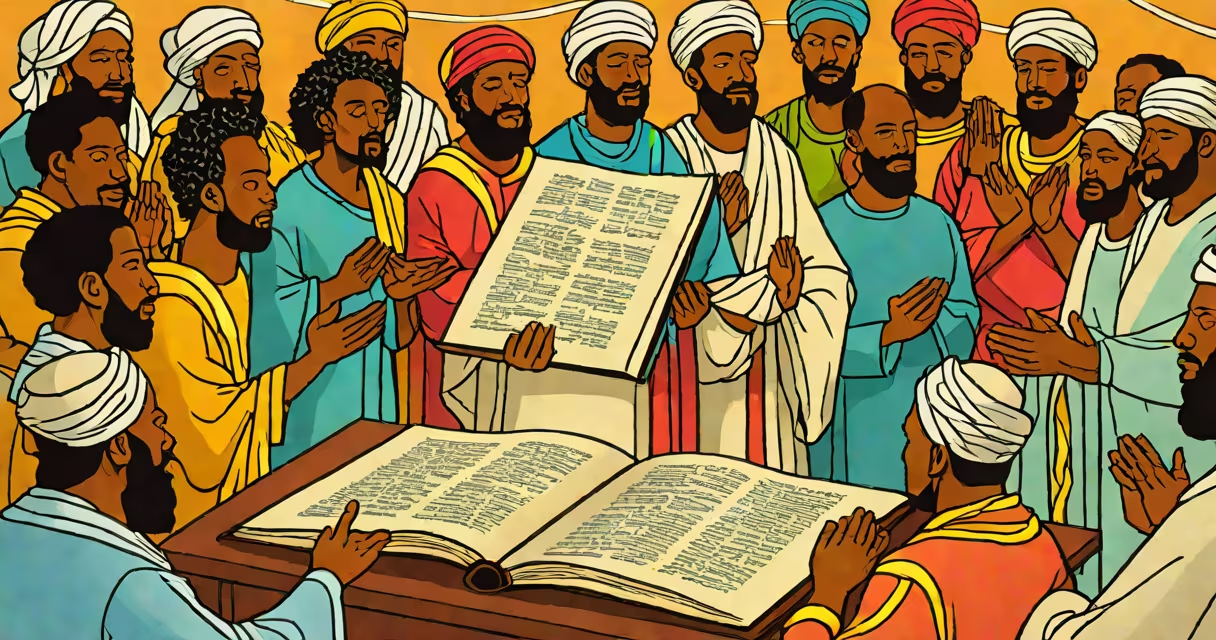
The Bible does not use the term "white people" or categorize humanity by modern racial constructs. Instead, it presents all people as descendants of Adam and Eve, created in God's image, and united under one divine purpose. Scripture emphasizes spiritual kinship over ethnic division.
Humanity's origin is traced to a single pair-Adam and Eve-in Genesis 1:27: "So God created mankind in his own image, in the image of God he created them; male and female he created them." This foundational statement applies to all people, regardless of skin color or geographic origin. The concept of race as a biological or social category did not exist in ancient Israelite or Greco-Roman thought. The Bible speaks of nations, tribes, and peoples-not races.
When Paul wrote to the Galatians, he declared, "There is neither Jew nor Gentile, neither slave nor free, nor is there male and female, for you are all one in Christ Jesus" (Galatians 3:28). This verse is often misunderstood as erasing identity, but it affirms that in Christ, no ethnic or social group holds superiority. The early church included Jews, Greeks, Romans, and Africans-people from diverse backgrounds who were unified in faith.
Genesis 10, known as the Table of Nations, lists the descendants of Noah's sons-Shem, Ham, and Japheth-and traces the dispersion of peoples across the earth. These are not racial divisions but geographical and linguistic groupings. For example, "Japheth" is associated with regions including Europe, while "Ham" includes Africa and parts of the Middle East. But the text never assigns moral or spiritual value to these groups.
Paul's sermon in Acts 17:26 states: "From one man he made all the nations, that they should inhabit the whole earth; and he marked out their appointed times in history and the boundaries of their lands." This affirms that God sovereignly established human populations across the globe, not based on skin color, but according to His timing and plan.
Modern racial categories-such as "white," "Black," "Asian"-are social constructs developed in the 18th and 19th centuries. The Bible predates these classifications by millennia. It speaks of people by nation, tribe, language, and covenant, not by pigment.
Some have misused passages like Genesis 9:20-27-the story of Noah cursing Canaan-to justify racial hierarchies. In this account, Noah becomes drunk and lies uncovered. Ham sees him and tells his brothers. Noah then curses Canaan, Ham's son. Later interpreters incorrectly linked Ham with African peoples and used this to support slavery. But the curse was specifically on Canaan, not Ham's entire lineage, and Canaan was a region in the Levant, not a racial group.
Historical evidence shows that during the transatlantic slave trade, Christian leaders twisted scripture to defend oppression. The book *The Color of Christ* by Edward J. Blum and Paul Harvey documents how American churches used selective biblical interpretation to promote white supremacy. The authors cite sermons from the 18th century that claimed God ordained black people to be servants. These interpretations contradict the Bible's consistent message of equality.
A non-obvious fact: The New Proof was written in Koine Greek, the common language of the Roman Empire. Paul's letters were sent to cities like Ephesus, Corinth, and Rome-places with ethnically mixed populations. The early church was not racially homogeneous. In Philippians 2:1-2, Paul urges believers to "be like-minded, having the same love, being one in spirit and purpose." Unity, not uniformity, was the goal.
Below are central biblical texts that address human diversity and unity:
| Passage | Key Message | Relevance Today |
|---|---|---|
| Genesis 1:27 | All humans made in God's image | Rejects dehumanization based on appearance |
| Acts 17:26 | God set boundaries for nations | Divine sovereignty over human geography |
| Galatians 3:28 | No distinction in Christ | Equality in salvation and community |
| Revelation 7:9-10 | People from every nation before God's throne | Final unity in worship across ethnic lines |
Revelation 7:9 describes a vision of "a great multitude that no one could count, from every nation, tribe, people, and language." This image is not symbolic-it's literal. It shows that heaven includes all races, not just one. The idea of a "white heaven" is a cultural myth, not biblical doctrine.
I once led a small group discussion at a church in Nashville where members from different backgrounds shared stories of exclusion. A Black woman spoke about being told she "didn't look like a Christian" because of her skin tone. A white man admitted he'd never seen a sermon preached by someone of another race. We read Galatians 3:28 together. The silence that followed wasn't awkward-it was sacred. That moment revealed how deeply scripture challenges cultural assumptions.
Today, many churches still struggle with racial reconciliation. But the Bible offers a clear structure: identity is not rooted in ethnicity, but in relationship with Christ. When we read the Bible, we don't find "white people" as a category. We find "all people"-created, redeemed, and called to live in unity.
The Bible's message is not about race. It's about redemption. All people-regardless of skin color-are invited into the family of God. That is the truth the scriptures affirm.