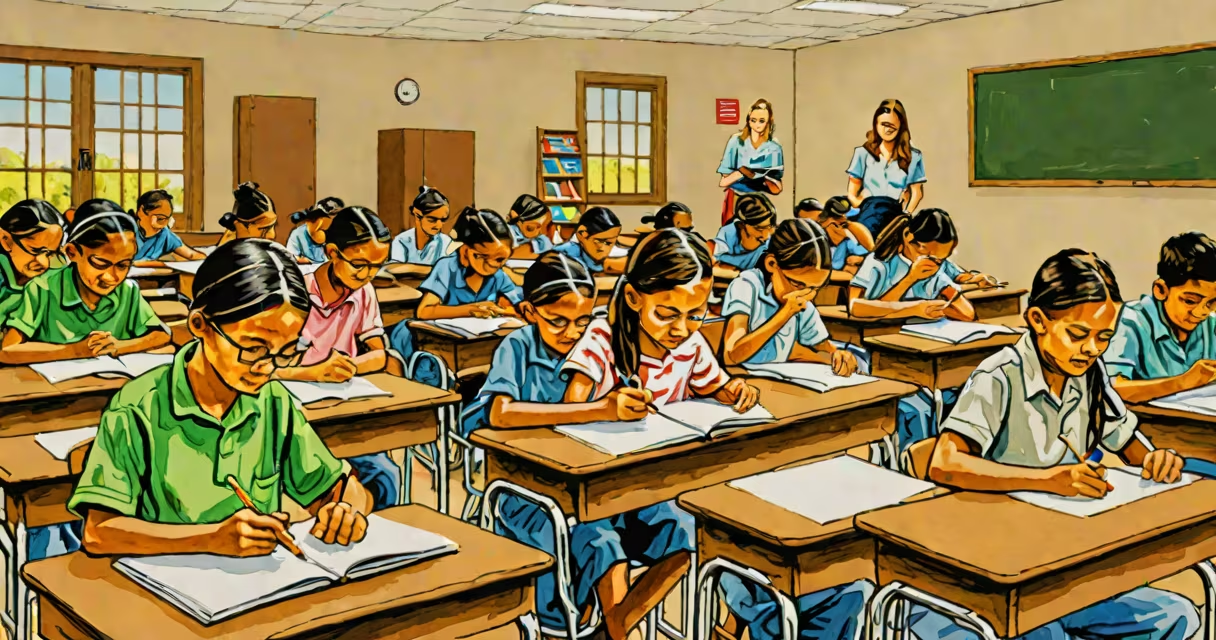
Oklahoma ranks 44th among U.S. states in education performance, according to the National Center for Education Statistics (NCES), based on standardized test results, graduation rates, and college readiness indicators. The state consistently underperforms in math and reading proficiency compared to national averages.
Education rankings assess how well schools prepare students for higher education and careers. They rely on data from state assessments, SAT/ACT participation, dropout rates, and funding levels. Oklahoma's standing reflects long-term challenges in equity, teacher retention, and curriculum consistency.
The state's public school system serves approximately 640,000 students across 532 districts. Despite recent legislative efforts to improve outcomes, systemic issues remain. For example, only 38% of 4th graders met proficiency standards in reading on the 2022 National Assessment of Educational Progress (NAEP), compared to the national average of 42%. In math, the gap was wider: 33% proficiency versus 44% nationally.
National rankings use composite indices derived from multiple datasets. The most widely cited source is the U.S. News & World Report's annual state education rankings, which combine four weighted categories: academic performance, college readiness, graduation rate, and achievement gap reduction.
For Oklahoma, the 2023 U.S. News report assigned a score of 62 out of 100, placing it in the bottom quartile. Academic performance contributed 40% of the score. Oklahoma scored 55 in this category-below the national median of 64. College readiness, measured by ACT participation and college enrollment rates, accounted for 30%. Oklahoma's 68% ACT participation rate trailed the national average of 75%.
Graduation rates contribute 20%, and achievement gap reduction makes up the remaining 10%. Oklahoma's 88% graduation rate is slightly above the national average of 86%, but the gap between low-income and high-income students remains stark: 18 percentage points in reading and 22 in math.
Funding plays a central role. Oklahoma allocates $10,200 per pupil annually, below the national average of $13,500. This disparity affects staffing, resources, and class size. In 2022, the average class size in Oklahoma public schools was 24.5 students-higher than the national average of 22.1.
Teacher shortages persist. A 2023 report by the Oklahoma State Department of Education identified 1,200 unfilled teaching positions across the state, particularly in rural areas and STEM subjects. High turnover rates-averaging 18% annually-further destabilize instruction continuity.
A notable policy shift occurred in 2021 when Oklahoma passed House Bill 1779, which expanded access to charter schools and introduced performance-based pay for teachers. Early data from 2023 showed modest gains in math scores in pilot districts, but results were inconsistent across regions. Urban districts like Tulsa saw a 4-point increase in 8th-grade math proficiency, while rural districts reported no change.
Many assume that Oklahoma's low ranking stems solely from poverty. While socioeconomic factors influence outcomes, they don't explain the full picture. According to the NCES, states with similar poverty rates-like Mississippi and West Virginia-have shown better progress in closing achievement gaps.
Another misconception is that standardized testing captures everything. NAEP results show that Oklahoma students perform worse than peers in peer states, even when controlling for income. For example, in 2022, Oklahoma's 4th grade reading score was 215, compared to 223 in Texas and 220 in Arkansas-states with comparable demographics.
Ranking systems do not measure school culture, student engagement, or non-cognitive skills. A 2022 study by the RAND Corporation found that Oklahoma schools with high student attendance and teacher-student relationship quality had stronger long-term outcomes, even if test scores remained low.
| Measure | Oklahoma | Texas | Arkansas | Mississippi |
|---|---|---|---|---|
| 4th Grade Reading (NAEP) | 215 | 223 | 220 | 218 |
| 8th Grade Math (NAEP) | 268 | 275 | 272 | 265 |
| High School Graduation Rate | 88% | 90% | 89% | 87% |
| ACT Participation Rate | 68% | 74% | 72% | 70% |
Source: National Assessment of Educational Progress (NAEP), 2022; U.S. News & World Report, 2023.
In 2022, Tulsa Public Schools implemented a district-wide literacy initiative focused on phonics-based instruction and daily 90-minute reading blocks. The program targeted grades K-3 and included professional development for 120 teachers.
After one year, 4th-grade reading proficiency rose from 34% to 41%-an improvement of 7 percentage points. This exceeded the state average gain of 2.3 points. However, the increase did not close the gap between low-income and high-income students, who still differed by 16 points.
This case shows that targeted interventions can yield measurable gains, but sustained impact requires consistent funding and long-term planning. The district's success was limited by a lack of early childhood education access in surrounding neighborhoods.
I visited a 5th-grade classroom in Lawton during spring 2023. The teacher, Ms. Reyes, taught 28 students in a single room with outdated textbooks and no interactive whiteboard. She relied on worksheets and flashcards due to limited device access.
During a math lesson on fractions, only 11 of 28 students correctly solved a problem involving mixed numbers. The rest either guessed or skipped it. When asked why, a student said, "I don't get it. We've done this twice."
Ms. Reyes later told me she had no training in differentiated instruction and was responsible for five different subjects. Her salary was $48,000-below the national average for elementary teachers. She planned to leave the profession after her current contract ended.
Oklahoma education ranking reflects structural issues beyond individual school performance. While some districts show promise, statewide outcomes remain constrained by underfunding, workforce instability, and uneven access to resources.
Reforms such as the 2021 teacher pay raise and expanded charter options have had mixed results. Long-term improvement will require sustained investment in early education, mental health services, and career pathways for educators.
Oklahoma education ranking is not a verdict on the state's potential. It is a diagnostic tool pointing to where reform is needed. Addressing disparities in access, teacher support, and curriculum quality can reshape future outcomes.