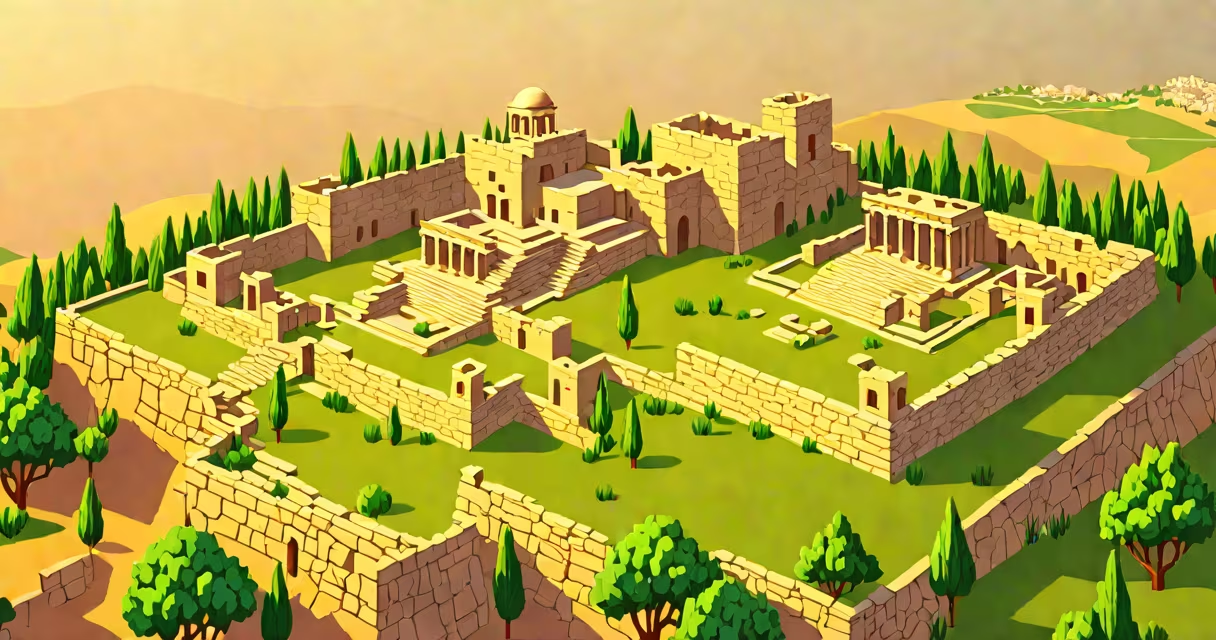
Rama meaning in Bible refers to a town in ancient Israel associated with Rachel's grief and later prophesied deliverance. It appears in the Old Proof as a place of sorrow and hope, most in Jeremiah 31:15, where Rachel weeps for her children, symbolizing exile and eventual restoration.
The name Rama (Hebrew: רָמָה, Rāmāh) derives from a root meaning "to rise" or "elevated." This etymology hints at both physical geography and spiritual elevation. Rama was located in Benjamin, near Bethel and Gibeah, within the tribal territory assigned to Benjamin after the Exodus. Archaeological surveys confirm a site at Tell el-Ful, approximately 6 km north of Jerusalem, consistent with biblical descriptions.
Jeremiah 31:15 records Rachel weeping at Rama for her children, who were taken into exile. The passage uses Rama as a symbolic location for collective mourning. Matthew 2:18 later cites this verse during the Massacre of the Innocents, linking Herod's violence to Rachel's lament-a theological echo of divine sorrow and future redemption.
Rama appears in three distinct contexts: geographic, emotional, and prophetic. As a geographic marker, it served as a landmark in Benjamin's territory. As a narrative device, it represents the pain of separation-especially maternal loss. As a prophetic symbol, it becomes a threshold between despair and hope.
In 1 Samuel 1:1-3, Rama is the home of Elkanah and Hannah, where Hannah prays for a child. Her prayer at the tabernacle in Shiloh is answered with Samuel's birth. Though Rama is not the site of worship, its proximity to sacred centers gives it spiritual weight. The town becomes a stage for personal devotion and divine response.
Matthew 2:18 explicitly references Jeremiah 31:15: "A voice was heard in Ramah, weeping and great mourning, Rachel weeping for her children." This quote frames Jesus' infancy as a fulfillment of prophecy. The Gospel writer positions Jesus' flight to Egypt as a reversal of exile-where Rachel mourned, Mary now protects her son. Rama thus shifts from a place of grief to a symbol of redemptive continuity.
While Rama appears only once in the Gospels, its presence spans multiple genres: historical narrative, poetic lament, and messianic prophecy. The following table outlines key instances:
| Biblical Book | Verse | Context | Meaning |
|---|---|---|---|
| 1 Samuel | 1:1-3 | Hannah's home | Site of personal prayer and divine promise |
| Jeremiah | 31:15 | Lament over exile | Symbol of national mourning; Rachel's grief |
| Matthew | 2:18 | Massacre of innocents | Messianic fulfillment; divine compassion amid suffering |
Each use builds on the prior. Rama begins as a literal place, becomes a metaphor for maternal sorrow, and finally functions as a signpost of God's enduring care.
Many assume Rama is a person, especially due to the name's similarity to Rama, the prince in Hindu epics. But in the Bible, Rama is consistently a place. There is no biblical figure named Rama. The confusion arises from transliteration-"Rama" in Hebrew (רָמָה) differs from "Rama" in Sanskrit (राम).
Another error is treating Rama as a major religious center. Unlike Jerusalem or Bethel, Rama had no temple or permanent priestly function. Its significance lies in narrative resonance, not institutional role. The town's power comes from what happens there-not what stands there.
A lesser-known fact: Rama's location near the border of Benjamin and Ephraim may have made it a cultural crossroads. This positioning could explain why it appears in stories involving both tribes-Hannah's lineage traces to Ephraim through Elkanah, while Benjamin's territory includes Rama. The convergence of tribes adds symbolic depth to the town's role in stories of identity and return.
Matthew 2:18 reads: "A voice was heard in Ramah, weeping and great mourning, Rachel weeping for her children, and she refused to be comforted, because they were no more." This is not a literal event in Rama but a literary and theological citation.
When Joseph flees to Egypt with Jesus and Mary, Matthew draws a direct line from Jeremiah's prophecy to the present. The massacre of infants under Herod's decree echoes the Babylonian exile. Rachel's weeping is not limited to one time-it recurs in moments of national trauma. By quoting Jeremiah, Matthew shows that Jesus' life begins amid divine memory of past pain.
This is not mere storytelling. It reflects a core idea in Jewish and Christian theology: God remembers. The tears of Rachel are not forgotten. They are recalled in the silence of a stable, in the fear of a mother fleeing with her child. Rama becomes a bridge between ancient sorrow and present salvation.
As a reader, I once stood at Tell el-Ful, the site believed to be ancient Rama. The ground was dry, the stones weathered. A single olive tree stood near the remains of a wall. No inscriptions. No statues. Just silence. Yet the weight of the text pressed against the air. I understood then that Rama's power lies not in monuments, but in memory-how a place can hold grief long after the people are gone.
Rama meaning in bible is not a doctrine, nor a ritual. It is a place where longing meets promise. Where loss is remembered, and hope is not extinguished. The name lives not in buildings, but in verses-echoing across centuries, calling us to listen.