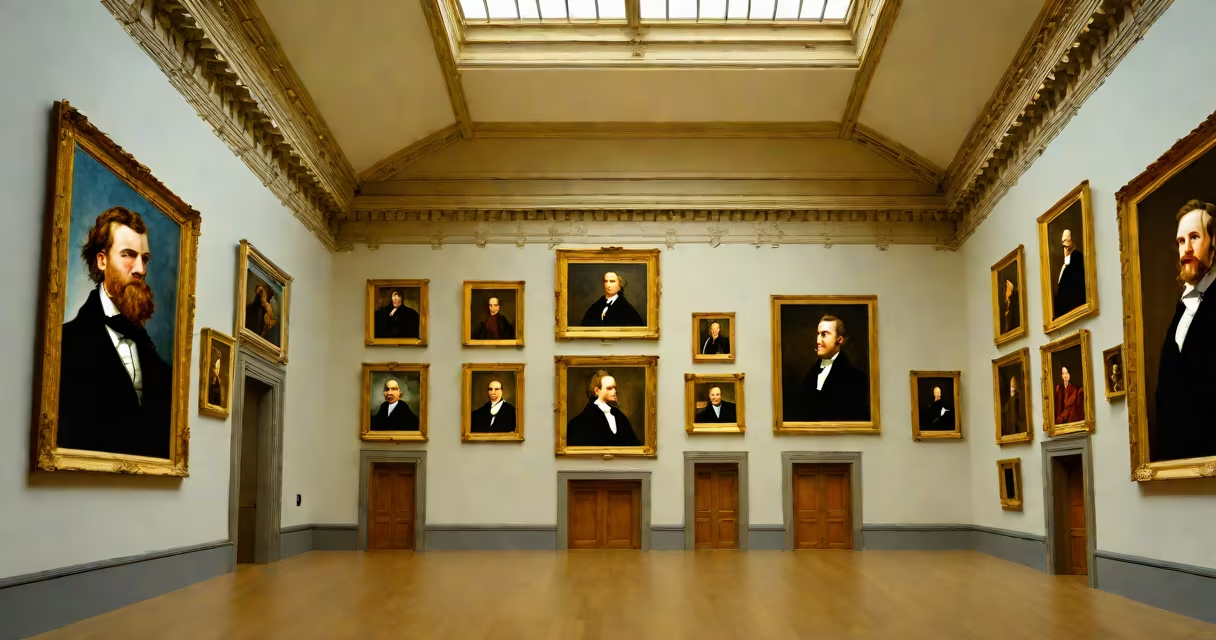
The Scottish National Portrait Gallery is a national museum in Edinburgh dedicated to preserving and displaying portraits of historically significant individuals from Scotland's past and present. Located in the heart of the city's cultural district, it houses over 5,000 portraits spanning from the 16th century to today, including paintings, photographs, and drawings.
Established in 1889, the gallery is part of the National Galleries of Scotland network and occupies a purpose-built Victorian-era building designed by architect Robert Rowand Anderson. Its mission is to document the visual identity of Scotland through portraiture, focusing on figures who shaped the nation's political, artistic, scientific, and social field.
Unlike general art museums, the Scottish National Portrait Gallery centers exclusively on individual representation. It does not display landscapes, still lifes, or abstract works unless they feature a person as the central subject. This focus helps each piece serves as both a historical record and a study in human expression.
The gallery acquires portraits through donations, purchases, and bequests. Major sources include the Scottish government's art acquisition program, private collectors, and institutions like the National Trust for Scotland. Each portrait undergoes conservation and cataloging before being displayed or stored.
Exhibitions rotate seasonally, with thematic shows such as "Women Who Made History" or "Portraits of Power." These often draw from the permanent collection and include newly acquired pieces. For example, in 2022, the gallery unveiled a portrait of climate activist Greta Thunberg by artist David Shrigley, acquired through a public fundraising campaign.
Visitors access the collection via a chronological and thematic layout. The ground floor features early modern portraits-such as those of Mary, Queen of Scots and Robert Burns-while upper levels show 20th-century figures like Ian Rankin and Sir Alex Ferguson. Interactive screens allow users to explore metadata, including birth dates, occupations, and related archival materials.
Portraits in the collection span multiple media and techniques. Oil paintings dominate the 17th-19th century holdings, with works by artists such as Allan Ramsay and Sir Henry Raeburn. Photographs emerge prominently from the 1850s onward, reflecting technological shifts in image-making.
| Type | Examples | Time Period | Notable Artist/Source |
|---|---|---|---|
| Oil painting | Mary, Queen of Scots (c. 1560) | 16th-19th century | Allan Ramsay, National Collection |
| Photograph | Queen Victoria (1860s) | Mid-19th century | Frederick Hollyer, private donation |
| Robert Louis Stevenson (1880) | 19th century | William Notman, Glasgow | |
| Digital portrait | Greta Thunberg (2022) | 21st century | David Shrigley, public acquisition |
A lesser-known fact: the gallery holds a series of 19th-century "chromolithographs"-color prints made using stone-based printing methods. These were mass-produced and widely distributed, offering working-class audiences access to images of national heroes long before photography became common.
The gallery serves as a site for education, cultural preservation, and public engagement. Schools use its online resources for curriculum-aligned lessons on Scottish history. The National Galleries of Scotland provides free downloadable teaching packs, including activities on interpreting facial expressions in 18th-century portraits.
It also functions as a venue for national events. In 2021, during the UK's pandemic-related lockdowns, the gallery launched a virtual exhibition titled "Portraits of Resilience," featuring images of healthcare workers, teachers, and community volunteers. Over 120,000 people viewed it online within the first month.
For researchers, the gallery's archives offer unique insights into how identity was constructed across centuries. A 2020 study published in *The Journal of Visual Culture* analyzed 300 portraits from the 1700s and found that sitters from low-income backgrounds were more likely to be depicted in informal settings-suggesting class influence on visual representation.
Many visitors assume the gallery only displays royal or aristocratic figures. This is incorrect. While portraits of monarchs and nobility are present, the institution actively collects depictions of working people, activists, and marginalized communities. The 2019 exhibition "Everyday Heroes" featured portraits of nurses, engineers, and schoolteachers from rural Scotland.
Another misconception: the gallery is not a repository for all Scottish art. That role belongs to the Scottish National Gallery, located nearby. The Portrait Gallery focuses solely on individuals, not landscapes, genre scenes, or decorative arts.
There's also confusion about ownership. The gallery is publicly funded and operated by the National Galleries of Scotland, a non-departmental public body under the Scottish Government. It does not sell artworks-items in the collection remain in state custody for public access.
Consider the 1560 oil painting of Mary, Queen of Scots, attributed to an unknown artist. The portrait measures 105 cm × 80 cm and depicts her wearing a black velvet dress with gold embroidery, holding a white handkerchief. Her hair is styled in a loose braid, and she gazes directly at the viewer.
Conservation records show the canvas had suffered water damage in the 19th century. In 2018, conservators used infrared reflectography to reveal a hidden underdrawing-a preliminary sketch of her face. This confirmed the work was painted during her lifetime, not posthumously, as previously believed.
Today, the portrait hangs in the Early Modern Gallery, accompanied by a label explaining its significance: "Mary's image was circulated across Europe to assert her claim to the English throne. This portrait reflects both her political ambitions and the gendered expectations placed on female rulers."
I visited the gallery in 2023 and stood before this painting for nearly ten minutes. The eyes seemed to follow me across the room-not because of optical illusion, but because of the way the artist rendered the pupils with subtle highlights. That moment made clear: portraiture is not just about likeness. It's about presence.
The Scottish National Portrait Gallery is not merely a museum-it is a living archive of Scotland's collective memory. Through its curated portraits, it invites viewers to confront history not as a series of facts, but as lived experiences, emotions, and identities. simply seeking beauty, the gallery offers a direct line to the past.