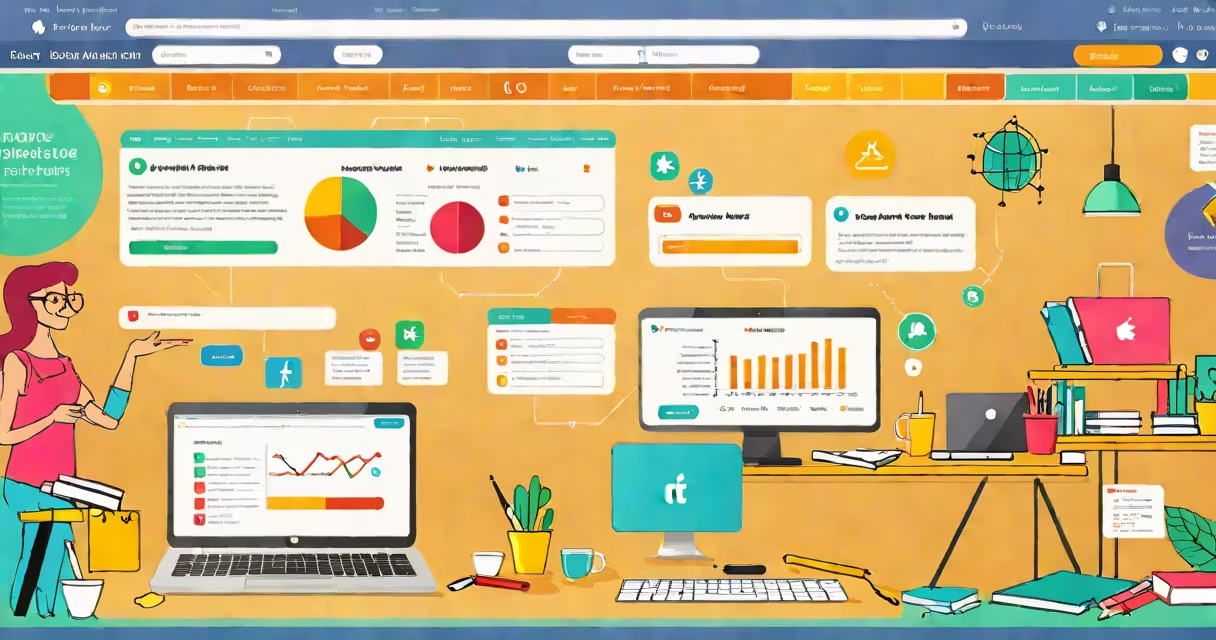
Online learning websites are digital platforms that host educational content delivered via the internet, enabling users to access courses, track progress, and complete assessments remotely. These sites support self-paced or instructor-led instruction across subjects like coding, business, and personal development.
They function by hosting multimedia content-videos, slides, reading materials-alongside interactive tools such as quizzes, discussion forums, and automated grading systems. Users enroll, view content in sequence, and receive feedback or certificates upon completion. Access requires only a device with internet connectivity.
Platforms like Coursera, Khan Academy, and LinkedIn Learning exemplify this model. They offer content developed by universities, corporations, or independent educators. Some charge fees; others are free with optional paid upgrades for credentials.
Content delivery relies on a web server hosting files and a content management system (CMS) organizing them into structured modules. When a user logs in, the platform tracks their progress using a database. Each completed lesson updates their profile and unlocks the next module.
Interactive elements include multiple-choice quizzes with instant feedback, discussion boards moderated by instructors, and downloadable resources like PDFs or code samples. Progress is visualized through dashboards showing completion percentages and time spent per unit.
For example, a user taking a Python course on a site like Codecademy receives a video tutorial on loops, followed by a hands-on coding exercise. After submitting code, the system runs automated tests. Passing triggers a badge and advances the learner to the next topic.
These platforms differ by structure, audience, and content format. The most common categories are:
| Type | Focus | Example | Key Feature |
|---|---|---|---|
| Massive Open Online Courses (MOOCs) | University-level academics | Coursera, edX | Free or low-cost courses with graded assignments; often lead to certificates from accredited institutions. |
| Skills-focused platforms | Job-ready competencies | Udemy, Pluralsight | Short, practical courses on software, design, or IT skills; creators set prices and earn royalties. |
| Corporate training portals | Employee development | Relias online learning, SAP Learning Hub | Custom content for compliance, safety, or internal processes; often integrated with HR systems. |
| Subject-specific academies | Deep expertise in one area | Khan Academy, Brilliant | Free, high-quality instructional videos and problem sets; designed for K-12 and early college learners. |
People often assume all online learning websites are free or lack rigor. That's incorrect. Many charge $50-$200 per course, and some require proctored exams or peer-reviewed projects. A certificate from a reputable provider like Google or IBM carries weight in job markets.
Another confusion is equating online learning with passive video watching. Modern platforms emphasize interactivity. A study by the U.S. Department of Education (2020) found that students in blended learning environments-where online components are paired with live sessions-achieved better outcomes than those in purely face-to-face or fully online settings.
Also, not all content is created equal. A course titled "Master Web Development" may cover basics in 10 hours, while a university-level equivalent spans 16 weeks with assignments, peer reviews, and final projects. Quality varies widely based on the provider's standards.
I once enrolled in a machine learning course on Coursera taught by Andrew Ng. The platform delivered weekly video lectures, followed by Jupyter notebook exercises hosted in the browser. I submitted code solutions, received automated feedback, and earned a shareable certificate after completing eight assignments and a final project.
The course included a discussion forum where learners posted errors and debugged together. One participant shared a bug in a gradient descent algorithm. The community identified a missing transpose operation in the matrix multiplication step. This real-time collaboration improved understanding beyond what videos alone could provide.
Another example is Relias online learning, used by healthcare organizations to train staff on patient safety protocols. The platform delivers HIPAA-compliant modules with scenario-based assessments. Employees must pass each quiz before advancing. Managers track completion rates across departments, ensuring regulatory compliance.
For individuals seeking foundational knowledge, Khan Academy offers free math and science courses with adaptive practice. Its AI-driven system adjusts difficulty based on performance. A user struggling with fractions gets simpler problems until mastery is demonstrated.
They democratize access to education. According to UNESCO (2022), over 1 billion people globally participated in online learning during the pandemic. Platforms enabled continuity in schooling and workforce training when physical classrooms closed.
They also support lifelong learning. Adults returning to education or switching careers rely on flexible, affordable options. A 2021 report by the National Bureau of Economic Research found that adults who completed online certifications were 15% more likely to change jobs or advance within their field.
When choosing a platform, evaluate accreditation, instructor credentials, and user reviews. Look for features like offline access, mobile apps, and progress syncing across devices. Always verify whether a certificate is recognized by employers or academic institutions.
Online learning websites are not a substitute for classroom education, but a useful alternative or supplement. Their effectiveness depends on structure, interactivity, and alignment with user goals. Whether mastering Python, earning a certification, or staying safe online, the right platform makes a measurable difference.