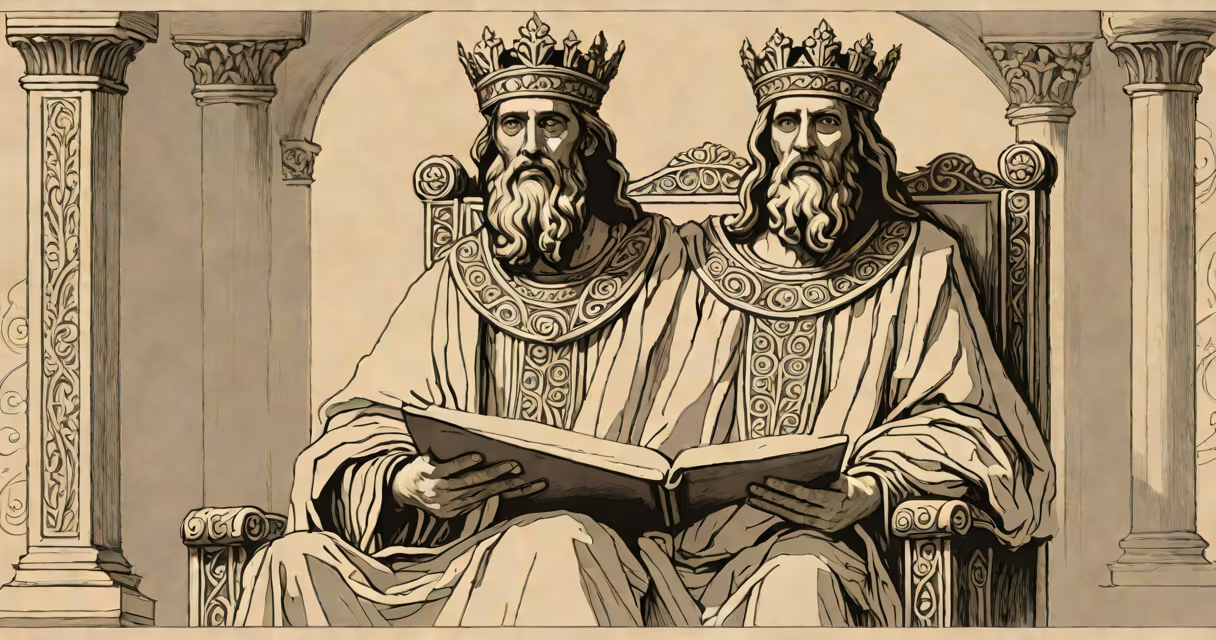
When King Solomon became ruler of Israel after his father David, he asked God for wisdom to govern justly. This moment, recorded in 1 Kings 3:5-14, defines his reign and sets a precedent for seeking divine insight over power or wealth.
Solomon's request occurred at Gibeon, where God appeared to him in a dream. Instead of asking for long life, riches, or military victory, Solomon asked for "an understanding heart" to judge God's people. He recognized his inadequacy: "I am only a child," he said, "and do not know how to go out or come in." God was pleased and granted him extraordinary wisdom, along with wealth and honor.
This event is foundational in biblical literature. The Book of Proverbs opens with "The fear of the Lord is the beginning of wisdom," a principle Solomon embodied. His reputation for wisdom spread far beyond Israel-foreign kings traveled to hear his judgments, and his proverbs became a lasting legacy.
The narrative in 1 Kings 3:5-14 details the sequence: God appears to Solomon at Gibeon, offering him anything he desires. Solomon responds not with personal gain but with a focus on public service. He asks for "an understanding heart to judge your people" and to distinguish between good and evil.
God responded directly: "Because you have asked for wisdom... I grant you a wise and understanding heart." He added that Solomon would have more than he requested-"riches, honor, and long life"-but only because he did not ask for those things first. This moment illustrates that God values humility and moral responsibility over material ambition.
Historical context matters. Solomon succeeded David, who had ruled for 40 years and left behind a unified kingdom. Solomon's immediate choice to seek wisdom rather than consolidate power shows a deliberate break from dynastic patterns seen in surrounding nations. While Pharaohs and Assyrian kings demanded tribute and worship, Solomon prioritized justice and peace.
Wisdom in the Hebrew Bible is not merely intellectual ability-it is practical judgment rooted in reverence for God. Proverbs 1:7 states: "The fear of the Lord is the beginning of wisdom." Solomon's request aligns with this principle: he didn't want cleverness; he wanted the capacity to make fair decisions based on divine truth.
His later actions reflect this. In the famous judgment of the two women claiming the same baby, Solomon proposed dividing the child. The true mother revealed herself by begging for the child's life, showing her emotional investment. Solomon then awarded the child to her. This case demonstrates wisdom applied-not just reasoning, but empathy and discernment.
Modern readers often misunderstand wisdom as mere problem-solving skill. But in biblical terms, it is relational. Wisdom requires listening to God, studying His ways, and living according to His standards. Solomon's request was not a one-time prayer-it launched a lifelong commitment to seek God's guidance in governance.
Many assume Solomon asked for wisdom because he was insecure. But the text emphasizes his confidence in God's promise. He wasn't afraid of failure-he trusted God to provide what he needed. His humility was not weakness; it was strategic self-awareness.
Another error is thinking wisdom equals intelligence. Solomon was exceptionally intelligent, but his wisdom extended beyond IQ. It included emotional maturity, patience, and the ability to see long-term consequences. For example, he delayed building the temple until he had secured alliances and gathered materials-showing foresight, not haste.
A lesser-known fact: Solomon's wisdom was not permanent. After marrying foreign wives and turning to idolatry, his judgment deteriorated. The book of Ecclesiastes, attributed to him, reflects a man wrestling with meaning after losing his spiritual edge. This shows that wisdom is not automatic-it must be maintained through consistent devotion.
Today, leaders still reference Solomon asking for wisdom. A 2022 study by the Harvard Business Review found that executives who frame decisions around ethical principles-like Solomon's focus on justice-outperform peers in team retention and long-term profitability. The study cited Solomon's model as a benchmark for servant leadership.
Consider a modern example: a school principal facing a conflict between two students. Instead of reacting emotionally or imposing punishment, she pauses. She asks, "What does fairness look like here?" and consults staff, parents, and student values. Her decision isn't based on popularity but on what honors the community's integrity. This mirrors Solomon's approach: not quick judgment, but thoughtful discernment.
For individuals, the story offers a template. When facing hard choices-career moves, relationships, financial risks-asking for wisdom isn't passive. It involves prayer, reflection, and seeking counsel. The Bible encourages believers to "ask God for wisdom" (James 1:5), echoing Solomon's example.
| Aspect | Solomon's Request | Modern Equivalent |
|---|---|---|
| Primary goal | Just governance | Leadership with integrity |
| Key motivation | Service to God's people | Community well-being over personal gain |
| Outcome | Divine favor, national prosperity | Trust, stability, long-term success |
I once sat in a small church meeting where a volunteer was struggling to mediate a dispute between members. No one wanted to take blame. I suggested they pause and pray for clarity, not just a solution. One woman said, "Let's ask for Solomon's kind of wisdom." The group agreed. They spent ten minutes reflecting silently. By the end, they reached a compromise that preserved relationships. It wasn't perfect-but it was fair. That moment reminded me that Solomon asking for wisdom isn't ancient history. It's a living model.
Scripture records Solomon's request as a turning point in Israel's history. His wisdom shaped laws, inspired poetry, and influenced generations. For anyone seeking guidance-whether in faith, leadership, or daily decisions-his example remains relevant. You don't need to be a king to ask for wisdom. You only need to recognize your limits and trust God to fill them.
Understanding Solomon asking for wisdom helps clarify what true leadership looks like-not power, not prestige, but the quiet courage to admit you don't know everything and to ask for help.