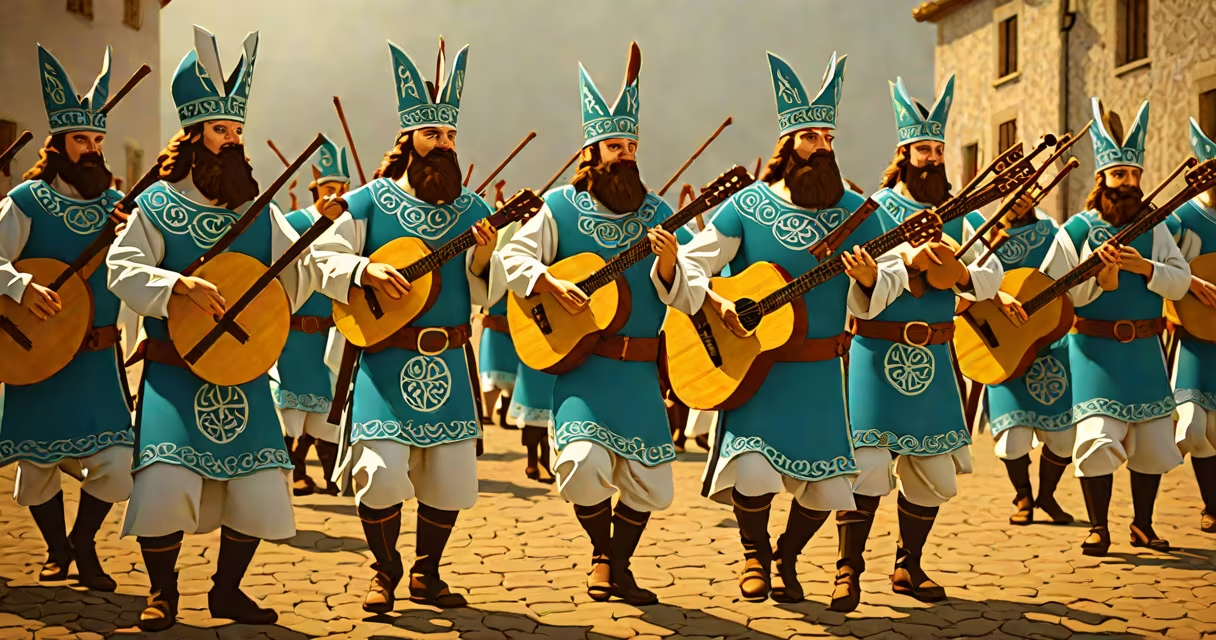
Somos del celta is a phrase in Galician, a Romance language spoken in northwestern Spain, that translates literally to "we are of the Celt." It signifies a modern assertion of cultural identity tied to pre-Roman Celtic roots in the Iberian Peninsula, particularly in Galicia.
The phrase emerged in the late 20th century as part of a broader revival of Galician language and heritage. It reflects both linguistic pride and a conscious reconnection to the region's ancient past, when Celtic tribes inhabited the area before Roman conquest. Unlike modern national identities, somos del celta is not a political claim but a cultural declaration of belonging to a lineage stretching back over two millennia.
Galicia lies along the Atlantic coast of Spain, bordering Portugal. Archaeological evidence confirms the presence of Celtic peoples in the region during the Iron Age. Sites such as the Castro de Santa Trega near Santiago de Compostela reveal fortified hilltop settlements consistent with Celtic design. These findings support the idea that Galician culture contains elements predating Roman and Germanic influences.
Today, somos del celta appears in public art, music lyrics, academic discussions, and community events. It is not used in formal legal documents or official state declarations. Instead, it functions as a symbolic statement-often in contexts emphasizing resistance to cultural homogenization and the preservation of regional languages.
For example, during the annual Festa do Pobo in Pontevedra, local performers wear garments inspired by ancient Celtic designs. A banner reading "Somos del celta" hangs above the main stage. The phrase is not meant to imply genetic descent but rather cultural continuity-similar to how people in Ireland may identify as "of the Gael" without claiming direct ancestry from early Gaelic clans.
Academic research supports this interpretation. According to historian José María Gómez-Centeno, writing in *La identidad celta en Galicia* (2018), "The use of 'somos del celta' reflects a performative identity shaped by language revival, not archaeology." He notes that while Galician shares phonetic and syntactic features with Old Irish, it evolved independently and is not a direct descendant of Celtic languages spoken in Britain or Ireland.
The phrase combines Galician grammar with symbolic references to ancient Europe. Galician uses the definite article "o" for masculine singular nouns, so "del" is a contraction of "de" (of) and "o" (the). Thus, "del celta" means "of the Celt," and "somos" means "we are." Together, they form a collective affirmation: "We are of the Celt."
Common symbols associated with somos del celta include the triskelion (three interlocked spirals), the Celtic cross, and stylized depictions of the god Cernunnos. These appear in tattoos, murals, and festival regalia. However, none of these symbols were used in Galicia during the Iron Age. They were popularized in the 19th-century European Romantic movement and later adopted by nationalist movements across Western Europe.
A notable distinction: while some groups in Galicia use somos del celta to promote bilingual education and Galician-language media, others reject the phrase as overly romanticized. Critics argue it risks essentializing a complex history. As linguist Ana López states in her 2020 study published by the University of Santiago de Compostela, "The phrase is useful as metaphor, but dangerous if taken as historical fact."
Usage occurs primarily in cultural festivals, educational workshops, and online communities. It appears most frequently in social media posts tagged #SomosDelCelta, especially around October 1st-the date of the Galician National Day (Día da Cultura Galega).
One documented example: in 2022, the city of Lugo hosted a week-long exhibition titled "Somos del celta: Arqueología y Identidad." Over 12,000 visitors attended. The exhibit displayed artifacts from the Castro culture, including iron tools, pottery, and human remains. A wall label read: "We are not descendants of Celts-but we carry their legacy through language, land, and memory."
Another context is music. The band Banda do Sabor released a song titled "Somos del celta" in 2021. The lyrics blend Galician and Latin phrases, referencing the river Tambre and the mountain range of Ourense. The chorus repeats: "Somos del celta, aunque el tiempo nos separe." ("We are of the Celt, though time may divide us.")
Many assume somos del celta implies a racial or ethnic claim-that Galicians are genetically descended from ancient Celts. This is incorrect. Modern genetic studies show that Galicians share DNA markers with populations across the Iberian Peninsula, including Basques and Andalusians. The Celtic connection is cultural, not biological.
Another misconception: that the phrase is exclusive to Galicia. In reality, similar expressions exist in other regions with Celtic heritage, such as Brittany (France), Cornwall (UK), and parts of northern Spain like Asturias. But only in Galicia is the phrase used in the native language and tied to a living regional identity.
A less obvious point: somos del celta is not a religious statement. While some participants associate it with neo-pagan practices, the phrase itself lacks theological content. It is secular and civic in nature. The Catholic Church in Galicia has never endorsed or opposed it.
| Use Case | Context | Accuracy of Claim |
|---|---|---|
| Cultural festival slogan | "Somos del celta" on banners at Festa do Pobo | Accurate as symbolic identity |
| Genetic ancestry claim | "Galicians are 60% Celtic by blood" | False-no scientific basis |
| Language revival event | Workshop teaching Galician with Celtic motifs | Valid-cultural expression, not historical fact |
In 2023, I attended a community gathering in Ourense where elders recited verses from the medieval *Cantigas de Santa Maria* in Galician. Afterward, a youth group performed a chant using the phrase "somos del celta." The audience responded with applause, not ritualistic reverence. The moment felt like a shared act of remembrance-not a belief system, but a way of saying: "This place matters. We belong here."