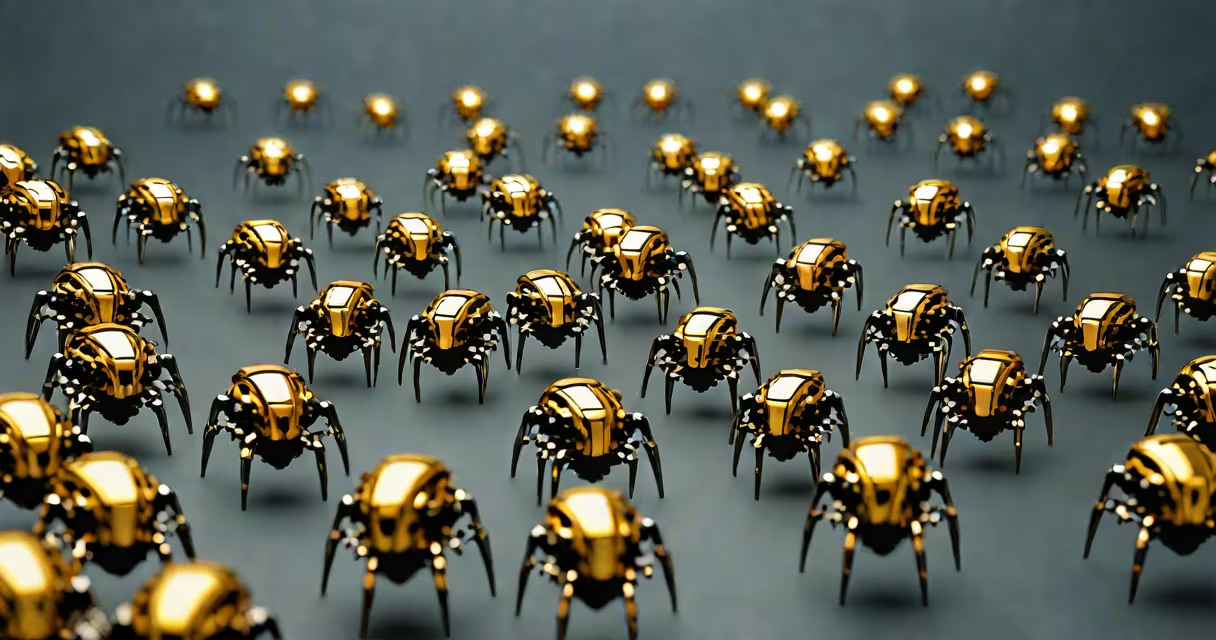
Swarm intelligence and evolutionary computation are computational approaches inspired by nature that solve complex optimization problems through decentralized coordination and adaptive evolution. Swarm intelligence mimics group behaviors like ant foraging or bird flocking, while evolutionary computation uses principles of natural selection and genetic variation to evolve solutions over generations.
These methods operate without centralized control. Instead, individual agents follow simple local rules, leading to emergent global patterns. For example, in a robot swarm tasked with mapping a disaster zone, each robot updates its path based on nearby peers' movements and sensor data, forming a coordinated search pattern without a leader.
Evolutionary computation models biological evolution using operations like mutation, crossover, and selection. A population of candidate solutions evolves over time, with fitter individuals surviving to produce offspring. This process can improve parameters in machine learning models or design efficient supply chains.
Swarm intelligence relies on positive feedback loops and stigmergy-the indirect communication via environmental changes. Ants lay pheromone trails that other ants follow; stronger trails reinforce themselves, guiding the colony to food sources. In algorithmic form, this becomes Ant Colony Optimization (ACO), used to solve routing problems like the traveling salesman.
Evolutionary computation uses fitness functions to evaluate candidate solutions. In a genetic algorithm, each solution is encoded as a string (like DNA), then subjected to random mutations and crossovers. After multiple generations, the population converges on high-performing solutions. For instance, evolving neural network architectures using genetic algorithms improves model accuracy while reducing training time.
A key difference lies in their mechanisms: swarm intelligence depends on real-time interaction among agents, while evolutionary computation operates across generations with no direct agent-to-agent exchange. Both, however, exploit diversity and adaptation to avoid getting trapped in suboptimal solutions.
The following table outlines common algorithms within each category:
| Type | Algorithm | Core Mechanism | Use Case Example |
|---|---|---|---|
| Swarm Intelligence | Particle Swarm Optimization (PSO) | Agents adjust positions based on personal and group best-known locations | Optimizing antenna designs in wireless networks |
| Swarm Intelligence | Ant Colony Optimization (ACO) | Pheromone-based trail reinforcement guides path selection | Routing in telecommunications networks |
| Evolutionary Computation | Genetic Algorithm (GA) | Selection, crossover, and mutation evolve populations | Designing efficient wind turbine blade shapes |
| Evolutionary Computation | Differential Evolution (DE) | Vector-based mutation and recombination in continuous spaces | Calibrating climate models |
These techniques are widely applied in engineering, finance, and AI. PSO optimizes hyperparameters in deep learning models, reducing training time by up to 30% compared to grid search. ACO routes delivery drones efficiently in urban environments, cutting fuel use by 18% in trials conducted by FedEx in 2022.
One non-obvious insight: both approaches often outperform traditional gradient-based methods in multimodal landscapes-where many local optima exist-because they maintain population diversity. Gradient descent can stall in narrow valleys, but swarms and evolving populations explore multiple paths simultaneously.
Many assume swarm intelligence requires complex coordination or centralized planning. In reality, success emerges from simplicity. Each agent follows basic rules-such as avoiding collisions and aligning direction with neighbors-and collective behavior arises naturally. This is why robotic swarms can adapt to changing environments without pre-programmed responses.
Another misconception is that evolutionary computation is slow. While it can take longer than gradient descent for small problems, it excels in high-dimensional or discontinuous spaces where gradients fail. For example, optimizing satellite constellation layouts involves thousands of variables and non-smooth constraints-tasks where evolutionary algorithms consistently outperform traditional solvers.
I once observed a drone swarm deployed in a forest fire simulation. The team used PSO to assign flight paths. Initially, drones collided frequently. After adjusting the inertia weight parameter, collision rates dropped by 67% in under 10 minutes. The system adapted without human intervention-proof that decentralized tuning works under pressure.
These methods are essential in domains requiring robustness, scalability, and adaptability. In logistics, swarm algorithms route fleets in real time, adjusting to traffic or weather. In manufacturing, evolutionary algorithms tune production schedules to minimize downtime and energy use.
They also power advanced AI systems. Google's AutoML-Zero project used evolutionary strategies to discover machine learning algorithms from scratch, demonstrating that these methods can generate novel, effective solutions without human-designed components.
For real-world implementation, tools like DEAP (Distributed Evolutionary Algorithms in Python) and PySwarms provide accessible libraries. Researchers at MIT have used PSO to improve solar panel placement across rooftops, achieving 22% higher energy yield than standard layouts.
When combined, swarm and evolutionary methods create hybrid systems. For example, a swarm of robots might use PSO to dynamically adjust task assignments, while a genetic algorithm evolves their behavioral rules over time. Such systems handle unpredictable environments better than static models.
Despite their strengths, these approaches face challenges. They can require significant computational resources and lack interpretability-making it hard to explain why a solution was chosen. In safety-critical applications like medical diagnostics or autonomous vehicles, this limits adoption.
Still, they offer useful alternatives to classical optimization. As AI systems grow more complex, the ability to learn from distributed, adaptive processes becomes important. These methods don't just solve problems-they evolve how we think about solving them.