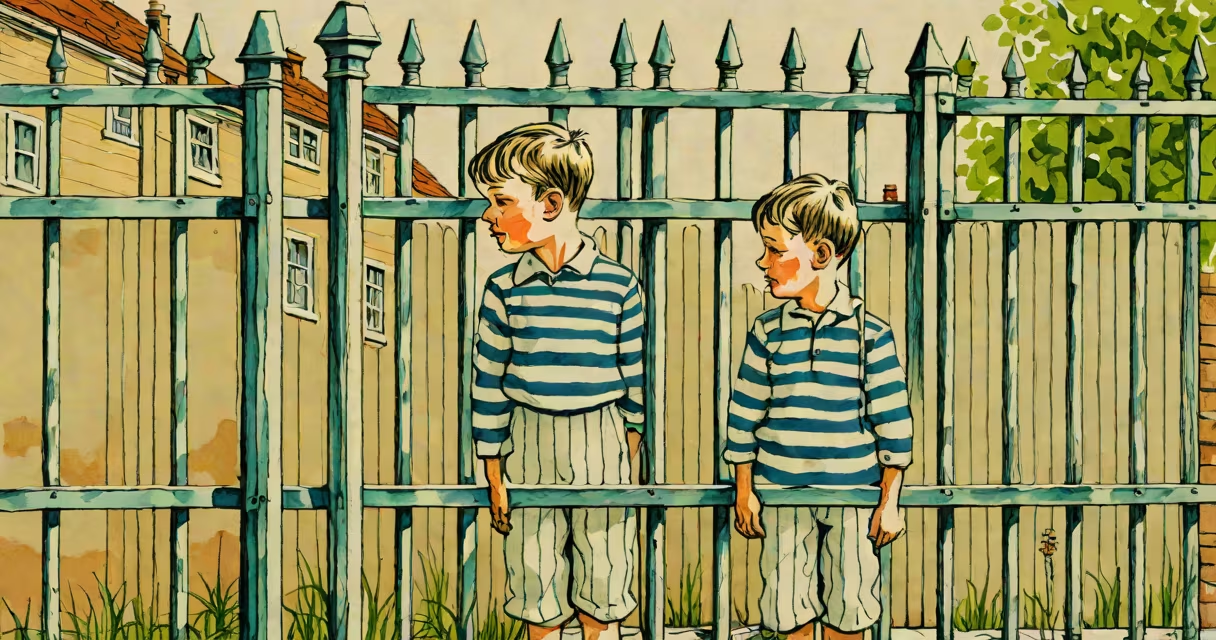
The boy in the striped pyjamas book is a 2006 historical fiction novel by Irish author John Boyne that presents the Holocaust through the eyes of nine-year-old Bruno, the son of a Nazi commandant stationed at Auschwitz. The narrative unfolds as Bruno, unaware of the camp's true purpose, befriends Shmuel, a Jewish boy imprisoned behind the wire fence, and imagines their connection transcends the war's brutality.
Set in 1943, the story begins when Bruno's family relocates from Berlin to a house near Auschwitz, which Bruno calls "Out-With." His father, a high-ranking SS officer, oversees the camp's operations. Bruno's innocence shapes the entire narrative-he mishears "Auschwitz" as "Out-With," doesn't recognize the significance of the striped uniforms, and assumes Shmuel's life is similar to his own. This limited understanding creates emotional tension and tragic irony.
Boyne wrote the novel as a deliberate challenge to how history is taught and remembered. He intended to show how moral blindness and ignorance enable atrocities. The book's structure-told entirely from Bruno's subjective viewpoint-forces readers to confront uncomfortable truths indirectly. The narrative avoids explicit descriptions of violence, focusing instead on emotional distance, misunderstanding, and the collapse of innocence.
The novel operates on a single, sustained metaphor: the fence. It separates Bruno's world-the garden, the house, the freedom of childhood-from Shmuel's-prisoners, forced labor, and daily deprivation. The fence is both physical and symbolic: it marks the boundary between safety and danger, knowledge and ignorance, privilege and suffering.
When Bruno decides to help Shmuel find his missing father, he enters the camp disguised in Shmuel's striped pyjamas. This act is not heroic-it is naive. He believes they will cross the fence together and return to the other side. The scene ends with both boys walking into the gas chamber, holding hands. Their deaths are described in a quiet, matter-of-fact tone that underscores the tragedy of their misunderstanding.
This ending is not a surprise to readers familiar with the Holocaust, but the emotional impact lies in the contrast between Bruno's childlike logic and the horror of the outcome. The book does not depict the gas chambers directly. Instead, it uses silence and omission to convey the unspeakable.
The novel is written in third-person limited perspective, restricted to Bruno's thoughts, vocabulary, and perceptions. Boyne uses simple syntax, short sentences, and childlike phrasing-"I think he was very sad"-to maintain authenticity. This stylistic choice makes the book accessible to younger readers but also amplifies its emotional weight.
Key literary devices include:
These elements combine to create a story that feels both personal and universal. The absence of adult commentary forces readers to interpret events themselves, making the book a useful tool for discussion about empathy, complicity, and moral responsibility.
The boy in the striped pyjamas book is widely used in middle and high school curricula across the United States, Canada, the UK, and Australia. It appears in English, history, and social studies classrooms as a way to introduce students to the Holocaust without overwhelming them with graphic detail.
According to the United States Holocaust Memorial Museum (USHMM), books like this are effective for engaging younger audiences because they "allow students to connect emotionally with individuals rather than abstract statistics." The museum notes that "narratives grounded in personal experience help learners process complex historical trauma."
Teachers often pair the novel with primary sources such as survivor testimonies, photographs from Auschwitz, and excerpts from Anne Frank's diary. The book's brevity-just under 200 pages-and clear prose make it suitable for classroom reading in 10-14 days.
It is also frequently adapted for film and stage. The 2008 movie directed by Mark Herman received critical attention for its restrained visual style and emotional restraint. The film's score, composed by David Arnold, uses minimal instrumentation-mostly piano and strings-to mirror Bruno's inner world.
Many readers assume the book is based on a true story. It is not. John Boyne has stated multiple times that he invented the characters and plot. There is no record of a child named Bruno living near Auschwitz or a Jewish boy named Shmuel entering the camp wearing striped pajamas. The story is fictional, though inspired by real events.
A common error is equating the book's portrayal of the Holocaust with historical accuracy. While the setting and context are accurate-Auschwitz operated from 1940 to 1945, and prisoners wore striped uniforms-the specific interactions between Bruno and Shmuel did not happen. The novel's power lies in its emotional truth, not factual precision.
Another misconception is that the book trivializes the Holocaust. Critics have argued this, especially after the film's release. However, the USHMM and the United Kingdom's Holocaust Education Trust both affirm that the book is used responsibly in educational settings when paired with factual material. The key is context: the novel is not a substitute for history, but a gateway to it.
One non-obvious fact: the book's original title in German translation was *Der Junge im gestreiften Pyjama*. The publisher chose the English version's title to emphasize the visual image-the boy in stripes-as a symbol of loss and identity erasure. The striped pajamas became the central motif, appearing on book covers worldwide.
In a 7th-grade class in Portland, Oregon, a teacher assigned The boy in the striped pyjamas book alongside a unit on human rights. Students read one chapter per night and discussed it in small groups. After finishing the book, they compared Bruno's description of the camp with actual photos from Auschwitz-Birkenau taken by Allied forces in 1945.
One student noted: "Bruno says the men in the striped clothes 'look like they're playing dress-up.' But the photo shows them emaciated, with shaved heads. That's not play." Another asked: "Why didn't Bruno's mom leave? She knew something was wrong."
The teacher then introduced a clip from the testimony of a Holocaust survivor, Eva Kor, who said: "I remember thinking, 'This can't be real.' And then I realized it was." The class concluded that the book's strength lies in showing how normal people can fail to see evil when it's masked by routine and authority.
Several novels explore the Holocaust through a child's lens. Here's how The boy in the striped pyjamas book differs from others:
| Book | Author | Perspective | Focus | Difference |
|---|---|---|---|---|
| The boy in the striped pyjamas book | John Boyne | German boy, outsider | Ignorance as moral failure | Protagonist is part of the oppressor system; his innocence enables harm. |
| Number the Stars | Lois Lowry | Danish girl, resistance | Rescue of Jews during WWII | Heroic narrative; protagonist actively resists. |
| Primo Levi's Survival in Auschwitz | Primo Levi | Adult survivor, memoir | Physical and psychological endurance | Firsthand account; no narrative distance. |
Unlike Number the Stars, which portrays courage and resistance, The boy in the striped pyjamas book shows how complicity arises not from malice, but from lack of awareness. Bruno is not evil-he is unthinking. That's what makes the ending so devastating.
I first read the book during a high school literature course. I remember sitting in a dim classroom, the sun slanting through blinds, and feeling my breath catch when Bruno walks into the gas chamber. I didn't expect to cry. The simplicity of the language made the horror feel more real, not less.
For educators and readers seeking a detailed entry point into Holocaust education, The boy in the striped pyjamas book remains a important text. Its power lies not in telling the truth, but in showing how easily truth can be missed when we don't look closely enough.