The Jim Crow laws were a series of state and local statutes enacted in the Southern United States between 1877 and the mid-1960s that mandated racial segregation and systematically disenfranchised African Americans. These laws enforced separation in public facilities, restricted voting rights, and codified white supremacy under the guise of "separate but equal."
These laws emerged after Reconstruction ended in 1877, when federal troops withdrew from the South. With federal oversight gone, Southern states passed legislation to reassert white dominance. The term "Jim Crow" originated from a minstrel show character popular in the 1830s, later adopted as a symbol of Black subjugation. By the 1890s, the legal structure was complete: segregation was not just social practice-it was law.
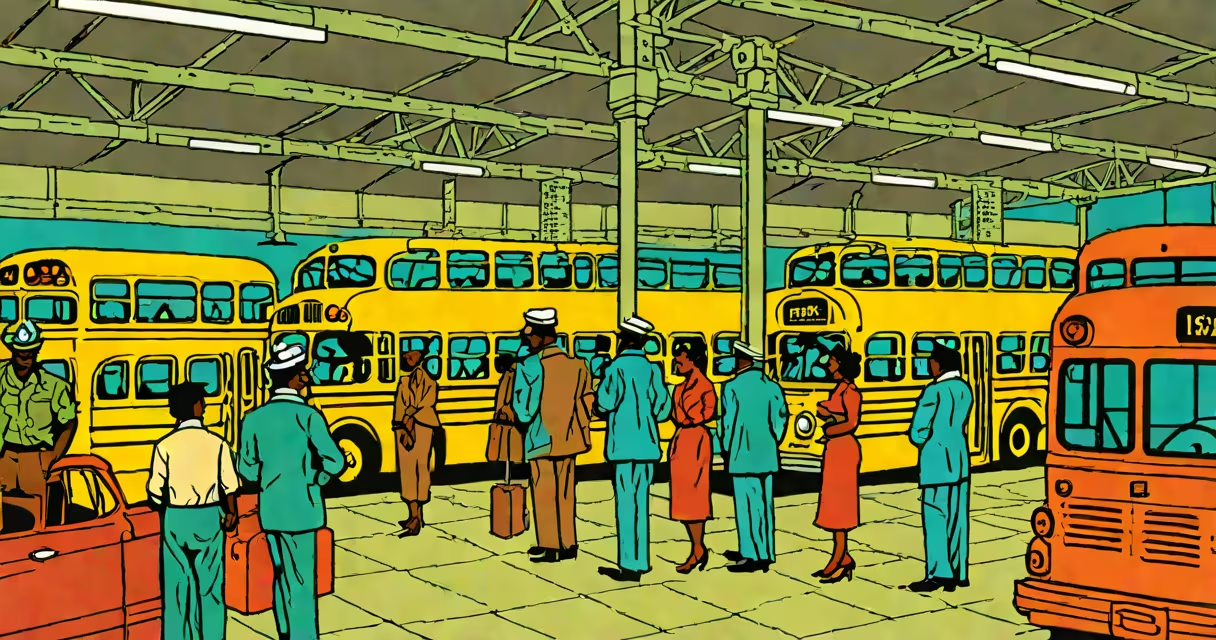
Under the Jim Crow system, Black citizens faced daily indignities. They could not sit in the same railroad cars, use the same water fountains, attend the same schools, or eat in the same restaurants. Public transportation required separate seating, often in the back of buses. In many towns, signs reading "White Only" or "Colored" marked entrances, restrooms, and waiting areas. The Supreme Court upheld this structure in Plessy v. Ferguson (1896), ruling that segregation did not violate the Equal Protection Clause as long as facilities were "equal"-a standard rarely met.
These laws operated through a combination of statutory mandates, violence, and economic coercion. State legislatures wrote codes that defined who was Black, often using the "one-drop rule"-any person with one Black ancestor was legally classified as Black. This classification determined access to housing, employment, education, and marriage.
Enforcement relied on local authorities and vigilante groups. Lynchings were common, especially after false accusations of crimes against white women. Between 1882 and 1968, the NAACP documented 4,743 lynchings of Black Americans-most occurring in the South under Jim Crow rule. Police often ignored or participated in these acts. Courts routinely denied Black defendants fair trials.
Economic control was another pillar. Sharecropping systems trapped Black farmers in cycles of debt. Land ownership was nearly impossible due to discriminatory lending practices. Even when Black workers earned wages, they were paid less than whites for the same labor. A 1950 study by the U.S. Department of Labor found that Black men earned 57% of what white men earned in the same job categories.
Jim Crow laws varied by state but followed a consistent pattern of exclusion. Below are representative examples:
| Type of Law | Example | Impact |
|---|---|---|
| Voting Restrictions | Mississippi's 1890 constitution introduced literacy tests, poll taxes, and grandfather clauses. Only those whose grandfathers had voted before 1867 qualified to vote-effectively excluding all Black men. | Black voter registration dropped from 130,000 in 1890 to fewer than 5,000 by 1900. |
| Public Facility Segregation | Alabama required separate waiting rooms for Black and white passengers at train stations. Black children attended schools with outdated textbooks and broken desks. | A 1951 study by the National Education Association found that per-pupil spending in Black schools was 41% lower than in white schools. |
| Marriage Bans | Virginia's Racial Integrity Act of 1924 banned interracial marriage and defined anyone with "any degree of Negro blood" as Black. | Interracial couples faced jail time. The law remained in effect until 1967, when Loving v. Virginia struck it down. |
One lesser-known enforcement tactic was the use of vagrancy laws. Local governments arrested Black people for minor offenses-such as loitering or failing to carry work permits-and sentenced them to forced labor. This practice formed the basis of convict leasing, which continued into the 1940s. In Alabama, over 70% of prisoners in the early 20th century were Black, despite making up only 30% of the population.
Many assume Jim Crow laws applied only to the Deep South. In reality, Northern states also enforced de facto segregation through housing covenants, redlining, and restrictive zoning. Chicago's 1920s zoning laws explicitly excluded Black families from certain neighborhoods. Federal housing policies under the FHA further entrenched racial divides.
Another myth is that Jim Crow ended with the Civil Rights Act of 1964. While the act outlawed segregation in public accommodations and employment, it did not erase decades of accumulated disadvantage. Jim Crow's legacy persists in wealth gaps, educational disparities, and mass incarceration. According to the Brookings Institution, the median white household net worth in 2022 was $285,000-over eight times higher than the $34,000 for Black households.
Some confuse Jim Crow with slavery. Slavery ended in 1865 with the 13th Amendment. Jim Crow was a distinct phase of legal oppression that followed emancipation. It did not abolish freedom-it redefined it. Freedom under Jim Crow meant surviving under constant surveillance, economic marginalization, and physical threat.
I once visited a small town in Mississippi where a former schoolhouse still stands, now repurposed as a community center. Inside, a faded sign reads "Colored School - 1923." The classroom walls bear chalk marks from decades ago. The building's roof leaks. The local historical society maintains records showing that the Black school received half the funding of the white one. This site is not a relic-it's a living reminder of how policy shapes memory.
Today, some Southern states have removed Confederate monuments but left Jim Crow-era statues intact. In 2021, Georgia replaced a monument of a Ku Klux Klan leader with one honoring civil rights leaders. Yet, in the same year, the state passed a law restricting voter access that critics called a modern-day poll tax. The mechanisms change, but the intent remains familiar.