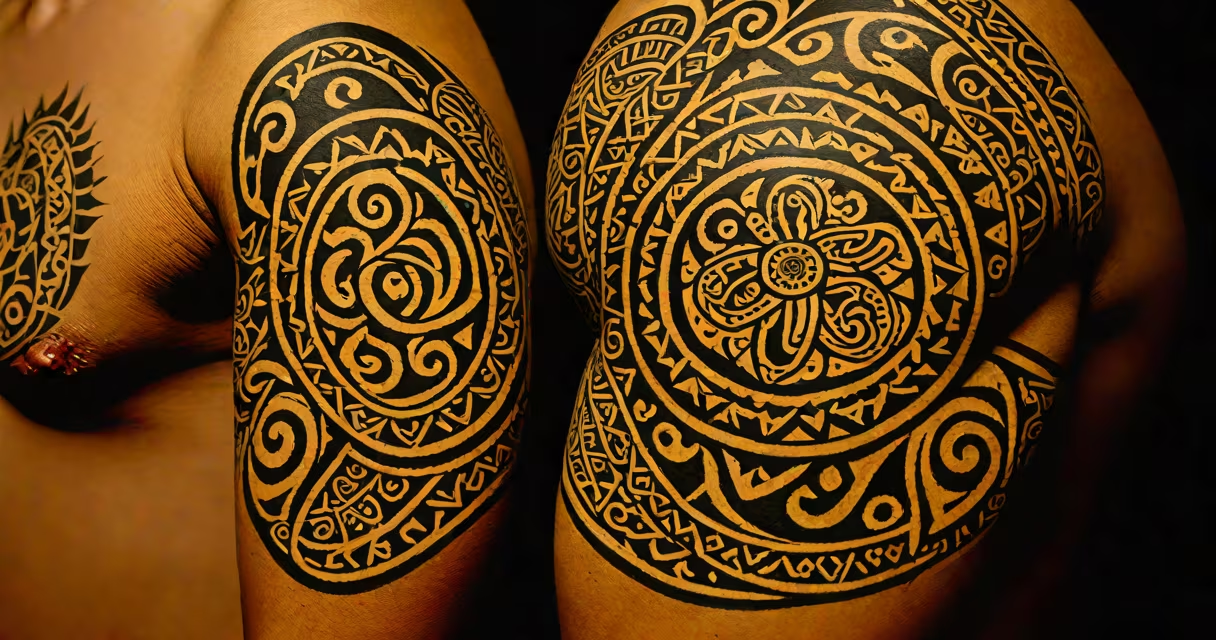
Tribal tattoo designs are stylized, often symmetrical patterns derived from Indigenous cultures, especially Polynesian, Maori, and Native American traditions. These designs use repetitive geometric shapes-spirals, waves, and interlocking lines-to convey identity, lineage, and spiritual protection. They are not random art but structured visual languages passed through generations.
These tattoos originated as permanent markers of social status, rites of passage, and ancestral connection. In Polynesian societies, such as those in Samoa and Tahiti, designs were applied using hand-carved tools and pigments made from natural materials. Each element carried specific meaning: a spiral might represent life's process, while a wave motif could denote resilience or the ocean's power. The placement on the body also mattered-tattoos on the arms or chest often signified strength and honor.
Today, tribal tattoo designs are widely reproduced in Western tattoo culture. However, many of these adaptations lack cultural context and risk appropriating sacred symbols. For example, a Maori moko pattern-used historically to identify rank and genealogy-is sometimes replicated without understanding its significance or permission from the community. This raises ethical concerns about cultural ownership and respect.
These designs rely on symmetry, repetition, and symbolic geometry. Unlike freehand or illustrative tattoos, tribal styles follow strict compositional rules. A single motif-like a double spiral or a series of interlocked triangles-can be expanded into a full sleeve or back piece. The continuity of lines creates a sense of movement and unity, reflecting concepts like balance, eternity, or interconnectedness.
The process begins with a sketch based on known traditional forms. Artists may reference historical examples from museum archives or ethnographic records. Once approved, the design is transferred to the skin using a stencil or freehand tracing. The actual tattooing involves multiple passes with a needle, building density and depth in black ink. The result is a high-contrast, enduring image that remains legible over time.
A common mistake is assuming all tribal-style tattoos are interchangeable. In reality, each culture has distinct visual vocabularies. A Samoan tatau uses thick, angular lines and covers large areas of the body, while a Māori moko features complex facial patterns with precise directional flow. Mixing elements from different traditions-such as combining Japanese irezumi motifs with Polynesian spirals-creates hybrid designs that may misrepresent both cultures.
Not all tribal tattoos come from the same source. Below are major categories with their roots and distinguishing traits:
| Type | Cultural Origin | Key Features | Common Placement |
|---|---|---|---|
| Polynesian tatau | Samoan, Tongan, Tahitian | Heavy black lines, geometric symmetry, symbolic motifs (e.g., shark teeth, waves) | Arms, legs, torso |
| Māori moko | New Zealand iwi (tribes) | Facial patterns, fine detailing, directional flow indicating genealogy | Face, neck, hands |
| Native American tribal | Various tribes (Navajo, Lakota, Ojibwe) | Animal totems, spirit symbols, nature themes | Arms, shoulders, back |
| Amazonian tribal | Indigenous groups in Brazil and Peru | Body paint and temporary markings, often featuring animal spirits and shamanic imagery | Upper body, face |
Each tradition evolved within specific environments and belief systems. For instance, Samoan tatau was traditionally earned through years of endurance during ritual sessions. The process itself was a test of courage and commitment. Today, some practitioners still follow this tradition, though it is rare outside Pacific Island communities.
Tribal tattoo designs serve multiple purposes beyond decoration. In Indigenous cultures, they function as maps of personal and communal history. A person's tattoo may indicate clan affiliation, achievements, or spiritual roles. Among the Māori, moko is not merely aesthetic-it is a living record of ancestry and social standing.
In contemporary settings, people choose tribal designs for their visual impact and perceived authenticity. A 2021 study by the Journal of Body Art and Culture found that 68% of individuals selecting tribal tattoos cited "cultural depth" or "meaningful symbolism" as reasons for their choice. Yet, only 32% could correctly identify the origin of their chosen design.
One example illustrates the gap between intent and understanding. A client in Portland requested a "Maori tribal design" for his back. The artist, unaware of the cultural weight, used a generic spiral pattern. Later, a Māori elder visiting the shop pointed out that the design bore no resemblance to authentic moko. The client had unknowingly participated in cultural misrepresentation.
Many assume tribal tattoos are simply "cool patterns." This overlooks their role as living cultural expressions. A key correction: not all tribal designs are ancient. Some modern interpretations blend traditional motifs with contemporary aesthetics-such as minimalist versions or color-infused patterns. While creative, these may dilute original meanings.
Another misconception is that tribal tattoos are universally accessible. In reality, certain designs are restricted to specific individuals or roles. For example, in some Māori communities, facial moko is reserved for chiefs and warriors. Non-Māori people are discouraged from getting such tattoos-even if they are well-intentioned. The principle is not exclusion but respect for cultural boundaries.
A non-obvious fact: many traditional tribal designs were originally painted or scarred into the skin, not tattooed. In pre-colonial times, tools like bone needles and ash-based pigments were used. Tattooing as we know it-using metal needles and machine ink-was introduced by European colonizers in the 19th century. Thus, the modern tattoo machine is a relatively recent addition to a centuries-old practice.
Consider a client who wanted a full-sleeve tribal tattoo based on Samoan tatau. He researched the meaning behind each symbol:
The artist consulted a Samoan cultural advisor to ensure accuracy. The final design took 12 hours over four sessions. The client reported feeling a deeper connection to the artwork-not just as body art, but as a personal narrative.
When choosing a tribal tattoo, research the source culture. Ask the artist about their references. Avoid designs that mimic sacred symbols without context. If you're drawn to a pattern from a culture not your own, consider whether you're honoring it-or reducing it to ornamentation.
Tribal tattoo designs are more than visual patterns. They are encoded histories, spiritual markers, and acts of belonging. Understanding their origins and meanings helps the act of wearing one becomes a gesture of awareness-not erasure.