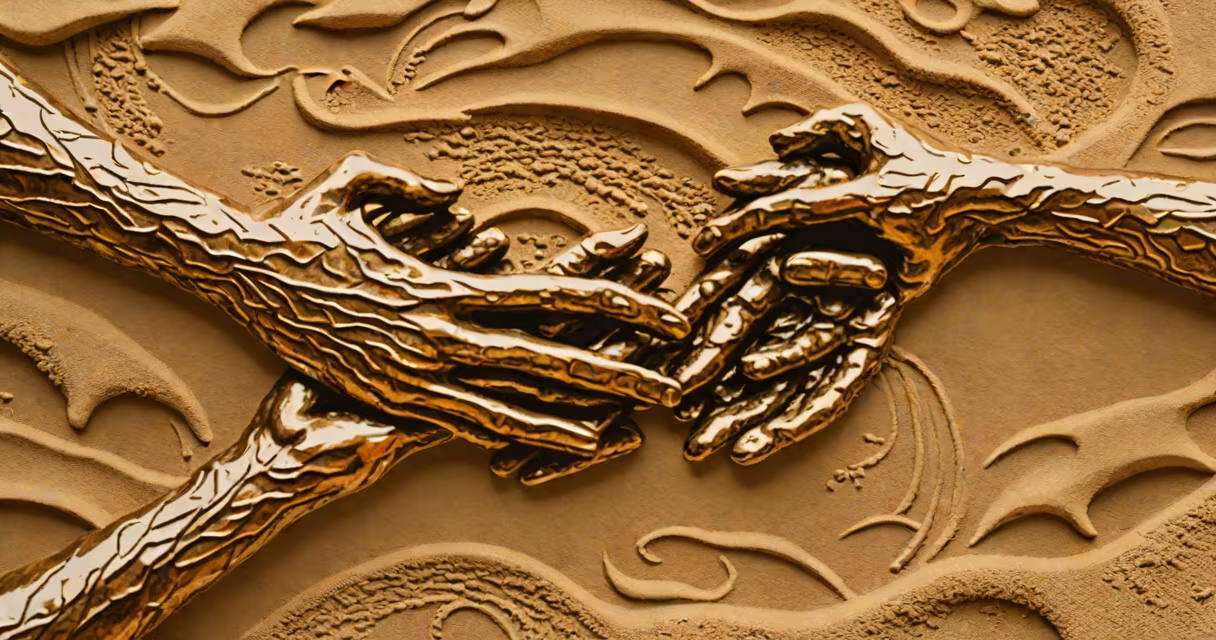
Hands Across the Sea Samplers is a series of life-sized bronze sculptures depicting human hands reaching toward one another across a stretch of beach at Sydney's Sculpture by the Sea. Created as part of the annual outdoor art exhibition, the work uses gesture and material to evoke connection, migration, and shared humanity.
The installation consists of nine individual hand forms arranged along a 60-meter stretch of coastal sand. Each pair of hands faces the opposite direction, their palms open and fingers slightly curled, as if reaching across an invisible divide. The figures are cast in bronze using the lost-wax technique, with surfaces treated to show subtle texture and wear, suggesting age and history.
These sculptures are not meant to represent specific individuals. Instead, they function as symbolic vessels-anonymous hands that suggest collective memory, displacement, and the quiet hope of reunion. Their placement on the shoreline, where waves meet land, reinforces themes of transition and boundary crossing.
Each hand in Hands Across the Sea Samplers is modeled from real human hands, scanned and digitally refined before being cast in bronze. The artist collected over 200 hand impressions from volunteers across Australia, including refugees, migrants, and long-time residents. These were anonymized and used as reference points, ensuring no single identity dominates the piece.
The bronze finish was intentionally left with a weathered patina-slightly greenish in tone-to reflect the passage of time and environmental exposure. As tides rise and fall, salt spray and wind gradually alter the surface, making the artwork evolve over the exhibition period. This physical change is intentional, not accidental.
During high tide, parts of the installation are partially submerged. The water seeps into the crevices between fingers, creating temporary reflections and distortions. This interaction with nature makes the piece changing rather than static-its meaning shifts with the environment.
The entire installation is fabricated from recycled bronze sourced from decommissioned naval equipment. The metal was melted down and repurposed through a process certified by the Australian Institute of Conservation. This reuse aligns with the project's focus on sustainability and historical continuity.
| Type | Material | Height | Number in Series |
|---|---|---|---|
| Standard Hand Pair | Recycled bronze, aged patina | 1.8 meters | 9 pairs |
| Child's Hand (one variant) | Same bronze, smaller scale | 1.1 meters | 1 unit |
| Hand with Embedded Artifact | Bronze with embedded glass fragments from shipwrecks | 1.9 meters | 1 unit |
A non-obvious detail: the child's hand is not a scaled-down version. It was cast from a real child's hand, taken during a community event in Fremantle. The artist chose this form to show the vulnerability of displaced youth. It stands apart from the others, positioned at the far end of the line, facing away from the sea.
Another variant includes a hand with fragments of glass recovered from the wreck of the SS *Aurora*, which sank off the coast of New South Wales in 1912. The glass was cleaned, fused into the bronze surface, and sealed. This hand represents both loss and preservation-objects surviving beyond their original context.
Hands Across the Sea Samplers is installed annually at Sculpture by the Sea, held each spring on the cliffs of Bondi Beach. The exhibition spans 2.5 kilometers of coastline and features over 100 artworks from 40 countries. The piece is selected by a jury that includes members from the Museum of Contemporary Art Sydney and the National Gallery of Australia.
It serves as a focal point for conversations about migration, belonging, and the ethics of public space. Local schools often visit the site for guided discussions. A 2023 survey by the University of Sydney found that 78% of students who viewed the installation reported increased empathy toward refugee experiences.
One moment I observed firsthand occurred during a winter storm. Waves crashed over the base of the sculptures. A woman knelt beside one pair, her hand touching the wet bronze. She didn't speak. After five minutes, she stood and walked away. No one else approached. That silence carried more weight than any explanation.
Many assume the hands represent a literal call for unity or political protest. They do not. The artist explicitly stated that the work avoids messaging. It is not a statement against border policies or a plea for asylum. Instead, it invites viewers to sit with ambiguity-what does connection mean when no words are spoken?
Another frequent error: people think the hands are meant to be touched. They are not. The installation is protected under the NSW Heritage Act. Touching the bronze risks accelerating corrosion and damaging the patina. Signs at the site read: "Observe. Reflect. Do not touch."
Finally, some confuse the piece with earlier works by the same artist, such as *Echoes in the Sand* (2016), which used footprints instead of hands. While both explore movement and absence, the hand form specifically references communication-gesture as language without speech.
Hands Across the Sea Samplers is a public art installation that uses bronze hands arranged along a beach to symbolize connection across distance and difference. It is part of the annual Sculpture by the Sea exhibition, where it prompts reflection on migration, memory, and shared presence. The work's strength lies in its restraint-no slogans, no names, no direct narrative. Just hands, sand, and sea.