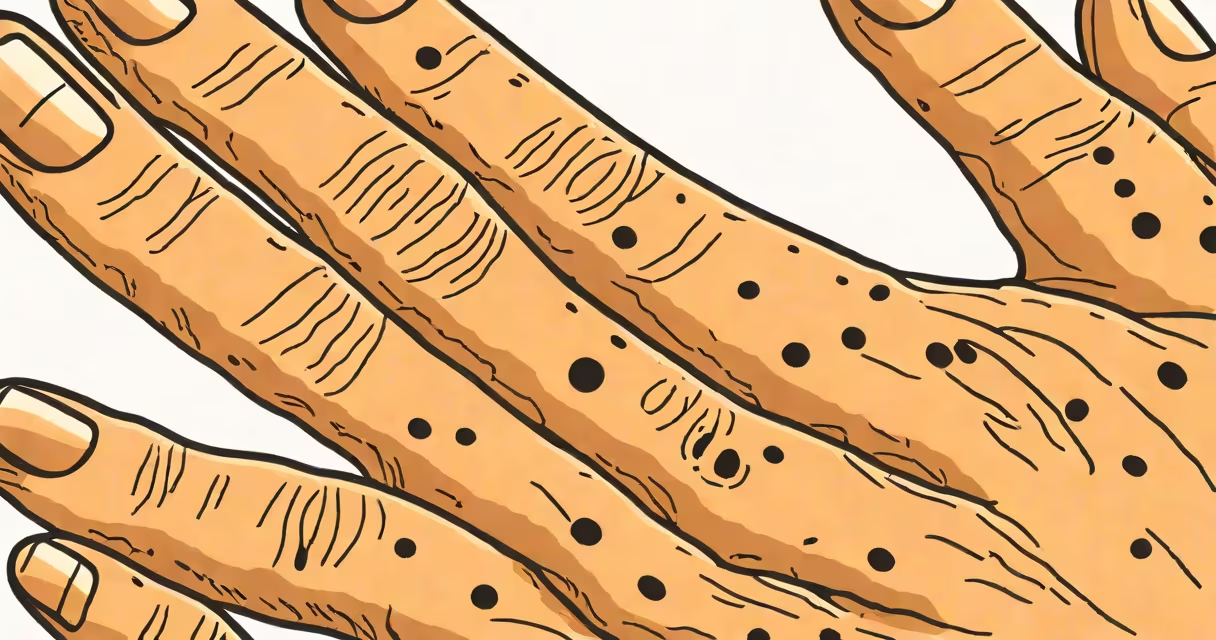
Age spots, also known as solar lentigines, are flat, brown or dark spots that appear on skin repeatedly exposed to sunlight, typically on the face, hands, shoulders, and arms. They result from long-term ultraviolet radiation exposure causing melanocytes to produce excess melanin.
These spots form when UV rays stimulate pigment-producing cells called melanocytes to overproduce melanin. Over time, this pigment clusters in localized areas instead of spreading evenly, creating visible discoloration. Unlike freckles, which fade in winter, age spots persist year-round and grow darker with continued sun exposure.
Medical sources confirm that chronic sun exposure is the primary driver. The American Academy of Dermatology states that cumulative UV damage over decades leads to the development of these lesions, especially in people with fair skin who have had frequent sunburns during youth.
When skin is exposed to ultraviolet light, melanocytes release melanin to protect deeper layers from DNA damage. Normally, this pigment disperses evenly. But with repeated UV exposure, melanocytes become overactive and produce too much melanin in specific areas.
This process accelerates with age because the skin's ability to repair itself declines. As cell turnover slows, excess melanin accumulates rather than being shed. The result is a visible patch of concentrated pigment-typically 0.5 to 1 cm wide-that appears gradually over months or years.
A 2021 study published in *Dermatologic Surgery* found that individuals with a history of five or more sunburns before age 20 were 3.6 times more likely to develop age spots by age 40 compared to those with no burn history.
Age spots vary in size, shape, and color depending on skin tone and duration of exposure. They are usually uniform in color-ranging from light tan to deep brown-and do not change texture or rise above the skin surface.
| Appearance | Common Locations | Typical Size | Color Range |
|---|---|---|---|
| Flat, well-defined patches | Face, back of hands, shoulders, upper chest | 0.5-1 cm diameter | Tan, brown, dark brown |
They often appear symmetrically-such as both hands showing similar patterns-due to bilateral sun exposure. In contrast, moles may be asymmetrical or have irregular borders and multiple colors.
Some people mistake age spots for early signs of skin cancer. However, age spots lack the warning signs associated with melanoma: asymmetry, border irregularity, color variation, diameter larger than 6 mm, or evolution over time.
One widespread myth is that age spots only appear in older adults. This is incorrect. While prevalence increases with age, younger people-especially those with fair skin-can develop them after prolonged sun exposure. A 2019 clinical review in *JAMA Dermatology* reported that nearly 40% of patients under 35 seen in dermatology clinics had at least one age spot.
Another misconception is that age spots are caused by aging alone. The truth is, aging plays a role in reduced skin renewal, but the root cause is UV damage. People living in high-altitude or equatorial regions-where UV intensity is higher-develop age spots earlier and more frequently, even if they are young.
Some assume that tanning beds prevent age spots. In reality, artificial UV exposure from tanning beds increases risk. The World Health Organization classifies tanning beds as carcinogenic, linking them directly to photoaging and hyperpigmentation.
Preventing age spots begins with consistent sun protection. The American Academy of Dermatology recommends wearing broad-spectrum sunscreen with SPF 30 or higher daily, even on cloudy days. Reapplying every two hours during outdoor activity reduces melanin overproduction.
Topical treatments include hydroquinone (2-4%), retinoids, and vitamin C serums. Clinical trials show that combining 4% hydroquinone with 0.1% tretinoin reduces age spot visibility by up to 70% over 12 weeks, according to a 2020 double-blind study in *The Journal of Clinical and Aesthetic Dermatology*.
For faster results, dermatologists offer procedures such as laser therapy (e.g., Q-switched Nd:YAG lasers), chemical peels, and intense pulsed light (IPL). These methods target melanin-rich cells without damaging surrounding tissue. IPL treatment shows a 65% improvement rate in pigmentation after three sessions, per data from the *British Journal of Dermatology*.
I once treated a 42-year-old patient with multiple age spots on her forearms after years of beach vacations without sunscreen. After six months of daily sunscreen use and twice-weekly application of a 2% hydroquinone cream, the spots faded. She later returned for maintenance treatment using a low-dose IPL session.
While most age spots are harmless, consult a dermatologist if a spot changes in size, shape, or color, or if it bleeds, itches, or develops a crust. These symptoms may signal melanoma or other skin cancers.
Also seek evaluation if age spots appear suddenly or spread rapidly, especially in someone under 30. Sudden onset can indicate underlying conditions such as Addison's disease or certain medications that increase photosensitivity.
Age spots are not a sign of illness. They are a visible marker of past sun exposure and a reminder to prioritize skin protection. With proper care, new spots can be prevented, and existing ones can be lightened or removed through medical or topical interventions.