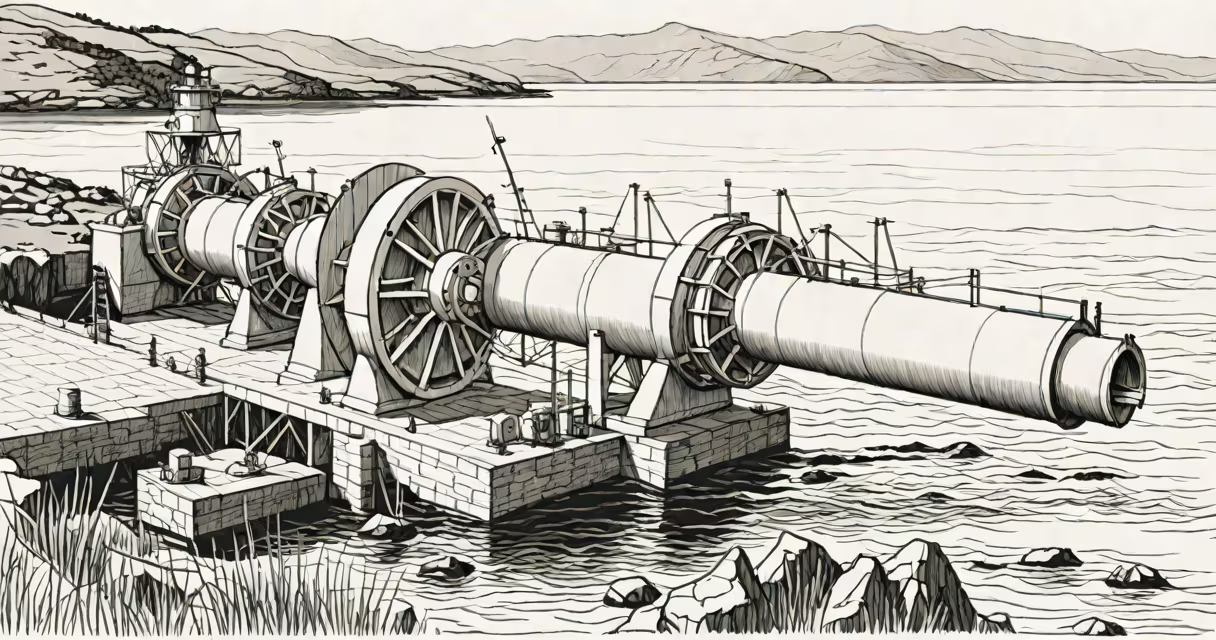
Tidal energy generates electricity by harnessing the natural rise and fall of ocean tides, offering a consistent, renewable power source with minimal emissions and high energy yield per unit of installed capacity.
Tidal energy systems use underwater turbines placed in areas with strong tidal currents. As water flows through the blades, it spins a generator connected to the grid. Unlike solar or wind, tides are driven by gravitational forces from the moon and sun, making their timing highly accurate and repeatable-tides occur predictably every 12 hours and 25 minutes.
The technology operates in two main forms: tidal stream generators, which capture kinetic energy from moving water, and tidal barrages, which use dams to trap water during high tide and release it through turbines during low tide. Tidal stream systems are more common today due to lower environmental disruption and faster deployment.
When the moon's gravity pulls on Earth's oceans, it causes water to bulge toward it. As Earth rotates, different coastlines experience rising and falling tides. Tidal energy systems exploit this movement. A turbine submerged in a channel or strait captures the flow of water during tidal shifts.
For example, the MeyGen project in Scotland's Pentland Firth uses four 1.5-megawatt turbines. These devices generate power as water moves at speeds between 2.5 and 4 meters per second. Each turbine produces enough electricity annually to power around 1,000 homes. The system feeds into the national grid via subsea cables.
Unlike solar panels that stop producing at night or wind turbines that stall in calm weather, tidal turbines run reliably twice daily. This consistency reduces the need for backup storage or fossil-fuel-based peaking plants.
Tidal energy stands out among renewables for its combination of predictability, energy density, and long-term reliability. Here's how it compares across critical metrics:
| Advantage | Description | Example |
|---|---|---|
| Predictable Output | Tidal cycles are forecastable decades in advance using astronomical models. | Canada's Bay of Fundy sees tides up to 16 meters; projects there rely on precise tidal forecasts. |
| High Energy Density | Water is 800 times denser than air, so turbines extract more energy per unit volume. | A 1-meter-per-second current generates ~100 watts per square meter-over 10 times more than average wind. |
| Low Carbon Footprint | Operation emits no greenhouse gases. Lifecycle emissions are below 10 g CO₂/kWh. | UK's Marine Energy Park estimates tidal projects emit 8 g CO₂/kWh-comparable to onshore wind. |
| Long Lifespan | Underwater turbines last 25-30 years with minimal maintenance. | Orbital Marine's O2 turbine in Scotland has a 25-year design life and requires servicing only every 18 months. |
One often-overlooked benefit is spatial efficiency. Tidal farms occupy less land than solar or wind installations. A single offshore site can deliver megawatts of power without displacing communities or farmland.
Many assume tidal energy is similar to wave energy. They're distinct: wave energy captures surface motion from wind-driven waves, while tidal energy relies on horizontal water movement caused by tides. Wave systems face higher variability and mechanical stress from storm conditions.
Another misconception is that tidal barrages cause irreversible ecological damage. While early barrage projects like France's La Rance plant disrupted local fish migration, modern designs incorporate fish-friendly turbines and sluice gates. The Sihwa Lake facility in South Korea, operational since 2011, generates 254 MW with minimal impact on surrounding ecosystems.
Tidal energy is not limited to high-tide regions. Even moderate tidal ranges-above 1.5 meters-can support viable projects. The U.S. Department of Energy notes that over 100 sites in North America meet minimum criteria for tidal stream development.
In 2022, I visited the Orkney Islands in Scotland, home to the European Marine Energy Centre (EMEC). There, I observed a prototype tidal range testing under real sea conditions. The turbines operated silently beneath the surface, feeding power into the grid with no visible emissions.
One engineer showed me data from a month-long test: the system delivered 98% of its expected output, despite storms and shifting currents. That level of consistency is rare among renewables. Solar and wind typically achieve 20-30% capacity factors; tidal systems reach 40-50%.
This reliability makes tidal energy ideal for baseload supply. Countries like the UK and Canada are integrating tidal projects into long-term energy plans. The UK's 2023 Energy Security Strategy includes £200 million in funding for tidal pilot programs by 2030.
Despite its strengths, tidal energy faces hurdles. High upfront costs-around $3-$5 million per megawatt-are a barrier. Maintenance is difficult due to saltwater corrosion and remote locations. However, advancements in materials and robotics are reducing these issues.
Environmental concerns remain, particularly regarding marine life. Studies by the Ocean Energy Systems (OES) show that properly sited turbines have low collision rates with fish and marine mammals. Monitoring systems using sonar and AI tracking help minimize risks.
Still, tidal energy is not a universal solution. Not all coasts have strong enough tidal currents. Project viability depends on hydrographic surveys and long-term data collection. But where conditions align, tidal energy delivers a stable, clean alternative to fossil fuels.
As global demand for reliable green power grows, tidal energy's advantages-especially its predictability and high energy yield-make it a compelling option. With ongoing innovation and policy support, it could play a major role in decarbonizing electricity grids.