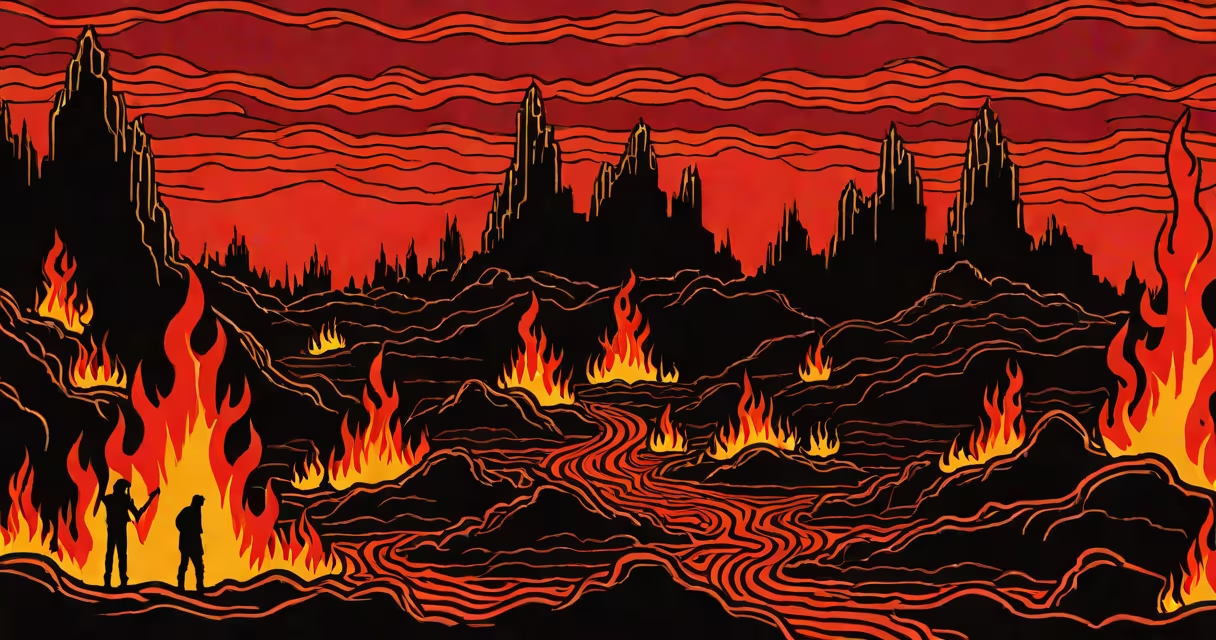
Hell is described in Christian scripture as a place of eternal separation from God, marked by fire, darkness, and torment, though its exact appearance remains symbolic rather than literal. The concept draws from Old Proof imagery of Sheol and New Proof references to Gehenna, a valley outside Jerusalem associated with judgment.
The Bible does not provide a detailed visual blueprint of hell. Instead, it uses metaphors rooted in ancient Near Eastern cosmology. In Matthew 25:41, Jesus says, "Depart from me, you cursed, into the eternal fire prepared for the devil and his angels." This fire is not necessarily physical but represents divine judgment and spiritual anguish. The Book of Revelation describes a "lake of burning sulfur" (Revelation 20:10), where Satan and the fallen are cast, but this is presented as apocalyptic vision, not a geographic map.
Artistic representations have shaped popular perceptions. Medieval European paintings often depict hell as a cavernous, fiery underworld with demons dragging souls into flames. These images reflect the cultural anxieties of the time, not scriptural accuracy. The most famous example is Dante's *Inferno*, which structures hell as a series of concentric circles, each punishing a different sin. While influential, Dante's vision is literary, not doctrinal.
Hell functions as a theological structure for understanding moral consequence and divine justice. It is not a physical location in space but a state of existence defined by exclusion from God's presence. Theologians such as N.T. Wright argue that hell is not a place of eternal torture but a condition of self-imposed separation-eternal alienation from God, who is love itself.
Scripture emphasizes relational consequences over spatial ones. In Luke 16:23, the rich man in Hades cries out, "I am in agony in this fire." But Hades in this context is not the final destination-it's a temporary holding place. Final judgment occurs after resurrection, when the dead are raised and face God's verdict (Romans 14:10-12).
Modern Christian denominations differ widely in their views. Catholic teaching, as outlined in the Catechism of the Catholic Church (paragraph 1035), affirms hell as a reality, but stresses that God desires all to be saved. Protestant traditions vary: some emphasize eternal conscious torment, others teach annihilationism-the belief that the wicked cease to exist rather than suffer forever.
Images of hell rely on recurring symbols drawn from ancient literature and religious texts:
These elements are not meant to be taken literally. They serve as emotional and moral language. For example, "gnashing of teeth" appears 13 times in the Gospels, always in contexts of judgment or exclusion-not as a physical detail.
References to hell appear in sermons, religious education, and moral instruction. They are used to show the seriousness of sin and the urgency of repentance. In the early church, hell was a tool for conversion-especially during periods of mass evangelization.
Today, theologians caution against using hell as a threat. Theologian John Hick argued that eternal punishment contradicts the idea of a loving God. He proposed that hell is not a place of endless suffering but a process of transformation through which individuals may choose reconciliation.
Some churches avoid discussing hell altogether, focusing instead on grace and mercy. Others integrate it into teachings on free will and accountability. The United Methodist Church, for example, teaches that hell is "a state of being separated from God," not a physical location.
Many people assume hell is a literal underground furnace with demons and pitchforks. This view stems from medieval art and later pop culture, not scripture. The Bible never describes hell as a place with lava rivers or demon guards.
A common error is equating hell with the afterlife. In Christian doctrine, heaven and hell are both states of eternal existence, but they differ in quality. Heaven is communion with God; hell is absence. The distinction matters: hell is not a mirror image of heaven, nor is it a area governed by evil spirits in control.
Another misconception is that hell is a punishment imposed by God. Scripture presents it as a result of human choice. Jesus says, "The Son of Man will send his angels, and they will weed out everything that causes sin and all who do evil" (Matthew 13:41). Judgment is not arbitrary-it follows patterns of behavior and intention.
One overlooked point: the word "hell" in English translations of the Bible doesn't always come from the same original term. In the New Proof, "Gehenna" appears 12 times and refers to the Valley of Hinnom, a site historically used for child sacrifice before reformers cleansed it. Jesus uses it as a metaphor for final judgment, not a geographic location.
Another fact: the earliest Christian writings don't describe hell in detail. The Gospel of Thomas, a non-canonical text, contains no mention of hell. The concept evolved over centuries, influenced by Roman and Persian dualism. Early Christians focused more on resurrection than on post-death punishment.
Even within the Bible, the portrayal of hell varies. In Ezekiel 32:18-32, the prophet describes the dead descending into Sheol, a shadowy underworld. But Sheol is not synonymous with hell-it's a neutral place of the departed, not a site of punishment.
Jesus tells a story in Luke 16:19-31 about a rich man who dies and goes to Hades, while a poor beggar named Lazarus is carried to Abraham's side. The rich man sees Lazarus and begs for relief. Abraham replies, "Child, remember that in your lifetime you received your good things, and Lazarus received bad things."
This parable illustrates moral reversal, not geography. The rich man is not punished because he was wealthy-he is judged for neglecting the poor. The story ends with a warning: "If they do not listen to Moses and the Prophets, they will not be convinced even if someone rises from the dead."
Despite its vivid imagery, the parable is not meant to be a literal description of the afterlife. It's a narrative device to teach ethical responsibility. The fire, the chasm, the request for water-all are symbolic of spiritual distance and unfulfilled longing.
When interpreting such passages, scholars like Elaine Pagels (author of *The Gnostic Gospels*) emphasize that early Christian communities saw the afterlife as a spiritual reality, not a physical one. The focus was on inner transformation, not external scenery.
What does hell really look like? Not like a painting, a movie scene, or a video game level. It is a concept rooted in moral consequence, divine justice, and spiritual relationship. The Bible offers no photograph, only poetry and prophecy. Its purpose is not to terrify but to awaken conscience.
Understanding hell requires moving beyond imagery. It demands reflection on justice, love, and the weight of choices. What does hell really look like? Perhaps it looks like a soul that has turned away from light-and chosen silence instead.