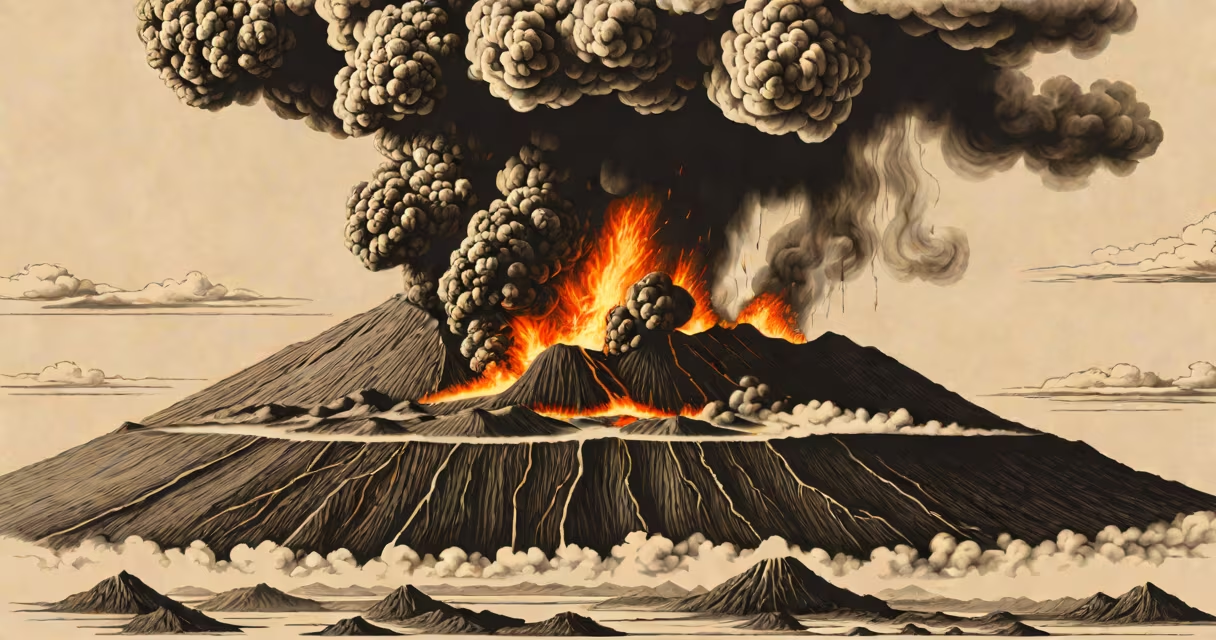
Volcanoes erupt when pressurized magma rises from beneath Earth's crust and escapes through a vent or fissure, driven by expanding gases and internal heat. This process occurs at tectonic plate boundaries or hotspots, resulting in lava flows, ash clouds, pyroclastic surges, or explosive blasts.
Magma forms when rock melts deep underground due to high temperature and pressure. As it accumulates in a magma chamber, dissolved gases such as water vapor, carbon dioxide, and sulfur dioxide begin to exsolve-separate from the molten rock-as pressure drops. These gases expand rapidly, pushing magma upward through fractures and conduits toward the surface.
The eruption type depends on magma composition. Basaltic magma, low in silica, flows easily and produces effusive eruptions like those seen in Hawaii. Rhyolitic magma, rich in silica, is thick and viscous, trapping gases and leading to violent explosions, as in Mount St. Helens in 1980.
Magma originates in the mantle or lower crust where temperatures exceed 1,200°C. Partial melting of peridotite or basaltic rock generates liquid rock that is less dense than surrounding solid material. Buoyancy drives it upward through weak zones in the crust.
As magma ascends, pressure decreases. This causes dissolved gases to form bubbles. The expansion of these bubbles increases internal pressure. When pressure exceeds the strength of overlying rock, a fracture opens, allowing magma to escape.
A 2018 study by the U.S. Geological Survey (USGS) found that gas content in magma correlates strongly with eruption explosivity. For example, magma with over 6% dissolved water can produce explosive eruptions, while magmas below 3% typically result in gentle lava flows.
Eruptions fall into two broad categories based on behavior and magma chemistry:
| Type | Magma Composition | Explosiveness | Example |
|---|---|---|---|
| Effusive | Basaltic (low silica) | Low | Hawaiian-style eruptions (Kīlauea, 2018) |
| Explosive | Rhyolitic or andesitic (high silica) | High | Mount St. Helens (1980), Vesuvius (79 CE) |
Effusive eruptions release lava steadily. Lava flows can travel kilometers and destroy infrastructure, but they move slowly enough for evacuation. Kīlauea's 2018 eruption produced over 1 billion cubic meters of lava, filling valleys and burying homes in Puna District, Hawai'i.
Explosive eruptions involve sudden decompression. Gas bubbles grow rapidly, fragmenting magma into ash and rock fragments. The 1980 eruption of Mount St. Helens ejected 1 cubic kilometer of material, flattened 600 square kilometers of forest, and sent ash 15 km into the atmosphere.
Most volcanoes form at tectonic plate boundaries. At divergent boundaries, like the Mid-Atlantic Ridge, plates pull apart, allowing magma to rise and form new crust. At convergent boundaries, subduction zones force oceanic plates under continental ones, melting rock and generating magma.
Hotspots are stationary plumes of mantle material that melt through the crust. They create chains of volcanoes as plates move over them. The Hawaiian Islands formed this way, with the oldest island (Kaua'i) over 5 million years old and the youngest (Hawai'i Island) still growing.
A common misconception is that all volcanic activity happens at plate edges. In reality, over 80% of Earth's volcanoes are located at subduction zones, but hotspot volcanism accounts for significant eruptions, including those in Yellowstone National Park.
Volcanic eruptions are not caused by "underground fires." Magma is not burning-it's molten rock heated by geothermal energy and radioactive decay in Earth's interior. The term "lava" applies only to magma once it reaches the surface.
Another error is equating all eruptions with destruction. While explosive events cause widespread damage, many eruptions are harmless or even beneficial. Volcanic soils are highly fertile-farming thrives near Mount Etna in Sicily and in parts of Indonesia.
One non-obvious fact: gas emissions often precede eruptions. Monitoring sulfur dioxide levels helps scientists predict activity. At Popocatépetl in Mexico, increased SO₂ detected in 2019 led to evacuations before a major explosion occurred.
In April 2010, Iceland's Eyjafjallajökull volcano erupted after decades of dormancy. Magma interacted with glacial ice, creating steam explosions that fragmented the magma into fine ash.
Over 500 million tons of ash were injected into the atmosphere. The ash cloud disrupted air travel across Europe for six days, grounding over 100,000 flights. This event demonstrated how a relatively small eruption can have global economic impact.
Scientists later confirmed that the eruption was triggered by a combination of magma ascent and ice-melt-induced pressure changes-a rare interaction between glacial and magmatic systems.
Understanding how volcanoes erupt relies on monitoring seismic activity, ground deformation, and gas emissions. The Global Volcano Model network tracks over 1,500 active volcanoes worldwide using satellite data and ground sensors.
When magma reaches the surface, it becomes lava. The temperature of basaltic lava ranges from 1,100°C to 1,200°C. At that heat, it can burn through wood, asphalt, and even concrete-but it moves slowly enough that people can outrun it.
Knowing how volcanoes erupt helps communities prepare. Early warning systems, evacuation plans, and land-use zoning reduce risk. The 1991 eruption of Mount Pinatubo in the Philippines was accurately forecasted, saving tens of thousands of lives.
Earth's changing interior continues to shape its surface. How volcanoes erupt is not random-it follows physical laws of pressure, density, and fluid dynamics. Studying these processes reveals both danger and wonder in Earth's living geology.