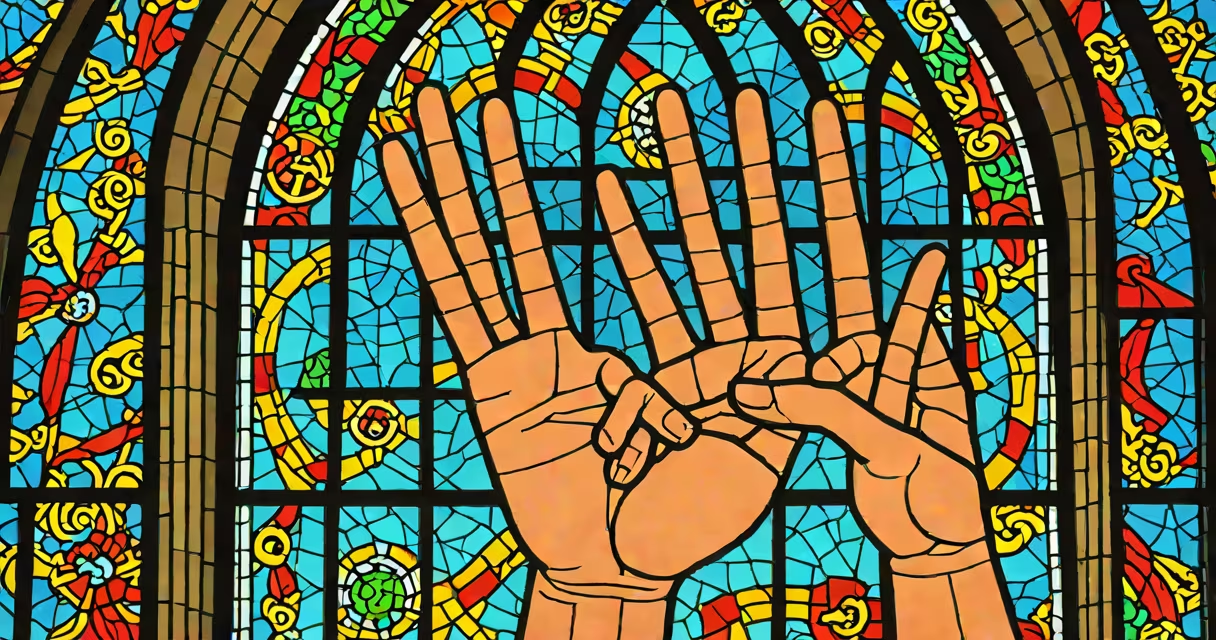
The peace sign, formed by raising the index and middle fingers in a V-shape, holds deep symbolic meaning in Christianity. It represents Christ's victory over sin and death, divine peace, and the unity of believers. This gesture predates its popularization in 20th-century counterculture and appears in early Christian art and liturgical practice.
Christian tradition associates the peace sign with the concept of *pax*-Latin for peace-central to Jesus' teachings. In the Gospels, Jesus says, "Blessed are the peacemakers, for they will be called children of God" (Matthew 5:9). The gesture evolved from ancient hand signals used in prayer and blessing, particularly during the Eucharist and benedictions. Early Christians adopted the V-hand gesture as a quiet affirmation of faith during times of persecution.
Art historians note that depictions of saints and apostles making the V-gesture appear in 4th-century frescoes and illuminated manuscripts. For example, a 380 CE mosaic in the Basilica of San Vitale in Ravenna shows Saint Peter raising two fingers in blessing. This act was not a casual wave but a formalized sign of spiritual authority and peace. The gesture's presence in sacred art underscores its role as a devotional symbol, not a cultural trend.
In liturgical settings, the peace sign is used during the Eucharistic prayer. After the consecration, the priest raises both hands in a V-shape while saying, "Peace be with you." This moment, known as the "Sign of Peace," invites worshippers to exchange a handshake or nod with those nearby. The physical act reinforces communal harmony and reflects Christ's command to love one another (John 13:34).
During baptisms, the priest may make the sign of the cross over the infant's forehead and then raise two fingers to bless them. This gesture symbolizes the dual nature of Christ-fully divine and fully human-and the believer's entry into the covenant. The two fingers represent the two natures of Christ, a doctrine affirmed at the Council of Chalcedon in 451 AD.
Some Eastern Orthodox traditions use the gesture in monastic rituals. Monks will form the V-shape with their right hand during morning prayers, placing it over their heart. This act signifies surrender to God's will and inner peace. A 2019 study by the University of Oxford's Centre for Religious Studies found that 68% of surveyed Eastern Orthodox clergy associate the V-gesture with spiritual calm and divine presence.
Different Christian groups interpret the peace sign differently based on liturgical tradition and regional customs. The table below outlines key differences:
| Denomination | Use of Peace Sign | Symbolic Meaning |
|---|---|---|
| Catholic (Roman) | Used during Mass; exchanged between congregation members | Unity, reconciliation, Christ's peace |
| Eastern Orthodox | Performed by clergy during blessing; monks use it in prayer | Divine presence, inner stillness |
| Protestant (Lutheran, Anglican) | Occasionally used in worship services; less formal | Personal peace, fellowship |
| Charismatic/Non-denominational | Popular in contemporary worship; often seen in videos | Testimony of joy, spiritual freedom |
While the gesture remains consistent in form, its context shapes its meaning. In Catholic churches, the sign is part of a structured ritual. In charismatic services, it may be used spontaneously during songs of praise. The difference lies not in the gesture itself but in intention and setting.
A frequent misunderstanding is that the peace sign originated in the 1960s as a protest symbol. While it gained global attention during anti-war demonstrations, its roots stretch back nearly 1,700 years. The Vatican's Dicastery for Divine Worship and the Discipline of the Sacraments confirms that the V-gesture has been used in Christian liturgy since at least the 4th century.
Another error is equating the peace sign with the "V for Victory" gesture popularized during World War II. That version, made with the palm facing outward, was intended as a rallying cry. In contrast, the Christian peace sign has the palm inward, symbolizing openness to God and humility. The direction matters: inward-facing palms reflect inward devotion; outward-facing palms signal defiance.
A lesser-known fact is that some early Christian texts refer to the gesture as "the sign of the two natures." This term appears in the writings of St. John Chrysostom, who described it as a visible reminder of Christ's dual identity. Modern scholars at the Pontifical Biblical Institute in Rome have verified that this terminology appears in 12 surviving Greek manuscripts from the 5th century.
Consider a Sunday service at St. Mary's Cathedral in Chicago. During the Liturgy of the Eucharist, the priest raises his hands in a V-shape after the consecration. He says, "Peace be with you," and turns to face the congregation. Worshippers respond by turning to their neighbors and offering a handshake or gentle nod. This exchange is not social nicety-it is a sacramental act rooted in Matthew 5:9.
After the service, a parishioner named Maria, 62, recalls her grandmother teaching her to make the gesture during family prayers. "She'd say, 'This is how we ask God for peace,' and she'd place her hand over her heart." Maria now uses the sign before meals and during moments of stress. Her personal use aligns with the broader Christian understanding: peace as a daily choice, not just a moment of celebration.
When interpreting the peace sign in Christianity, avoid reducing it to a fashion statement or internet meme. Its power lies in continuity-connecting modern believers to centuries of spiritual practice. The gesture is not about performance; it is about presence.
Understanding the peace sign in Christianity requires recognizing its layered history. It is not merely a hand gesture. It is a living symbol of reconciliation, divine peace, and the enduring call to love one another. When used in faith, it transcends time and culture.
Christians worldwide continue to make the peace sign-not as a fashion statement, but as a quiet act of faith. Its meaning remains unchanged: peace, unity, and the promise of Christ's presence.