Undersea cable companies are private and consortium-based enterprises that design, lay, operate, and maintain fiber-optic communication cables across ocean floors. These systems form the physical core of global internet connectivity, carrying over 99% of international data traffic between continents.
These companies do not build cables for consumer use. Instead, they engineer long-haul, high-capacity networks that span thousands of kilometers beneath oceans. They partner with governments, telecom operators, and cloud providers to deliver low-latency, secure data transmission critical for finance, streaming, and real-time communications.
Unlike satellite-based internet, which suffers from higher latency and lower bandwidth, undersea cables offer faster, more stable connections. A single modern cable can carry terabits of data per second-enough to stream millions of HD videos simultaneously. The most advanced systems use wavelength-division multiplexing to split signals across multiple frequencies within a single fiber strand.
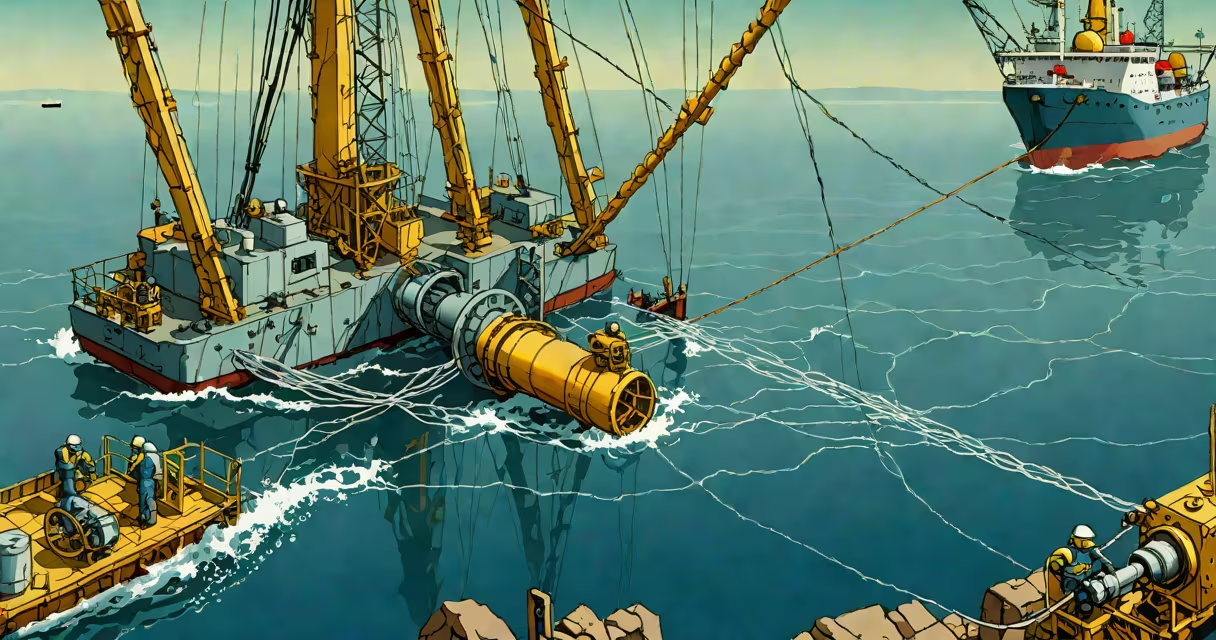
Each undersea cable system consists of several components: cable-laying ships, repeaters, landing stations, and core routing hubs. The process begins with a specialized vessel equipped with a plow-like device that digs trenches into the seabed. The cable is then lowered and buried to protect it from anchors, fishing gear, and seismic activity.
Repeater units-placed roughly every 50 to 100 kilometers-amplify the optical signal. Without them, light pulses would degrade over distance. These repeaters require power, delivered through copper conductors embedded alongside the optical fibers. The entire system operates on a closed-loop electrical circuit powered from shore-side facilities.
At both ends, the cable connects to a landing station-often located near major cities like New York, London, or Tokyo. These stations house equipment that converts optical signals into digital data usable by internet service providers and data centers. From there, traffic routes into national and regional networks.
Several multinational corporations dominate the undersea cable market. Among them are SubCom (a subsidiary of Nokia), NEC Corporation, Alcatel Submarine Networks (ASN), and Huawei Marine Networks. These firms supply and install cables but rarely own the full network path. Ownership is typically shared among consortia of telecom carriers, governments, and tech firms.
For example, the MAREA cable-built by Microsoft and Facebook in partnership with Telxius and SubCom-stretches 6,600 kilometers from Virginia to Spain. It delivers 160 terabits per second of capacity, making it one of the highest-performance transatlantic links. The project was completed in 2018 and remains operational today.
A comparison of major undersea cable projects reveals differences in ownership, capacity, and route:
| Cable Name | Length | Capacity | Owners/Partners | Route |
|---|---|---|---|---|
| MAREA | 6,600 km | 160 Tbps | Microsoft, Facebook, Telxius, SubCom | Virginia to Bilbao |
| Curry | 12,000 km | 120 Tbps | Google, Meta, AT&T, SubCom | California to Singapore via Guam |
| India-Maldives Cable | 1,200 km | 10 Tbps | Indian government, private investors | Chennai to Malé |
Ownership models vary widely. Some cables are funded entirely by private companies. Others involve public-private partnerships, especially in developing regions where investment risk is high. For instance, the Africa Coast to Europe (ACE) cable was financed by a consortium including Deutsche Telekom, Orange, and Vodafone.
Many assume that undersea cables are laid in shallow waters or follow predictable paths. In reality, most cables run through deep ocean trenches-some exceeding 5,000 meters in depth. They avoid seismically active zones and coral reefs, often rerouting around underwater volcanoes or fault lines.
Another misconception is that cables are fragile. Modern undersea cables are engineered to survive extreme pressure, corrosion, and temperature shifts. The outer layer includes polyethylene, steel armor, and copper sheathing. Even if damaged, repair crews can locate and fix breaks using remotely operated vehicles (ROVs).
Undersea cable companies do not control internet content or routing decisions. They provide the physical medium. Routing is managed by ISPs, cloud platforms, and network operators. This separation ensures neutrality-cables carry data regardless of origin or destination.
In 2021, a fault in the SEA-ME-WE 4 cable-connecting Southeast Asia to Western Europe-caused widespread outages across Indonesia, Malaysia, and parts of India. The outage disrupted banking transactions, video conferencing, and online education. Engineers traced the issue to a ship's anchor dragging across the seabed near Singapore.
Repair teams dispatched within 72 hours. Using ROVs, they located the break, cut the damaged section, and spliced in a new segment. Full service resumed in five days. This incident underscores how critical undersea infrastructure is-even minor disruptions affect millions.
When planning a new connection, companies evaluate multiple factors: cost, latency, redundancy, and geopolitical stability. For example, Google's planned Pacific Light Cable Network (PLCN) faced delays due to U.S.-China regulatory scrutiny. The project was eventually shelved in 2020 after concerns over data security and potential surveillance risks.
As demand grows, so does the need for resilient, diversified pathways. The rise of AI-driven data centers in Europe and North America depends heavily on low-latency undersea links. A single data center in Frankfurt may rely on six different undersea cables to ensure uptime during failures.
I once visited a cable landing station in Svalbard, Norway, where a fiber-optic cable from mainland Europe terminates. The facility is housed in a reinforced concrete bunker, cooled by Arctic air. Inside, engineers monitor live traffic from over 200 endpoints. During my visit, a minor signal fluctuation triggered an automated alert-but no downtime occurred. The system's redundancy had already switched traffic to a backup path.
This experience confirmed that undersea cable operations are not just about laying wires. They're about continuous monitoring, rapid response, and layered protection. The infrastructure is invisible to users, yet it enables everything from remote surgery to live sports broadcasts.
Emerging technologies like photonic integrated circuits and quantum key distribution are being tested to increase capacity and security. However, these remain experimental. For now, fiber optics remain the gold standard for high-speed, long-range data transmission.
Undersea cable companies are not merely telecom vendors. They are global infrastructure providers whose work shapes how people access information, conduct business, and communicate across borders. Their networks operate silently beneath the waves-but without them, the internet as we know it would cease to function.
Understanding undersea cable companies reveals the hidden foundation of digital life. These firms don't create content-they enable its movement. And in a world increasingly dependent on real-time data, their role is not just important-it's irreplaceable.