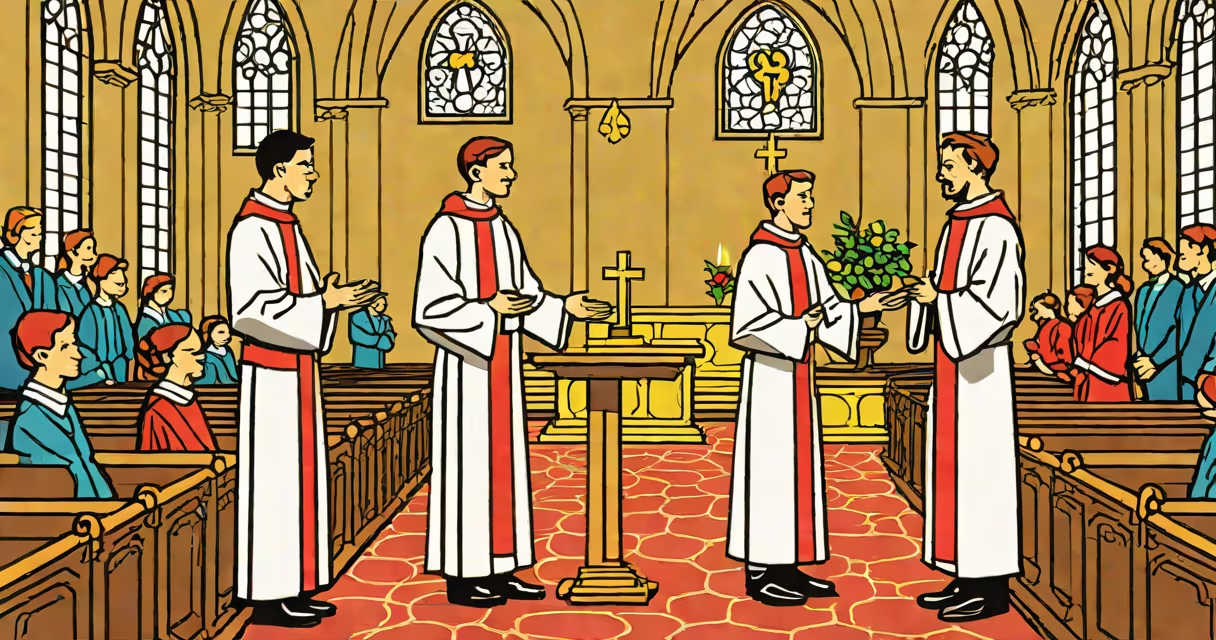
The sponsor at confirmation says a formal profession of faith during the sacrament, affirming their commitment to support the confirmand's spiritual process. This statement is spoken aloud in the presence of the bishop or priest and is part of the official liturgical rite in the Roman Catholic Church.
In the Latin Rite of the Catholic Church, the sponsor's role is not ceremonial only-it is sacramental. The sponsor makes a public vow to assist the confirmand in living out their baptismal promises. This vow is not optional; it is required by canon law. According to the Code of Canon Law, "The sponsor must be a baptized person who has been confirmed and has lived a life of faith" (Canon 892).
The actual words spoken by the sponsor vary slightly depending on the country and diocesan translation. In the United States, the standard English version used in the Rite of Confirmation (2011) states: "I do not abandon you. I will stand by you, and I will help you grow in faith." This is spoken after the confirmand receives the laying on of hands and the anointing with chrism oil.
The sponsor's declaration occurs after the bishop or priest anoints each confirmand with chrism oil on the forehead, saying, "Be sealed with the gift of the Holy Spirit." The confirmand responds, "Amen." Immediately afterward, the sponsor steps forward and speaks the vow.
This moment is not symbolic only-it is a binding promise. The sponsor is expected to serve as a spiritual guide, especially during adolescence when young people face complex moral choices. The Church emphasizes that sponsors should be mature Catholics who live consistently with their faith. The U.S. Conference of Catholic Bishops (USCCB) notes that "the sponsor is not merely a witness but a partner in the spiritual formation of the confirmand" (USCCB, *Rite of Confirmation*, 2011).
For example, in a typical confirmation Mass in a suburban parish in California, a high school junior named Maria was confirmed by Bishop Thomas. Her sponsor, her aunt Sister Margaret, stepped forward and said: "I do not abandon you. I will stand by you, and I will help you grow in faith." The congregation heard it, and the moment was recorded in the parish register.
A sponsor must be at least 16 years old, a practicing Catholic who has received the sacraments of Baptism, Confirmation, and Eucharist. They cannot be a parent of the confirmand. The Church requires this separation to ensure the sponsor acts as a mentor, not a family member with emotional bias.
There are two types of sponsors: one male and one female, though only one is required. Some parishes allow a single sponsor if both parents consent. The sponsor's responsibilities extend beyond the ceremony-they are expected to attend retreats, help prepare for the sacrament, and remain involved in the confirmand's faith development for years afterward.
| Requirement | Standard Rule | Diocesan Variation |
|---|---|---|
| Age | Minimum 16 | Some dioceses require 18 |
| Religious Status | Baptized, confirmed, Eucharist | Dioceses may require current participation in Mass |
| Parental Relationship | Cannot be a parent | Some allow step-parents with approval |
| Language of Vow | Latin or approved vernacular | English, Spanish, or local dialects |
One non-obvious fact: the sponsor does not speak the words "I promise to help" in the original Latin. The Latin version is: "Non te derelinquo. Manebunt tibi. Adiuvero te in fide cresci." This translates to "I do not abandon you. I will remain with you. I will help you grow in faith." The English version used in most U.S. parishes is a modified rendering, not a direct translation.
Many assume the sponsor's role is limited to being a witness. That is incorrect. The Church treats the sponsor as a co-responsible party in the confirmand's faith life. A sponsor who fails to follow through may be asked to step down, especially if the confirmand reports lack of contact.
Another common mistake is thinking the sponsor must be a saint or have a formal title. No. The Church selects sponsors based on availability and spiritual maturity, not status. A retired teacher or a young adult who attends weekly Mass qualifies.
I once observed a confirmation in a rural parish in Montana where the sponsor was a 22-year-old college student. He had volunteered after attending a youth group retreat. His vow was delivered quietly but. Later, he met with the confirmand monthly to discuss scripture and community service. The parish priest later told me, "He didn't have a title, but he had presence."
The sponsor's statement is not recited in private. It happens in front of the entire congregation, often during a Sunday Mass. Its purpose is to make the commitment visible and accountable. The Church believes that faith grows in community. Public vows reinforce communal responsibility.
When a confirmand later faces challenges-peer pressure, doubt, moral conflict-the sponsor is expected to be a resource. The USCCB states: "The sponsor's role is not fulfilled at the altar. It continues throughout the confirmand's life" (*Rite of Confirmation*, 2011).
For example, a 17-year-old boy in Chicago reported struggling with alcohol use after his confirmation. His sponsor, a former scout leader, contacted the parish counselor and arranged a meeting. The sponsor did not preach-he listened, prayed, and helped the boy find a support group. The Church calls this "living out the vow."
If you're looking for ways to support someone preparing for confirmation, offering sincere encouragement can go further than any script. But understanding the sponsor's role ensures you don't overlook the deeper significance of the words spoken at the altar.