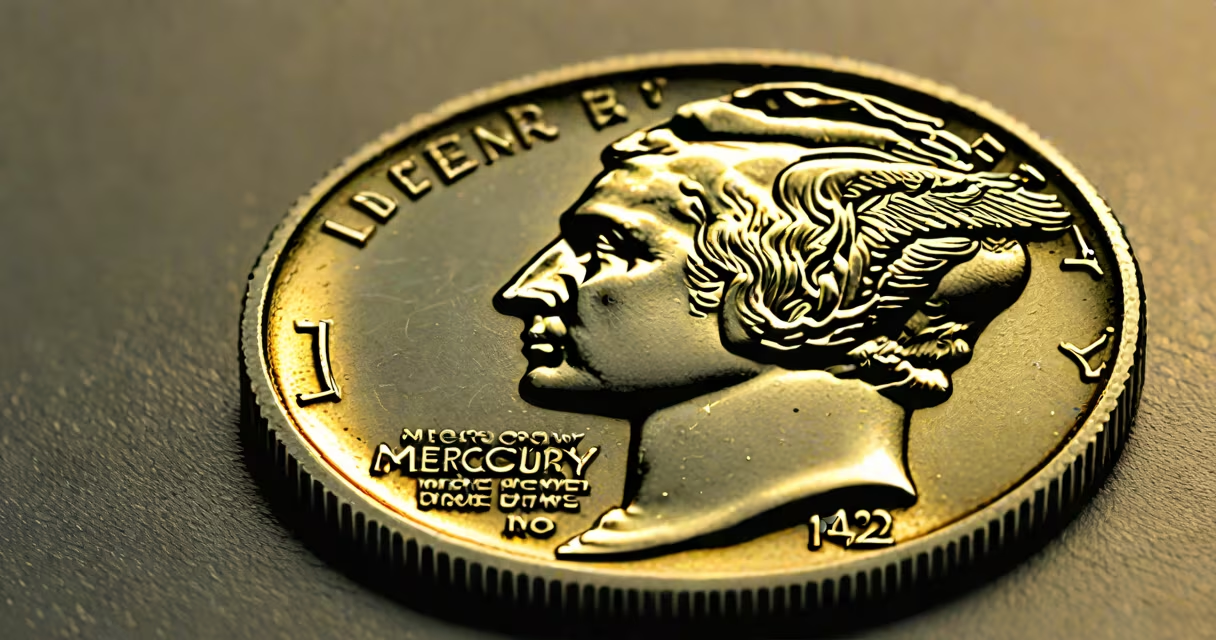
The 1942 Mercury dime is a U.S. 10-cent coin featuring Liberty wearing a winged cap, minted during World War II. Its value ranges from $2.50 to $10 in circulated condition, rising to $50 or more in uncirculated grades. The coin's worth depends on grade, mint mark, and silver content.
Designed by Adolph Weinman, the Mercury dime was produced from 1916 to 1945. The 1942 issue was struck at three mints: Philadelphia (no mint mark), Denver (D), and San Francisco (S). Despite the name, the figure is not Mercury-it represents liberty personified with a winged cap symbolizing freedom of thought.
Each 1942 Mercury dime contains 0.0723 troy ounces of pure silver. With silver prices fluctuating, the bullion value alone exceeds $2.50 as of 2024. This base value increases when the coin is in better condition.
Coin value is based on three factors: condition, mint mark, and demand. A coin's grade is assessed using the Sheldon Scale, which ranges from Poor (P-1) to Perfect Uncirculated (MS-70).
A worn 1942 P-dime (Philadelphia) in Good (G-4) condition may sell for $2.50. A similar coin in Fine (F-12) condition can reach $4. A Very Fine (VF-20) example might fetch $6. An uncirculated coin graded MS-65 can sell for $12 to $15. Coins in MS-67 or higher often exceed $50.
Mint marks matter. The 1942-D (Denver) and 1942-S (San Francisco) dimes are rarer than the Philadelphia version. A 1942-D dime in MS-65 is worth $10 to $18. The 1942-S, though less common, typically trades between $15 and $30 in MS-65, depending on eye appeal.
| Mint Mark | Good (G-4) | Fine (F-12) | Very Fine (VF-20) | MS-65 | MS-67 |
|---|---|---|---|---|---|
| P (Philadelphia) | $2.50 | $4.00 | $6.00 | $12-$15 | $25-$35 |
| D (Denver) | $3.00 | $5.00 | $7.50 | $10-$18 | $30-$50 |
| S (San Francisco) | $4.00 | $6.00 | $9.00 | $15-$30 | $50+ |
Grading is not standardized across sellers. A coin described as "uncirculated" by one dealer may be graded MS-63 by a professional service like PCGS or NGC. Always verify with a third-party grading company.
Many collectors assume all Mercury dimes are valuable. That's false. The 1942 P-dime is common-over 100 million were minted. Its low premium reflects high supply. Only about 1.5 million 1942-D dimes and 400,000 1942-S dimes were produced.
Another misconception: the coin's name implies it features Mercury. The winged cap symbolizes liberty, not the Roman god. Weinman intended the design to represent freedom of thought, not mythology.
A non-obvious fact: the 1942-S dime has a higher survival rate than earlier issues. San Francisco's lower production volume combined with fewer circulation years preserved more examples in high grades. This makes the 1942-S more desirable among collectors.
In 2023, a 1942-S Mercury dime graded MS-65 by PCGS sold for $38.75 on eBay. The coin had sharp details-the wing tips on the cap were distinct, the obverse hairlines were crisp, and the reverse showed full feather detail on the eagle's wing. The buyer paid a premium due to the coin's eye appeal and low population of MS-65 examples.
Compare that to a 1942-P dime in G-4 condition, which sold for $2.75 in a local coin shop. The difference stems from scarcity and preservation. The San Francisco mint mark adds rarity, while the high grade adds desirability.
For accurate valuation, use a professional grading service. PCGS and NGC offer certified grading with a tamper-proof slab. Submitting a coin to either service costs $25-$50, depending on speed and grade level.
When selling, list on platforms like eBay, Heritage Auctions, or local coin dealers. Dealers buy at a discount-typically 10-20% below market value-to cover risk and overhead. For example, a 1942-D dime valued at $14 on eBay might sell for $11 to a dealer.
I once evaluated a 1942-P dime brought in by a collector. It had light wear on the cheek and hairline. After cleaning, the coin looked better-but I advised against it. Cleaning removes original toning and reduces value. The coin was worth $3.50 uncleaned, $2.00 after. Original surfaces preserve authenticity.
Always avoid chemical cleaners or ultrasonic baths. These damage the surface and reduce numismatic value. Preserve the coin's natural state.
If you're considering collecting, focus on high-grade examples with strong eye appeal. The 1942-S dime in MS-65 or higher offers the best return potential. For beginners, start with common dates in fine or very fine condition to learn grading without high risk.
Understanding what is a 1942 mercury dime worth requires attention to grade, mint mark, and preservation. Silver content provides a floor value, but condition drives price. A well-preserved 1942-S dime can outperform many rarer coins in long-term appreciation.