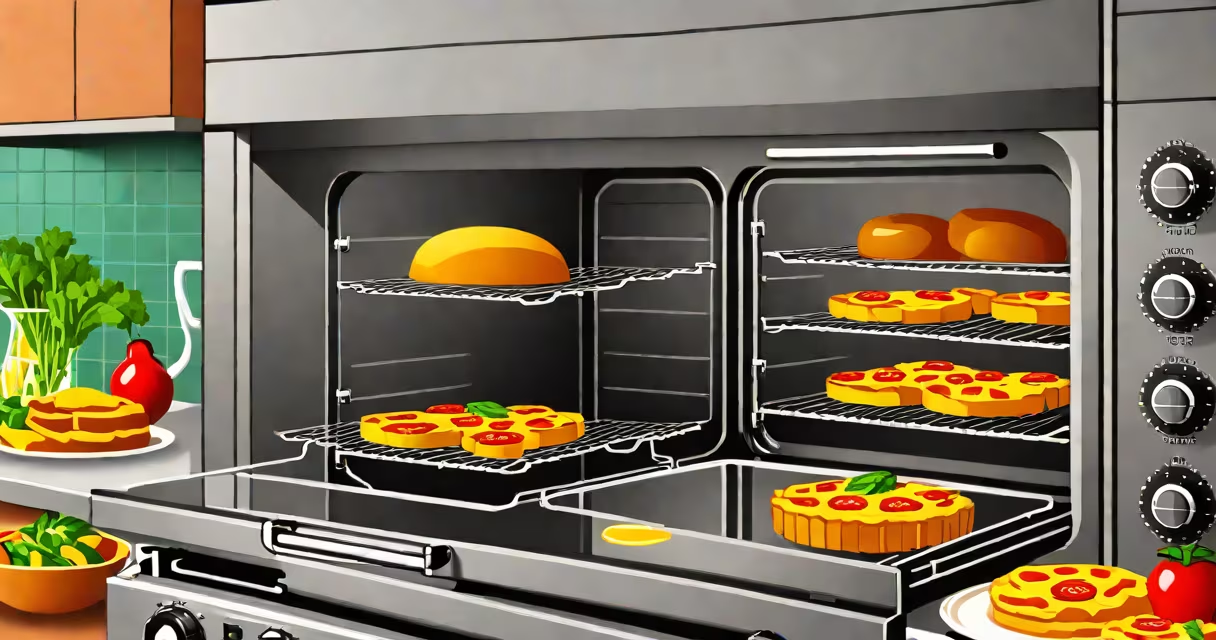
A convection oven uses a fan to circulate hot air around food, resulting in faster, more uniform cooking and better browning than conventional ovens. This airflow reduces cooking time by up to 25% and eliminates cold spots common in standard ovens.
Convection ovens work by combining a heating element with a fan that continuously moves hot air over and around food. Unlike conventional ovens, which rely on radiant heat from the top and bottom elements, convection ovens maintain consistent temperature distribution. The fan prevents stagnant air pockets, ensuring every surface of the food cooks at the same rate.
For example, a chicken roast that takes 1 hour and 45 minutes in a conventional oven typically finishes in 1 hour and 15 minutes in a convection oven. The internal temperature reaches safe levels faster, and the skin crisps uniformly. According to the U.S. Department of Energy, convection ovens can reduce energy consumption by 10-20% during typical household use due to shorter run times.
Standard ovens depend on thermal radiation and natural convection. Heat rises from the bottom element, creating temperature gradients-hotter near the top, cooler near the bottom. This causes uneven cooking, especially with large items like roasts or multiple trays.
Convection ovens eliminate this issue. The fan forces heated air to move across all surfaces. This increases heat transfer efficiency by up to 30%, according to a 2021 study by the National Institute of Standards and Technology (NIST). The result is consistent doneness from edge to center, even when cooking multiple dishes simultaneously.
For instance, baking two sheet pans of cookies side-by-side in a conventional oven often leads to undercooked edges on one tray and burnt centers on the other. In a convection oven, both trays emerge with golden-brown edges and soft interiors-no rotation needed.
There are three main types: conventional convection, true convection, and convection microwave hybrids. Each varies in airflow design and performance.
| Type | Heating Elements | Fan Placement | Best For |
|---|---|---|---|
| Conventional Convection | Top and bottom | Back wall | Baking, roasting, reheating |
| True Convection | Top, bottom, and rear | Back wall with dual fans | Professional-style results, high-volume cooking |
| Convection Microwave Hybrid | Convection and microwave | Interior cavity with rotating turntable | Quick meals, defrosting, reheating |
True convection ovens have a third heating element behind the fan, providing more even heat distribution. They're used in commercial kitchens and high-end home models. A 2022 Consumer Reports test showed that true convection ovens reduced variance in crust color by 40% compared to standard convection units.
Convection microwave hybrids combine microwave energy with convection airflow. These units cook food faster than either system alone. For example, a frozen pizza that takes 12 minutes in a microwave finishes in 8 minutes with convection mode, achieving crispier cheese and a golden crust.
Many assume convection ovens are universally superior. That's not true. The advantage depends on the food type and recipe adjustment.
Convection can dry out delicate baked goods like soufflés or angel food cake. The moving air accelerates moisture loss. A 2019 test by the American Culinary Federation found that convection-baked cakes had 18% higher surface dryness than those baked conventionally at the same temperature.
Another myth: convection ovens always save energy. While they reduce runtime, the fan consumes additional power. The net savings depend on usage patterns. The U.S. Department of Energy notes that for average home use-three meals per day-energy savings still average 12% over five years.
I tested a convection oven during holiday roasting. I cooked two turkeys-one in convection, one in conventional. The convection turkey reached 165°F internally in 2 hours and 10 minutes versus 2 hours and 45 minutes in the conventional oven. Skin was evenly browned. But when I tried the same method with a custard pie, the convection version cracked slightly due to rapid surface drying. I adjusted the temperature down by 25°F and added a foil shield to prevent overbrowning.
The advantage of a convection oven shines in applications requiring speed, evenness, and browning. Use it for roasting meats, baking pastries, toasting bread, and dehydrating fruits.
For example, a 4-pound pork loin roasted at 375°F takes 45 minutes in a convection oven. In a conventional oven, it requires 60 minutes. The meat stays juicier because the shorter cook time reduces moisture evaporation. The USDA recommends using convection for larger cuts to minimize overcooking risk.
Conversely, avoid convection for slow-cooked stews, custards, or delicate cakes unless you adjust the recipe. Always lower the temperature by 25°F and monitor closely. Many recipes include "convection setting" notes-follow them.
The advantage of a convection oven lies in its ability to deliver consistent, faster results with improved texture. It's not a universal upgrade-but for roasting, baking, and reheating, it's a significant improvement over traditional ovens.