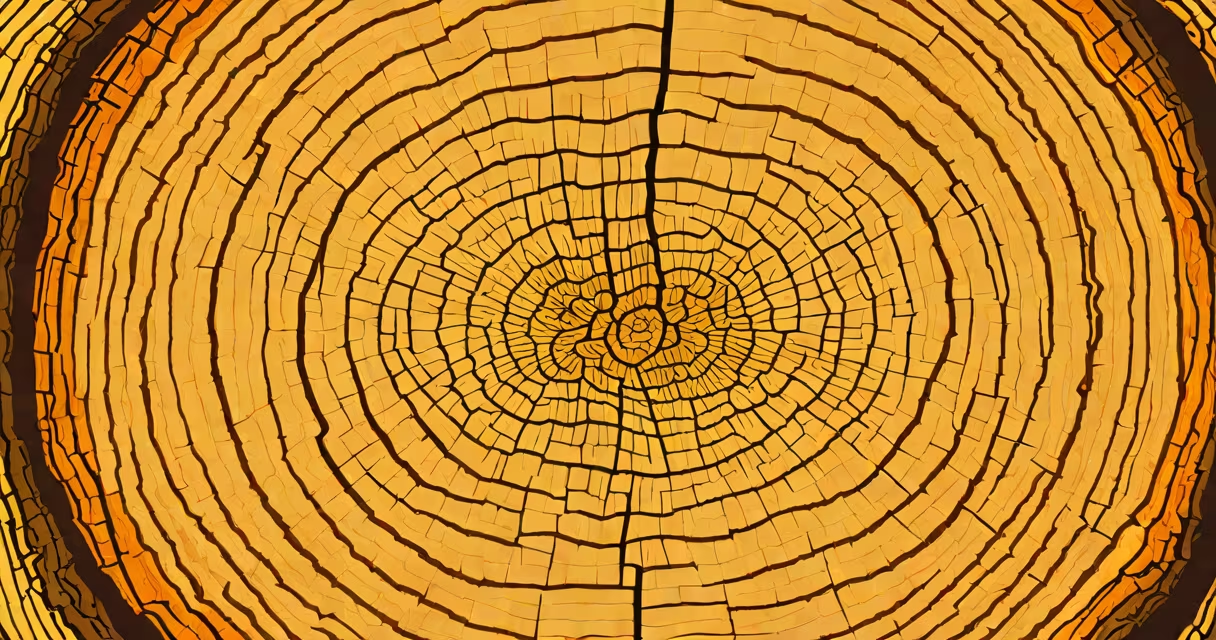
Dendrochronology is the scientific study of tree rings to date wooden artifacts, reconstruct past climates, and establish precise timelines for environmental and human events. It relies on the annual growth patterns visible in cross-sections of trees, where each ring represents one year of growth.
This method was developed in the early 20th century by astronomer Andrew Ellicott Douglass, who noticed that tree ring widths varied with rainfall and temperature. He began using these patterns to date ancient Puebloan structures in the American Southwest, establishing the foundation for modern dendrochronological research.
Tree rings form due to seasonal changes in growth rate. During spring and summer, cells grow rapidly and appear lighter in color. In fall and winter, growth slows, forming darker bands. These alternating light and dark layers create distinct annual rings that can be counted and measured.
Scientists collect core samples from living trees or preserved wood using a specialized tool called an increment borer. The sample is then mounted, sanded, and examined under a microscope to identify and measure each ring. Ring width is recorded in micrometers or millimeters.
Patterns of wide and narrow rings reflect environmental conditions. Wide rings indicate favorable years-plentiful rain, mild temperatures, good soil nutrients. Narrow rings signal drought, cold, or stress. By comparing ring patterns across multiple trees from the same region, researchers build master chronologies that span hundreds to thousands of years.
For example, the bristlecone pine (Pinus longaeva) in California's White Mountains produces some of the longest continuous records. One specimen, known as "Methuselah," is over 4,800 years old. Its rings have helped extend the tree-ring timeline back to 6,700 BCE, providing a reference for dating other wooden materials.
Dendrochronology is applied in archaeology, climatology, and forensic science. The most common uses include:
| Type | Use Case | Example |
|---|---|---|
| Living-tree chronologies | Modern climate monitoring | Alaskan spruce rings track 20th-century warming trends |
| Precise cross-dating | Archaeological site dating | Timber from Chaco Canyon buildings matched to 1100 CE |
| High-resolution density analysis | Reconstructing past solar activity | Ring density anomalies linked to volcanic eruptions in 536 CE |
A key advantage of dendrochronology is its precision. Unlike radiocarbon dating, which provides ranges (e.g., 1200-1300 CE), dendrochronology can pinpoint a year within a single calendar year. This accuracy makes it invaluable for calibrating radiocarbon dates.
Many assume dendrochronology applies to all trees. In reality, only trees with clear annual growth rings-typically temperate species like oak, pine, and spruce-are suitable. Tropical trees often lack distinct rings due to consistent growing seasons.
Another misconception is that ring width alone determines climate. While ring width correlates with moisture and temperature, it's not the only factor. Scientists also analyze latewood density, isotopic composition (δ¹³C and δ¹⁸O), and ring boundary clarity to refine interpretations.
For instance, a 2018 study published in *Nature Geoscience* showed that in high-elevation forests, ring width can be influenced more by snowpack duration than temperature. This finding corrected earlier assumptions that wider rings always meant warmer years.
In the 1920s, Andrew Douglass studied wooden beams from Pueblo Bonito in Chaco Canyon. He compared their ring patterns to those from nearby living trees and found a match extending back 800 years. This allowed him to date the structure's construction to around 1050 CE.
Further analysis revealed a series of narrow rings between 1130 and 1170 CE-indicating prolonged drought. Archaeologists now link this dry period to the abandonment of major sites in the Four Corners region. Without dendrochronology, this connection would have remained speculative.
I once stood in a museum exhibit holding a sliver of wood from a 1,200-year-old pine beam. The rings were barely visible to the naked eye, but under magnification, they formed a rhythmic pattern stretching back through centuries. That moment confirmed how deeply time is etched into nature's architecture.
Dendrochronology requires overlapping sequences. A single tree can only provide a record equal to its lifespan. To build long-term chronologies, scientists must find overlapping patterns across many trees, often from different locations.
The International Tree-Ring Data Bank (ITRDB), maintained by NOAA and the National Center for Atmospheric Research, hosts over 100,000 tree-ring measurements from 10,000 sites worldwide. Researchers use this database to validate regional chronologies and detect large-scale climate shifts.
According to the U.S. Geological Survey, accurate dendrochronology requires at least 50 overlapping samples for a stable chronology. Fewer than 20 samples risk introducing bias from local anomalies.
Dendrochronology is not a standalone tool. It must be combined with other methods-like stratigraphy in archaeology or ice core data in paleoclimatology-to confirm findings. But when used correctly, it offers unmatched temporal resolution for understanding Earth's past.
Dendrochronology is not just about counting rings-it's about reading the story written in wood. From ancient temples to climate change, it turns annual growth into a detailed record of time.