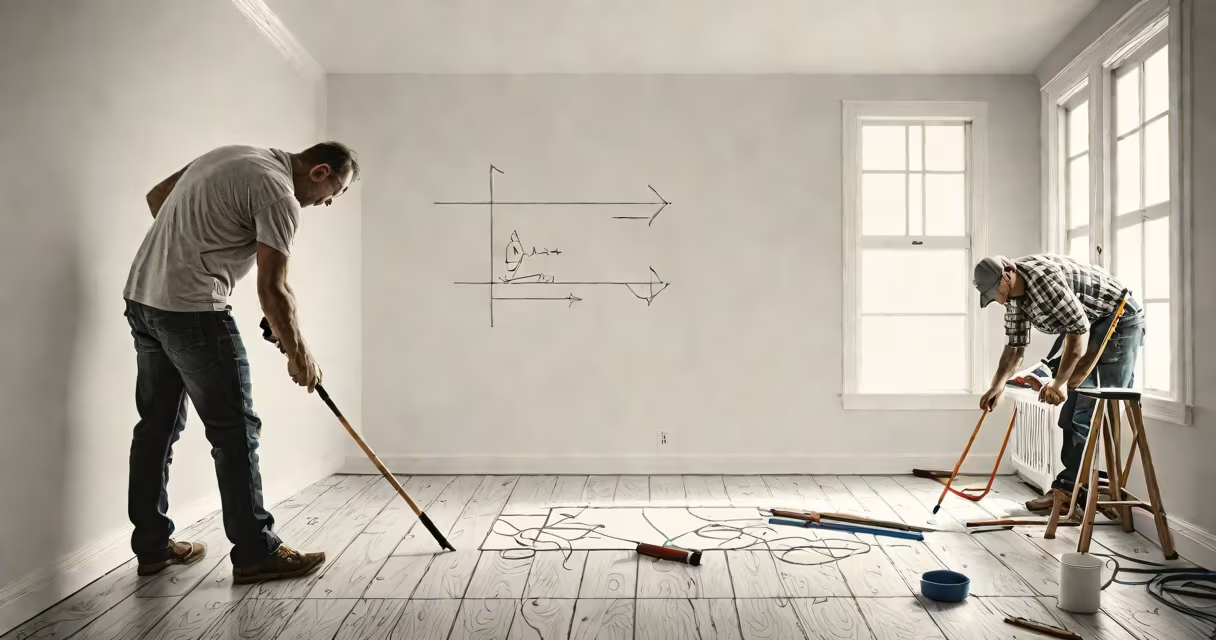
Sweat equity in real estate is the increase in a property's market value resulting from the owner's direct labor on improvements, not from paid contractors or capital investment. It reflects the tangible effort-such as demolition, framing, painting, or flooring-that adds measurable value to a home.
This concept applies when a homeowner or investor performs work themselves, reducing out-of-pocket expenses while increasing the asset's worth. For example, replacing outdated kitchen cabinets with custom-built ones using hand tools can raise a home's appraisal by $10,000 to $15,000, depending on location and materials. The difference between the original purchase price and the new appraised value after the upgrade represents sweat equity.
According to the National Association of Realtors (NAR), homeowners who complete major renovations themselves see an average return on investment (ROI) of 60% to 80% when selling, compared to 40% to 60% for professionally managed projects. This gap highlights how personal labor translates into real financial gain.
Sweat equity functions as a form of deferred capital. Instead of spending $10,000 to hire a contractor to install a new bathroom, a homeowner spends 300 hours installing tile, plumbing fixtures, and cabinetry. The time invested becomes equivalent to money spent, especially when the property sells for $20,000 more than it would have otherwise.
The IRS does not recognize sweat equity as taxable income, but it does affect cost basis for capital gains purposes. If you buy a house for $200,000 and spend $15,000 in materials and 500 hours of labor improving it, your adjusted cost basis becomes $215,000. When you sell, your profit is calculated against this higher basis, lowering potential tax liability.
A real-world example: In 2021, a couple in Portland, Oregon, bought a $320,000 fixer-upper with structural issues. They spent six months removing drywall, rewiring electrical systems, and installing hardwood floors. After completing the work, they listed the home for $480,000. The $160,000 increase was largely attributed to their labor, not market conditions. Their sweat equity amounted to approximately $110,000 in value, based on local comparable sales data.
Not all improvements generate equal equity. High-impact projects include structural changes, kitchen and bathroom upgrades, and energy-efficient installations. These areas consistently show strong ROI because they directly influence buyer perception and functionality.
| Project Type | Typical Value Added | Time Investment (Average) | ROI Range |
|---|---|---|---|
| Kitchen remodel | $10,000-$25,000 | 80-150 hours | 65%-90% |
| Bathroom renovation | $8,000-$20,000 | 60-120 hours | 60%-85% |
| Hardwood floor installation | $5,000-$12,000 | 40-80 hours | 50%-75% |
| Exterior siding replacement | $7,000-$18,000 | 100-200 hours | 55%-80% |
Low-impact tasks like painting walls or replacing light fixtures typically yield less than $2,000 in added value and may not justify the time unless paired with larger upgrades.
Sweat equity is most common among first-time homebuyers, investors targeting rental properties, and those seeking to build wealth without large upfront capital. It allows people to enter real estate markets with limited funds by trading time for value.
For example, a single parent in Denver bought a duplex for $240,000 in 2020. With no savings for repairs, they used weekends and evenings to replace roofs, update HVAC systems, and finish basements. By 2023, both units were rented at $1,800/month each. The combined equity growth reached $120,000, mostly due to labor. Without sweat equity, they would have needed $50,000 in cash to cover repairs.
Real estate professionals often discourage relying solely on sweat equity, citing risks such as poor craftsmanship, safety hazards, and delayed timelines. A 2022 study by the Urban Land Institute found that 37% of DIY renovations exceeded initial time estimates, leading to extended occupancy and lost rental income.
Many assume sweat equity is automatically valuable. It isn't. A poorly executed kitchen remodel can decrease a home's value. According to the U.S. Census Bureau, homes with substandard renovations sell for 12% below market average in competitive neighborhoods.
Another myth: sweat equity is free. While labor is unpaid, materials, permits, and tools represent real costs. In one case, a Florida homeowner spent 400 hours rebuilding a deck. The project cost $3,200 in lumber and hardware, but the final appraisal showed only $1,800 in added value-meaning the labor did not fully offset material expenses.
Finally, sweat equity doesn't count toward loan approvals. Lenders assess property value based on appraisals, not personal effort. You cannot borrow against sweat equity. If you need financing, you must rely on documented market value, not time invested.
I once helped a friend renovate a 1950s bungalow in Austin. We stripped vinyl flooring, installed engineered wood, and replaced windows. Over five months, we worked 15-hour weeks. The home sold for $45,000 above our original estimate. The appraiser cited "significant cosmetic and structural upgrades" as the reason. But the process taught me that planning matters: we underestimated framing repairs by 40 hours and had to delay the project.
To maximize results: